 sales@webguruz.in
 +1 (213) 715-5368
Vedanshi
2026-10-23
7 min read
Custom HubSpot Integrations: Benefits, Examples, and Best Practices
Your business uses HubSpot to manage customer relationships, but disconnected systems create data issues.
Read More
Published On:2026-04-06
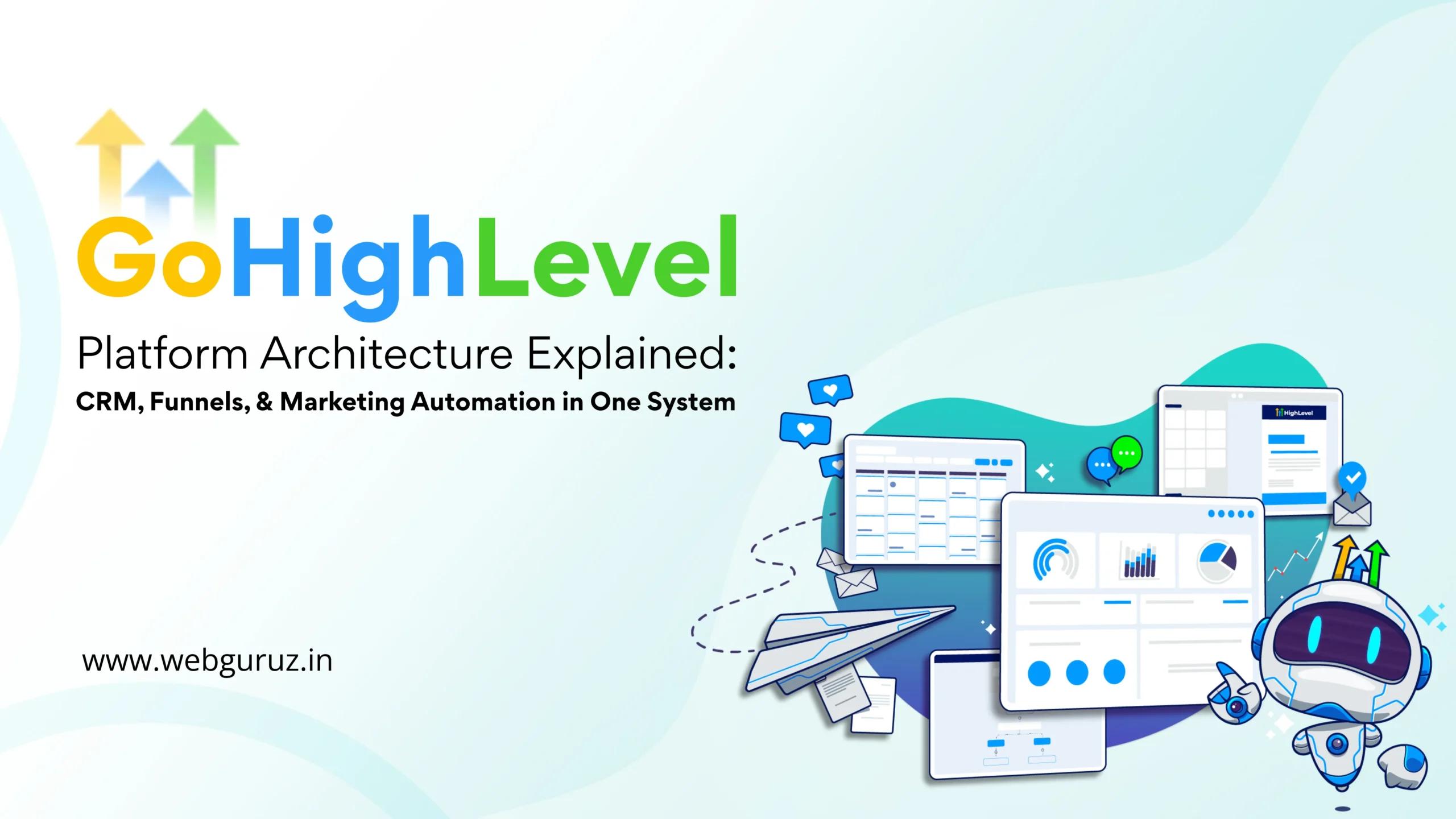
If you’ve spent any time in the digital marketing world lately, you’ve probably heard the name GoHighLevel (GHL) pop up in conversations about marketing automation solutions. It launched in 2018, founded by Shaun Clark and Varun Vairavan, and it was built specifically for marketing agencies and small businesses that were tired of paying for five different tools just to run one client campaign.
In simple terms, GoHighLevel is an all-in-one platform that combines a CRM, sales funnel builder, email and SMS marketing, appointment scheduling, reputation management, and marketing automation, all under a single login and a single monthly bill.
As of early 2026, GoHighLevel serves over 60,000+ agencies and has reportedly crossed the $200 million annual recurring revenue (ARR) mark, making it one of the fastest-growing SaaS platforms in the marketing space. That’s not a small number, and it’s growing because the problem it solves is genuinely frustrating for a lot of people.
Running a business means juggling a lot of software: a CRM here, an email tool there, and a funnel builder somewhere else. GoHighLevel promises to replace all of that with one platform. But does it actually deliver? Let’s break down exactly how it’s built and why so many agencies are switching.
Quick Stats:
One of the most common questions people ask is, “How does GoHighLevel actually put all these features together without things falling apart?” That’s a fair question. Cramming a CRM, funnel builder, and full marketing automation suite into one product sounds messy, but the architecture is actually quite thoughtful.
GoHighLevel is built around a sub-account model. At the top level, you have your Agency account, which is your master dashboard. Under that, you create sub-accounts, one for each client or business location. Each sub-account gets its own CRM contacts, pipelines, funnels, automations, and settings. Think of it like a franchise model: the franchise owner (you) controls the brand rules, and each store (sub-account) runs its own day-to-day operations.

At the heart of GoHighLevel is its CRM. This is where all your contact data lives, including names, phone numbers, emails, tags, conversation history, deal stages, and custom fields. The CRM is what makes everything else possible, because it’s the shared source of truth that your funnels, emails, texts, and automation workflows all feed into.
Unlike a more complex system built through HubSpot CRM development, GoHighLevel’s CRM is designed for speed and simplicity. You don’t need a developer to set it up. A non-technical business owner can have a working CRM pipeline running in under an hour.
A plumbing company in Texas used GoHighLevel’s CRM to replace spreadsheets and a separate booking tool. Within 30 days, they reported a 40% drop in no-shows by using automated appointment reminders sent through the platform’s SMS workflow, all triggered automatically from the CRM when a new deal reached the “Booked” pipeline stage.

The funnel builder inside GoHighLevel is one of its most popular features. It’s a drag-and-drop page editor, no coding needed, that lets you build multi-step sales funnels, landing pages, order forms, and even full websites. Every lead that fills out a form on a GHL funnel is automatically added to the CRM, tagged, and can trigger an automated follow-up sequence immediately.
This is where GHL starts to feel genuinely powerful as a marketing automation hub. The funnel isn’t just a pretty page; it’s the entry point into an entire customer journey that the platform can manage, start to finish.

If the CRM is the heart of GoHighLevel, marketing automation is its brain. The Workflow Builder is where you design automated sequences that respond to what a contact does or doesn’t do in real time.
Most marketing automation solutions require you to build separate automations for email and separate ones for SMS, and often connect them using a third-party tool like Zapier. GoHighLevel handles all of this natively. One workflow can send an email, then wait 2 days, check whether the email was opened, send an SMS if it wasn’t, add a tag if a link was clicked, and move the contact to a new pipeline stage, all without leaving the platform.
To really understand where GoHighLevel fits, it helps to do a proper CRM comparison against two other widely-used platforms: HubSpot CRM and Monday.com CRM. These are all legitimate tools, but they’re built for different audiences and different problems.
HubSpot CRM development started as a marketing-first platform built for scaling enterprise-level teams, with deep integrations, detailed analytics, and a large ecosystem of apps. Monday.com CRM, on the other hand, grew out of a project management tool and added CRM features later, making it great for teams that want flexibility and visual workflow management alongside basic contact tracking.
GoHighLevel was designed from day one for agency use, meaning it’s optimized for managing multiple clients, reselling the platform under your own brand, and running every part of a digital campaign without leaving the dashboard.
| Feature | GoHighLevel | HubSpot CRM | Monday.com CRM |
|---|---|---|---|
| Starting Price | $97/month (agency) | Free; paid from $20/seat/mo | From $12/seat/mo |
| Built-in Funnel Builder | Yes (native) | Partial (landing pages only) | No |
| Email Marketing (native) | Yes | Yes | No (needs integration) |
| SMS/Text Automation | Yes (built-in) | Via a third-party add-on | No |
| Marketing Automation Workflows | Full visual builder | Robust (higher tiers) | Basic automations |
| White-Label / Reseller Option | Yes (core feature) | No | No |
| Appointment Booking (native) | Yes | Via Meetings (paid tier) | No |
| Multi-Client Sub-Accounts | Yes | No | No |
| Best For | Agencies, small businesses, local marketing | Mid-to-large B2B teams, SaaS companies | Teams needing a visual project + CRM hybrid |
To be fair in this CRM comparison, HubSpot CRM development is genuinely more powerful for enterprise-level analytics, custom reporting, and integrations with complex sales stacks. If you’re running a 100-person sales team with complex multi-touch attribution needs, HubSpot is likely the better fit, but you’ll pay for it. Plans with full automation and reporting can easily run $800–$3,200/month for a team.
Monday.com CRM shines when teams already live in Monday.com for project management and want to track deals in the same workspace. It’s not designed to replace a marketing stack; it’s designed to sit alongside one. The native automation features in Monday.com CRM are functional but not deep enough for multi-channel marketing sequences.
The best way to understand any platform is to see how real businesses use it. Here are some documented and widely-reported use case patterns from GoHighLevel’s user base.
A dental clinic automated patient reactivation campaigns using SMS and email sequences triggered 6 months after a patient’s last visit. Reported a 25% reactivation rate, no staff manual outreach needed.
A real estate agency used GHL’s CRM and workflow automation to nurture 2,400 leads over 6 months with drip email + SMS sequences. Conversion rate improved from 2.1% to 5.8% without adding headcount.
A marketing agency rebranded GoHighLevel under their own name, charging clients $297–$597/month per sub-account. With 40 clients paying $297/month, their GHL cost is $497/month, creating a strong recurring margin.
A course creator used GHL’s funnel builder, email automation, and membership site feature together to launch a $997 course. Built the entire funnel, checkout, and post-purchase onboarding in one account, no Kajabi or ClickFunnels needed.
According to a 2024 survey by Agency Analytics, agencies using all-in-one platforms reported 32% lower operational costs compared to those using three or more separate tools for CRM, email, and funnel management. This is one of the core economic arguments behind platforms like GoHighLevel and its growing adoption as a primary marketing automation solution.

GoHighLevel is a genuinely powerful set of marketing automation solutions, but it’s not the right fit for everyone. Being honest about this matters more than overselling.
For small businesses and agencies, GoHighLevel usually wins on cost. You get SMS, funnels, booking, and full marketing automation for $97/month. HubSpot CRM’s comparable features start at $800+/month. However, HubSpot CRM development is the stronger pick for enterprise teams needing advanced reporting and deeper integrations.
For most small businesses and agencies, yes. GoHighLevel can replace tools like ClickFunnels, ActiveCampaign, Calendly, and Podium in one subscription. Most agencies report saving $400–$900/month after consolidating. It falls short only for advanced email deliverability platforms and specialized analytics suites.
Monday.com CRM is built for teams that manage deals and projects in the same workspace, making it great for internal collaboration. GoHighLevel is built for external-facing marketing, lead generation, and client management. For pure marketing automation capability, GoHighLevel wins. For project-integrated deal tracking, Monday.com CRM is the better fit.
There’s a real learning curve; most users need 2–4 weeks to get comfortable. GoHighLevel offers help docs, video tutorials, a guided “Launchpad” onboarding, and an active user community on Facebook and YouTube to speed things up.
It works for both, but it’s most popular in B2C and local service businesses. For B2B, it handles inbound lead generation, appointment setting, and follow-up nurturing well. For complex deal cycles, account-based marketing, or enterprise integrations, HubSpot CRM development is usually the stronger option.
Vedanshi
2026-10-23
7 min read
Your business uses HubSpot to manage customer relationships, but disconnected systems create data issues.
Read More
Vedanshi
2026-10-22
7 min read
Ask ChatGPT, Gemini, or Perplexity to recommend a supplier or a software tool, and you get a short list of names, not ten blue links.
Read More
Vedanshi
2026-10-21
7 min read
Building a website takes more than picking colors, dropping in images, and writing copy.
Read More