 sales@webguruz.in
 +1 (213) 715-5368
Vedanshi
2026-10-09
7 min read
How to Use HubSpot AI Agents to Automate Sales, Marketing, and Customer Support
A sales team spends hours researching prospects. Marketing repeats the same tasks across campaigns.
Read More
Published On:2026-09-21
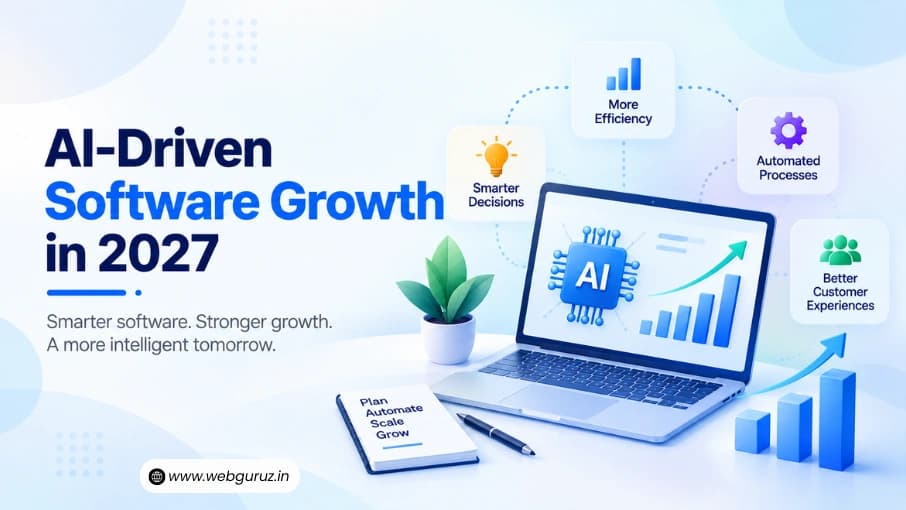
Software companies have never had more opportunities to grow, or more competition for attention. A strong product is no longer enough. Companies need to be discoverable, trusted, easy to evaluate, and capable of turning demand into efficient revenue. As AI changes how people search for software, compare solutions, and make buying decisions, the path to growth is changing too.
Google says AI Overviews now reach 2.5 billion monthly users, while AI Mode has surpassed 1 billion. As AI makes complex searches easier, people are searching more frequently.
For software companies, this means visibility now extends beyond traditional search. Potential customers may ask AI tools which software to choose, compare platforms, or find the best solution for a specific business need
That is where Google AI SEO Services becomes part of a broader growth strategy. The goal is not simply to rank for keywords or generate more clicks, but to build a digital presence that helps a company get discovered and considered throughout increasingly AI-driven buying journeys.
But visibility is only the beginning. Once the right prospects arrive, software companies need connected CRM, Marketing Automation, customer data, and revenue operations to convert demand, improve retention, and scale efficiently.
So, what does a modern software growth engine look like in 2027?

Software growth is becoming less about isolated marketing, sales, and technology initiatives and more about how effectively those functions work together. A practical way to think about the modern software growth model is through five connected layers:
Before a software company can grow, potential customers need to find it. SEO remains important, but search is evolving as AI-powered experiences answer more complex questions and help users explore topics.
For software companies, content now needs to do more than target keywords. It should answer customer questions, solve problems, demonstrate expertise, and provide information that search engines and AI systems can understand and use.
This is where Google AI SEO Services fits into the broader growth model. The goal is not simply to generate clicks, but to increase the chances of being discovered and considered when buyers research categories, compare vendors, or evaluate solutions.
For example, “What is the best CRM for a 50-person B2B SaaS company with a long sales cycle?” requires far more contextual content than “CRM software.”
Getting discovered is only the beginning. Software companies also need a connected customer journey that turns interest into a qualified pipeline. A website should help prospects understand the product, evaluate its fit, and take the right next step, whether requesting a demo, starting a trial, or speaking with sales.
That activity should connect directly to the CRM. Marketing Automation can help businesses build a structured customer journey around their actual sales process.
For example, when a prospect downloads a guide, attends a webinar, visits a product page, and requests a demo, these interactions can contribute to a complete customer record, giving sales and marketing teams better context.
As software companies grow, customer information becomes spread across CRMs, marketing platforms, product analytics, support systems, and billing tools. Without a connected structure, businesses may have plenty of data but little actionable intelligence.
CRM Consulting Services can help establish the data structure, lifecycle stages, processes, and reporting needed to turn customer information into decisions.
For example, increasing product usage and new user additions may signal an expansion opportunity, while declining engagement or rising support issues may indicate churn risk.
The purpose of CRM is therefore not simply to store customer information, but to make it useful for smarter decisions.
As a software company grows, manually managing leads, follow-ups, customer interactions, and internal handoffs becomes difficult.
Marketing Automation can make these processes more consistent and scalable. Businesses can automate:
For businesses using HubSpot, HubSpot Consulting Services, HubSpot Automation Services, and HubSpot CRM Workflows can bring customer data, automation, and revenue processes together.
The benefit goes beyond saving time. Automation creates repeatable processes that can handle increasing volumes without requiring teams to redesign workflows manually.
Customer acquisition gets a software company into the market, but retention and expansion determine how efficiently it grows. Connected customer data can help teams identify opportunities earlier, whether that means recognising expansion potential or responding to declining engagement.
For example:
Increasing product usage → expansion signal → CRM update → automated alert → sales follow-up
Technology can automate these processes, but strategy is still essential. Businesses need to understand why customers buy, stay, leave, and what value they need next.
This is where RevOps Consulting Services can help connect marketing, sales, customer success, and revenue processes around sustainable growth.
The value comes from connecting these layers. More traffic without conversion creates wasted demand. More leads without CRM structure creates operational friction. More customers without retention processes can increase revenue while simultaneously increasing churn and support costs. The objective is to create a system in which each part of the growth process supports the next.
As software companies grow, marketing, sales, and customer teams can begin working with different goals and data. Marketing may focus on leads, sales on conversions, and customer success on retention, while leadership needs to understand how these activities contribute to revenue.
RevOps brings these functions together through shared processes, data, and performance metrics. HubSpot Consultants can help businesses connect these systems and create a more unified revenue lifecycle.
Instead of treating acquisition, conversion, retention, and expansion separately, businesses can evaluate the entire revenue journey. This can reveal problems such as strong lead volume but poor lead quality, growing sales alongside rising churn, or increasing revenue accompanied by higher acquisition costs.
A connected RevOps model helps leadership evaluate these relationships rather than optimizing each department in isolation. More software does not automatically create more growth. Connected systems, clear processes, and shared revenue goals do.

AI is becoming part of the entire software growth engine, from how prospects discover products and leads are qualified to how customer data is analyzed, workflows are automated, and software is built.
For example, HubSpot AI-Powered Solutions can bring AI into customer and revenue processes, while AI development tools can support coding, testing, debugging, and deployment. This allows teams to reduce repetitive work and focus more on strategy, customer needs, and innovation.
But AI also creates a competitive challenge. As development becomes faster and more accessible, some businesses may choose to build tools internally rather than buy them. McKinsey’s 2026 research found that 32% of organizations had decided against buying at least one software product or feature because they believed they could build it internally with AI coding tools.
For software companies, the advantage will therefore come from more than simply adopting AI. Product differentiation, customer experience, proprietary data, integrations, and continuous innovation will become increasingly important.
The companies best positioned for 2027 will be those that use AI across their growth and development processes to create measurable improvements in customer experience, productivity, decision-making, and revenue efficiency.
As software companies scale, the technology supporting growth can become fragmented.
Customer data may live in a CRM. Marketing activity may sit in automation platforms. Product behaviour may be tracked separately. Support teams may use another system, while billing and financial information remain elsewhere.
The solution is not necessarily to replace every platform.
It is to make the systems work together around the customer journey.
HubSpot Consultants can help businesses structure their CRM around that journey, while HubSpot Automation Services can reduce repetitive work across marketing and sales.
RevOps Consulting Services can also help bring marketing, sales, and customer operations around shared data and revenue goals.
The result is a shift from isolated tools to connected growth infrastructure.
The goal is simple: create a business where search, customer data, automation, AI, and revenue operations reinforce one another instead of operating as disconnected initiatives.

For software companies preparing for the next stage of growth, five priorities stand out.
Create content that answers real customer questions, demonstrates expertise, explains your product clearly, and addresses comparison and evaluation queries—not just high-volume keywords.
Make sure lead activity, lifecycle stages, customer interactions, and sales outcomes are visible across the teams responsible for revenue.
Identify high-volume, rule-based activities that can be automated while preserving necessary human judgment. HubSpot CRM Workflows can help automate these processes and maintain consistency as the business scales.
Look for behavioural signals that indicate expansion potential, disengagement, or churn risk and turn them into actionable processes.
Instead of measuring traffic, leads, or sales independently, connect acquisition, conversion, retention, expansion, and revenue efficiency.
These priorities help ensure that growth does not simply produce more volume. It produces a business that can handle that volume efficiently.
Software growth in 2027 will be less about simply acquiring more customers and more about building a business that can scale intelligently.
AI-powered search is changing how software companies get discovered. CRM and Marketing Automation are changing how they manage demand and customer relationships. RevOps is connecting revenue teams, while AI is increasingly helping businesses analyze information, automate work, and make better decisions.
The strongest software companies will not treat these capabilities as separate initiatives. They will connect them.
Whether that means improving visibility through Google AI SEO Services, strengthening customer operations through CRM Consulting Services, implementing HubSpot Consulting Services, or building smarter processes with automation and AI, the goal remains the same: create a growth engine that becomes more efficient as the business gets bigger.
Software companies grow through a combination of customer acquisition, retention, expansion, automation, and increasingly AI. Strong digital visibility, connected CRM systems, and efficient revenue operations can help companies scale without increasing complexity at the same rate.
AI can improve multiple parts of the growth journey, from helping customers discover software through AI-powered search to automating marketing, analyzing customer data, supporting sales teams, and handling repetitive operational tasks.
AI search is changing how buyers research and compare software. Companies need useful, authoritative content that can be understood and surfaced by AI-powered search experiences, making Google AI SEO Services increasingly relevant to software growth strategies.
As a software company grows, customer information and processes can become fragmented. CRM and automation help centralize data, standardize processes, automate repetitive work, and give marketing, sales, and customer teams better visibility across the customer journey.
RevOps connects marketing, sales, and customer operations around shared data, processes, and revenue goals. RevOps Consulting Services can help software companies identify operational gaps and build a more connected system for sustainable growth.
An AI-ready growth engine connects search visibility, conversion, CRM data, automation, customer retention, and revenue operations. AI can then be applied where it improves decision-making, customer experience, productivity, or revenue efficiency.
Vedanshi
2026-10-09
7 min read
A sales team spends hours researching prospects. Marketing repeats the same tasks across campaigns.
Read More
Vedanshi
2026-10-07
7 min read
HubSpot UNBOUND 2026 sent a clear message to businesses: growth is becoming more connected.
Read More
Vedanshi
2026-10-07
7 min read
For years, ranking on Google’s first page was one of the clearest goals in search marketing. But search is no longer limited to a list of blue links.
Read More