 sales@webguruz.in
 +1 (213) 715-5368
Vedanshi
2026-10-09
7 min read
How to Use HubSpot AI Agents to Automate Sales, Marketing, and Customer Support
A sales team spends hours researching prospects. Marketing repeats the same tasks across campaigns.
Read More
Published On:2026-09-21
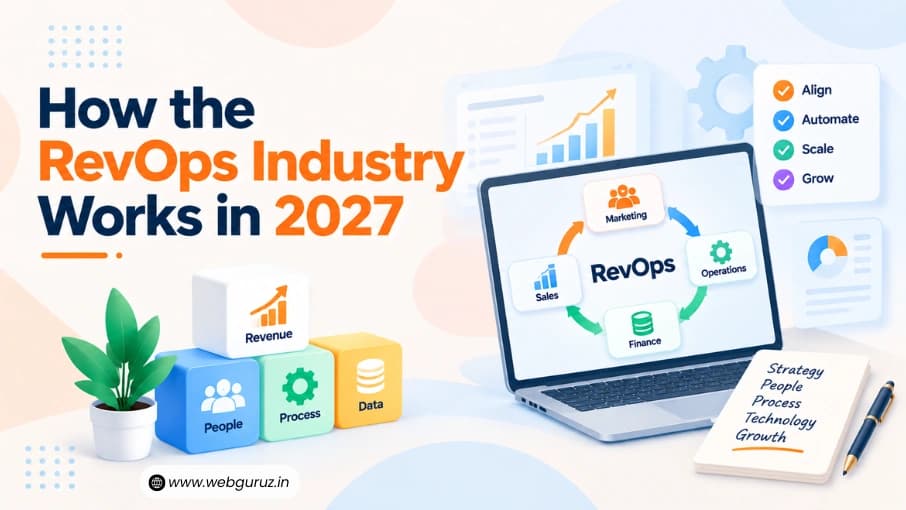
Businesses don’t necessarily have a shortage of revenue software. They have a shortage of connected revenue systems.
According to Zylo’s 2026 SaaS Management Index, the average organization now runs 305 applications across the business. When those systems don’t share data properly, teams end up dealing with duplicate records, broken handoffs, conflicting reports, and hours of manual work just to keep the revenue engine moving.
That is where Revenue Operations Software comes in.
At its core, RevOps software connects the data, processes, and tools used by marketing, sales, and customer success so they can operate around a shared view of the customer and revenue lifecycle. Instead of every team working from its own systems and definitions, the goal is to create one connected operating layer.
But the category is changing.
In 2026, AI is moving beyond simple recommendations and rule-based automation. RevOps teams are beginning to explore AI agents that can take action inside revenue workflows. One 2026 RevOps study found that 20% of teams specifically want to use AI agents in their revenue departments, while most organizations expect their AI usage to increase over the next 6-12 months.
That shift matters for 2027.
Revenue Operations Software is no longer just about storing customer information, automating repetitive tasks, or producing another dashboard. The next generation of RevOps consulting is increasingly about helping businesses understand what is happening, decide what should happen next, and eventually allow AI to execute parts of that work.
So what exactly falls under Revenue Operations Software? How does it differ from a CRM? Where do platforms such as HubSpot fit? And what should businesses actually look for when building their RevOps stack?
Let’s break it down.
Think of revenue operations software as the technology layer connecting the revenue engine.
Marketing generates demand. Sales turns opportunities into customers. Customer success works to retain and expand those relationships. Each function creates data, triggers processes, and depends on information from the others.
Without connected systems, those handoffs can become messy.
A lead may be qualified by marketing but handled differently by sales. A salesperson may have information that customer success never receives. Leadership may see one revenue number in a CRM and another in a reporting platform.
RevOps software is designed to reduce those gaps.
Depending on the tools involved, it can help businesses:
The important point is that RevOps software isn’t necessarily one product.
A business might use its CRM as the foundation and connect specialized tools for data enrichment, automation, forecasting, analytics, or revenue intelligence. Others may choose a broader platform that brings several of these capabilities together.
The objective is the same: make the revenue operation work as one system instead of a collection of disconnected tools.

A RevOps stack doesn’t need a separate tool for every problem. The right setup depends on how a business sells, how complex its customer journey is, and where its current systems are creating friction.
Most modern stacks, however, revolve around a few core categories.
The CRM is usually the foundation. It stores customer records, interactions, deals, and lifecycle information so marketing, sales, and customer success can work from the same data.
But a CRM alone isn’t the same as RevOps software. A CRM tells teams what is happening with an account or deal; the broader RevOps layer connects systems, orchestrates processes, and shows how the overall revenue engine is performing.
This is one reason HubSpot Consultants can become valuable in RevOps projects. The challenge isn’t simply configuring a CRM. It’s structuring it around the way the business actually generates revenue.
Revenue teams rarely keep all their information in one system. Marketing platforms, CRMs, billing systems, customer success tools, and data warehouses may all contain pieces of the customer record.
Data and integration tools bring these sources together, clean inconsistencies, and make information available where it’s needed.
This layer is becoming especially important as companies try to prepare their data for AI. In LeanData and LXA’s 2026 research, 82% of enterprise B2B leaders said clean data and reliable routing need to come before scaling AI, but only one in three said they have the systems to support it.
This is where RevOps software turns information into action.
A new lead can be routed automatically. A stalled opportunity can trigger an alert. A customer reaching a particular stage can start an onboarding process.
These workflows reduce manual handoffs and help teams follow consistent processes instead of relying on someone to remember the next step.
For businesses using HubSpot, this is where HubSpot Automation Services can become part of a wider RevOps strategy.
Traditional reporting tells you what already happened. Revenue intelligence increasingly helps teams understand what is likely to happen next.
Modern platforms can analyze pipeline activity, customer signals, and historical data to identify risks, prioritize opportunities, and improve forecasting. AI is accelerating this shift by turning large amounts of revenue data into recommendations and next actions.
This is the newest layer of the RevOps stack, and the one that will matter most going into 2027.
Predictive AI can identify patterns. Generative AI can summarize information and create content. Agentic AI can go a step further by carrying out multi-step tasks such as routing leads, updating records, or creating follow-up actions.
The important shift is from software that helps people do the work to software that can increasingly do parts of the work itself.
That makes governance just as important as capability. As AI takes on more responsibility, businesses need clear rules about what it can access, change, and execute.
RevOps software works best when the different parts of the revenue stack are connected rather than operating as separate systems.
A typical process might look like this: a prospect engages with marketing, enters the CRM, receives additional data through enrichment, gets qualified and routed through automation, and is then managed through the sales pipeline. Once the deal closes, the same customer data can support onboarding, service, retention, and expansion.
The goal is not to have the most tools. It is to make sure the right data moves between the right systems at the right time.
This is where HubSpot fits in. HubSpot can act as the central platform in this ecosystem by bringing CRM, marketing, sales, service, operations, automation, reporting, and AI capabilities into one environment. But simply having HubSpot does not create a mature RevOps operation.
The platform still needs to be structured around the company’s revenue process, including lifecycle stages, pipelines, data, integrations, reporting, and workflows. For example, if sales teams spend too much time qualifying leads manually, better data enrichment, lead scoring, automated routing, and CRM workflows may solve the problem without adding another standalone tool.
This is where effective HubSpot implementation and consulting can make a difference: connecting the platform to the processes and data that actually drive revenue.
This is one of the most important things businesses need to understand before investing in a RevOps stack.
Software can automate a process, but it cannot determine whether that process makes sense.
If marketing and sales disagree about what qualifies as a good lead, automating lead routing won’t solve the disagreement. If customer data is inconsistent, an AI system working from that data can produce unreliable results. If nobody owns a revenue process, another dashboard won’t create accountability.
This is why RevOps sits between technology and business operations.
RevOps Consulting Services can help businesses examine the processes behind their software before deciding what needs to be changed. That may involve auditing the existing technology stack, redesigning workflows, defining ownership, improving data quality, or deciding which processes should be automated.
The best RevOps strategy is therefore not necessarily the one with the most sophisticated technology.
It is the one where technology supports a clearly defined revenue process.

AI is likely to be the biggest factor separating the next generation of RevOps software from the previous one.
Traditional automation depends on rules. Someone defines the conditions, and the system follows them.
AI introduces a different model. Systems can interpret information, identify patterns, make recommendations, and increasingly take actions based on context.
That could mean an AI agent identifying a high-risk opportunity, researching an account, updating CRM information, preparing a follow-up, or routing work to the appropriate team member.
HubSpot’s growing range of HubSpot AI-Powered Solutions reflects this broader shift from automation toward AI-assisted and agentic operations.
But greater autonomy also creates greater responsibility.
Businesses need to decide which actions AI can perform independently, which require approval, what data it can access, and how its actions should be monitored.
In 2027, AI readiness will therefore become less about simply having AI features and more about having the data, processes, permissions, and governance needed to use them safely.

The biggest changes in RevOps won’t come from adding more tools. They will come from how businesses connect data, technology, and decision-making across the revenue lifecycle.
Here are five changes businesses should expect as RevOps continues to evolve in 2027.
AI in RevOps is moving beyond summarizing calls, generating content, or suggesting next steps.
In 2027, more businesses will begin using AI agents to perform defined operational tasks. These could include researching accounts, updating CRM records, qualifying leads, identifying pipeline risks, creating follow-up tasks, or routing work to the right team.
The important shift is that AI will increasingly become part of the workflow itself rather than sitting alongside it as a separate assistant.
CRM data has traditionally been used to track customers, deals, and sales activity. That role is expanding.
As automation and AI become more dependent on customer data, businesses will need cleaner, more structured, and more reliable CRM records. Incomplete lifecycle stages, duplicate contacts, inconsistent properties, and outdated records can affect not only reporting but also the actions automated systems take.
This means data quality will become a core RevOps responsibility rather than simply a CRM administration task.
RevOps has always been responsible for connecting teams and processes. In 2027, that responsibility will become even more important as businesses operate across larger technology stacks and increasingly autonomous AI systems.
Instead of simply managing individual tools, RevOps teams will increasingly focus on how data moves between systems, how processes are triggered, who owns each stage of the customer journey, and where human approval is required.
The role will shift further from managing systems to orchestrating the revenue operation.
More software does not automatically create better RevOps.
As businesses evaluate the cost and complexity of maintaining multiple disconnected platforms, many will look for ways to consolidate their revenue technology stack. Platforms that combine CRM, automation, reporting, customer data, and AI capabilities can become increasingly attractive when they reduce unnecessary integrations and duplicate data.
The goal won’t necessarily be to replace every specialized tool. It will be to create a stack where the tools that remain have a clear purpose and work together reliably.
Giving AI access to revenue systems creates a new operational responsibility.
Businesses will need clear rules around what AI can access, what actions it can take automatically, which decisions require human approval, and how those actions are monitored.
This makes governance a natural part of RevOps. As AI becomes more involved in routing, qualification, forecasting, customer communication, and CRM management, expert RevOps services will increasingly help define the boundaries within which those systems operate.
The businesses that benefit most from AI in 2027 won’t necessarily be the ones using the most AI features. They will be the ones with the data, processes, systems, and governance needed to make those features work reliably.
There is no universal RevOps software stack.
A startup with a straightforward sales process may need a CRM, basic automation, reporting, and a few integrations. A larger organization with multiple sales teams, markets, products, and customer journeys may need much more sophisticated data, forecasting, and orchestration capabilities.
Before choosing software, businesses should ask:
| Question | Why it matters |
|---|---|
| What revenue problem are we solving? | Prevents unnecessary software purchases |
| Where does our customer data live? | Identifies data gaps and duplication |
| Which processes are still manual? | Shows where automation can create value |
| Can the tools integrate with our existing stack? | Prevents another disconnected system |
| Is the platform ready for AI? | Supports future automation and agentic workflows |
| How will we measure success? | Connects software investment to business outcomes |
Cost should also be considered beyond the subscription price. Implementation, integrations, data migration, training, customization, maintenance, and ongoing support can all affect the actual investment.
For some businesses, improving the systems they already own may create more value than buying something new.
The RevOps software industry is moving toward a more connected and increasingly intelligent model.
CRM remains the foundation. Automation continues to remove repetitive work. Revenue intelligence helps teams understand what is happening. AI is beginning to determine what should happen next and, in some cases, execute that work.
That progression makes one thing increasingly clear.
The future of RevOps isn’t about collecting more software. It’s about building a revenue system where data flows, processes connect, and technology can increasingly help the business act on what it knows.
Businesses that get that foundation right will be in a much stronger position to take advantage of AI as its role in revenue operations expands.
Revenue Operations Software connects the systems, data, workflows, and processes used across marketing, sales, and customer success to create a more coordinated revenue operation.
No. A CRM is usually an important part of the RevOps stack, but RevOps software can also include automation, data enrichment, forecasting, analytics, revenue intelligence, integrations, and AI.
Not necessarily. Many businesses can build an effective RevOps operation around their existing CRM and a smaller number of connected tools. The right setup depends on the complexity of the business and its revenue processes.
HubSpot can bring CRM, marketing, sales, service, automation, reporting, and AI capabilities into a connected platform. Its effectiveness depends on how well the system is implemented around the company’s actual revenue processes.
AI is more likely to change the work RevOps teams perform than eliminate the function. As AI takes over more repetitive execution, RevOps professionals will increasingly focus on strategy, data quality, process design, governance, and deciding where AI should be used.
Vedanshi
2026-10-09
7 min read
A sales team spends hours researching prospects. Marketing repeats the same tasks across campaigns.
Read More
Vedanshi
2026-10-07
7 min read
HubSpot UNBOUND 2026 sent a clear message to businesses: growth is becoming more connected.
Read More
Vedanshi
2026-10-07
7 min read
For years, ranking on Google’s first page was one of the clearest goals in search marketing. But search is no longer limited to a list of blue links.
Read More