 sales@webguruz.in
 +1 (213) 715-5368
Vedanshi
2026-10-23
7 min read
Custom HubSpot Integrations: Benefits, Examples, and Best Practices
Your business uses HubSpot to manage customer relationships, but disconnected systems create data issues.
Read More
Published On:2026-06-17
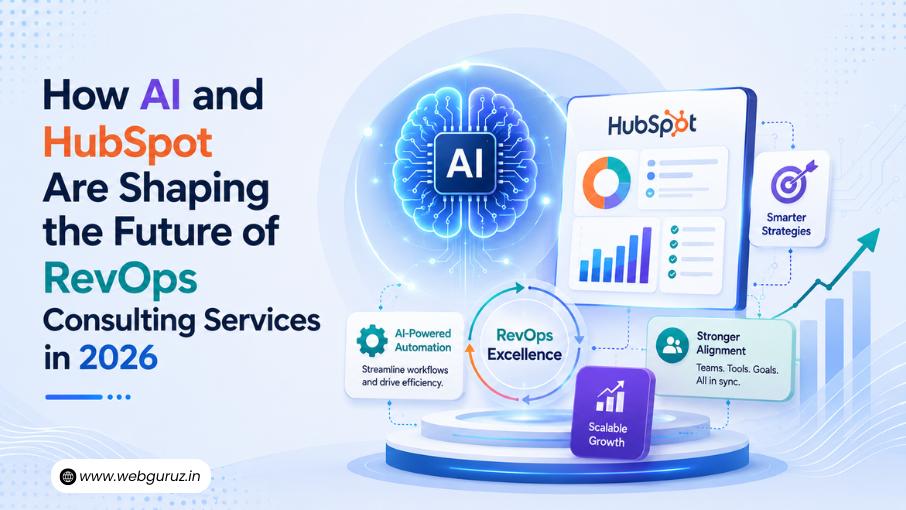
Revenue growth has never depended on just one team. Marketing generates demand, sales converts opportunities, and customer success drives retention and expansion. But when these functions operate in silos, businesses often struggle with inconsistent data, inefficient processes, and missed opportunities.
This is where RevOps consulting services are changing the game. By aligning people, processes, and technology under a unified strategy, Revenue Operations (RevOps) helps organizations create a seamless customer journey while improving operational efficiency. Today, artificial intelligence (AI) and platforms like HubSpot are taking that transformation even further by enabling smarter automation, better forecasting, and more informed decision-making.
As companies look for sustainable ways to scale, AI-powered RevOps is emerging as a strategic advantage rather than just another technology trend.
Revenue Operations is a business framework that unifies sales, marketing, and customer success around shared goals, processes, and data. Instead of each department working independently, RevOps ensures that every customer interaction contributes to a consistent and measurable growth strategy.
Rather than relying on disconnected spreadsheets or isolated software platforms, organizations can centralize customer information and automate workflows that support the entire revenue lifecycle. This unified approach not only improves internal collaboration but also creates better experiences for prospects and customers alike.
Businesses investing in expert RevOps services often discover that operational alignment becomes just as valuable as the technology supporting it.

AI is no longer an emerging technology reserved for early adopters. According to McKinsey’s latest global research, 88% of organizations report using AI in at least one business function, reflecting how quickly AI has become embedded in day-to-day operations. For businesses investing in RevOps, this widespread adoption underscores the importance of building workflows and processes that can take advantage of intelligent automation rather than relying solely on manual execution.
Artificial intelligence is fundamentally changing how businesses manage revenue processes. Instead of simply automating repetitive tasks, AI can analyze customer behavior, identify trends, recommend actions, and surface insights that would otherwise take hours to uncover.
For example, AI-powered systems can:
According to McKinsey, organizations are rapidly increasing their use of generative AI across business functions, with marketing and sales among the areas expected to realize significant productivity gains. This highlights why AI is becoming a cornerstone of modern revenue strategies rather than an optional enhancement.
The shift from traditional operations to AI-enabled RevOps is easier to understand when viewed side by side. The comparison below highlights how intelligent automation and a connected HubSpot ecosystem can transform the way businesses manage revenue.
| Traditional Revenue Operations | AI-Powered RevOps with HubSpot |
|---|---|
| Teams work in departmental silos | Sales, marketing, and customer success operate from a unified strategy |
| Customer data is spread across multiple tools | A centralized CRM provides a single source of truth |
| Lead qualification relies on fixed rules | AI predicts and prioritizes high-intent leads |
| Reporting is manual and retrospective | Real-time dashboards deliver actionable insights |
| Workflows require constant manual updates | Intelligent automation adapts based on customer behavior |
| Personalization is limited to basic segmentation | AI enables dynamic, context-aware customer experiences |
| Decision-making depends heavily on human analysis | AI surfaces recommendations and trends to support faster decisions |
Unified customer data has become a competitive differentiator. Salesforce research found that 81% of customers expect companies to provide faster interactions as technology advances, increasing the pressure on businesses to eliminate data silos and streamline operations. A well-implemented RevOps strategy supported by HubSpot helps teams respond more quickly with consistent, data-driven experiences.
HubSpot has grown far beyond its roots as a marketing platform. Today, it offers an integrated ecosystem that supports CRM, sales, customer service, content management, automation, reporting, and AI-driven insights.
With innovations such as the HubSpot RevOps Data Hub 2026 vision and increasingly sophisticated AI capabilities, businesses can consolidate customer information, reduce manual processes, and improve cross-functional visibility.
Instead of maintaining separate systems for every department, organizations can use a unified platform to manage the complete customer lifecycle, from first interaction to long-term retention.
The real value of AI becomes evident when it is embedded into day-to-day operations. AI HubSpot RevOps workflows can automate routine decisions while providing teams with actionable recommendations.
Some practical applications include:
Rather than replacing employees, these workflows allow teams to focus on relationship building and strategic decision-making.

Implementing RevOps successfully requires more than purchasing software. Organizations often benefit from specialized guidance to ensure technology aligns with business objectives.
Some of the biggest advantages include:
Technology implementation is rarely one-size-fits-all. Businesses often require specialized expertise to configure and optimize their HubSpot ecosystem.
For example:
Together, these capabilities create an environment where AI and automation can deliver measurable business value.

Many organizations already have capable technology stacks but struggle to connect systems and processes effectively. If any of the following sound familiar, it may be time to evaluate your RevOps strategy:
Addressing these issues through RevOps Consulting Services can improve efficiency while creating stronger alignment across departments.
Migrating systems is about more than moving data from one platform to another. It is an opportunity to redesign processes, eliminate outdated workflows, and establish a stronger operational foundation.
Organizations planning a HubSpot migration should also consider opportunities for:
When migrations are approached strategically, businesses avoid carrying legacy inefficiencies into their new environment.
AI is amplifying the value of HubSpot marketing automation by making workflows more adaptive and data-driven. Instead of static rules, organizations can create campaigns that respond dynamically to customer behavior and changing business conditions.
This means emails can be personalized at scale, leads can be prioritized intelligently, and customer journeys can evolve based on real-time interactions rather than predefined assumptions.
The result is a marketing engine that is both more efficient and more relevant to individual customers.
Businesses are entering an era where success depends not only on acquiring customers but also on orchestrating every interaction across the revenue lifecycle. AI will continue to play a larger role in forecasting, workflow optimization, customer insights, and strategic planning.
As discussed throughout How AI and HubSpot Are Shaping the Future of RevOps Consulting Services, the organizations that gain the greatest competitive advantage will be those that combine intelligent technology with strong operational foundations and collaborative teams.
Rather than viewing RevOps as a departmental initiative, forward-thinking businesses are treating it as a company-wide strategy for sustainable growth.

Adopting AI is only one piece of the puzzle. To create a revenue engine that scales with your business, organizations need a well-defined RevOps strategy supported by the right technology and processes. HubSpot provides a strong foundation, but its true value comes from thoughtful implementation and ongoing optimization.
A future-ready approach should include:
Organizations that treat RevOps as an ongoing discipline (not just a software implementation) are often better positioned to improve collaboration, increase operational efficiency, and drive predictable revenue growth.
Growth becomes much easier when teams operate from the same data, pursue shared objectives, and use technology that supports collaboration instead of creating silos. Modern RevOps consulting services help businesses build that foundation while enabling AI-powered insights and automation that improve efficiency across the customer lifecycle.
Whether you’re investing in HubSpot automation services, planning a HubSpot CRM migration, enhancing your website through HubSpot CMS development, or exploring advanced AI capabilities, a thoughtful RevOps strategy can unlock significant long-term value. With the right expertise and technology in place, organizations are better equipped to make smarter decisions, streamline operations, and drive predictable revenue growth.
RevOps consulting typically covers process optimization, CRM strategy, workflow automation, reporting, data governance, and technology alignment across marketing, sales, and customer success teams.
HubSpot provides a centralized platform for CRM, marketing, sales, customer service, automation, analytics, and AI-driven insights, making it easier for teams to collaborate and manage the customer lifecycle.
Yes. AI is designed to enhance productivity by automating repetitive tasks, surfacing insights, and supporting better decision-making. Human expertise remains essential for strategy, relationship management, and oversight.
A migration is often worthwhile when existing systems are fragmented, difficult to scale, or no longer support evolving business processes. It can also be an opportunity to improve data quality and modernize workflows.
Accurate and consistent data enables better forecasting, more reliable reporting, smarter automation, and AI-driven recommendations that teams can trust when making business decisions.
Vedanshi
2026-10-23
7 min read
Your business uses HubSpot to manage customer relationships, but disconnected systems create data issues.
Read More
Vedanshi
2026-10-22
7 min read
Ask ChatGPT, Gemini, or Perplexity to recommend a supplier or a software tool, and you get a short list of names, not ten blue links.
Read More
Vedanshi
2026-10-21
7 min read
Building a website takes more than picking colors, dropping in images, and writing copy.
Read More