 sales@webguruz.in
 +1 (213) 715-5368
Vedanshi
2026-10-23
7 min read
Custom HubSpot Integrations: Benefits, Examples, and Best Practices
Your business uses HubSpot to manage customer relationships, but disconnected systems create data issues.
Read More
Published On:2026-05-29
There is a moment most growing businesses hit where the traditional sales playbook stops working the way it used to. More ads, more cold calls, more pipeline, and yet growth starts to feel like pushing a boulder uphill. You close a customer and then immediately have to go find another one. The effort never compounds. It just repeats.
HubSpot saw this pattern in their own business (and in thousands of companies they worked with) and decided there had to be a better model. In 2018, their CEO Brian Halligan stood on stage at INBOUND and announced that HubSpot was retiring the funnel. In its place: the flywheel.
It was not just a rebranding exercise. It was a fundamentally different way of thinking about how businesses grow, one where customers are not the end of the journey but the engine of it. At WebGuruz Technologies, a HubSpot Platinum Solutions Partner with over a decade of implementation experience, this model is not just something we talk about; it is how we build growth systems for the businesses we work with.This is The HubSpot Flywheel: Modern Growth Strategy Explained, and what follows is a thorough look at how it works, why it works, and how to actually put it into practice with the right tools and the right team behind you.
The traditional sales funnel has been a marketing staple for over a century. It works like this: awareness at the top, consideration in the middle, and decision at the bottom. Prospects enter, they get worked through the stages, and they become customers, and then the funnel is done with them. They fall out of the bottom, and the team goes back to the top to find more.
For a long time, this model worked well enough. But it was built for a world where businesses controlled the flow of information. Today’s buyers do not need a salesperson to learn about a product. They research independently, read reviews, ask peers, and often know more about your offering than your junior sales reps do by the time they speak to anyone. The funnel assumes a passive buyer being moved along by a company. The reality is an active buyer who is already moving, with or without you.
The funnel also treats customers like an output. You put effort in at the top, a customer comes out at the bottom, and the system resets. Word of mouth, referrals, reviews, and organic advocacy; none of these exist inside the funnel model. They just happen somewhere off to the side, untracked and unmanaged. And that is a significant blind spot, given that 84% of B2B purchasing decisions begin with a referral. The most powerful sales channel most businesses have is the one their funnel completely ignores.

This is exactly the gap the flywheel fills.
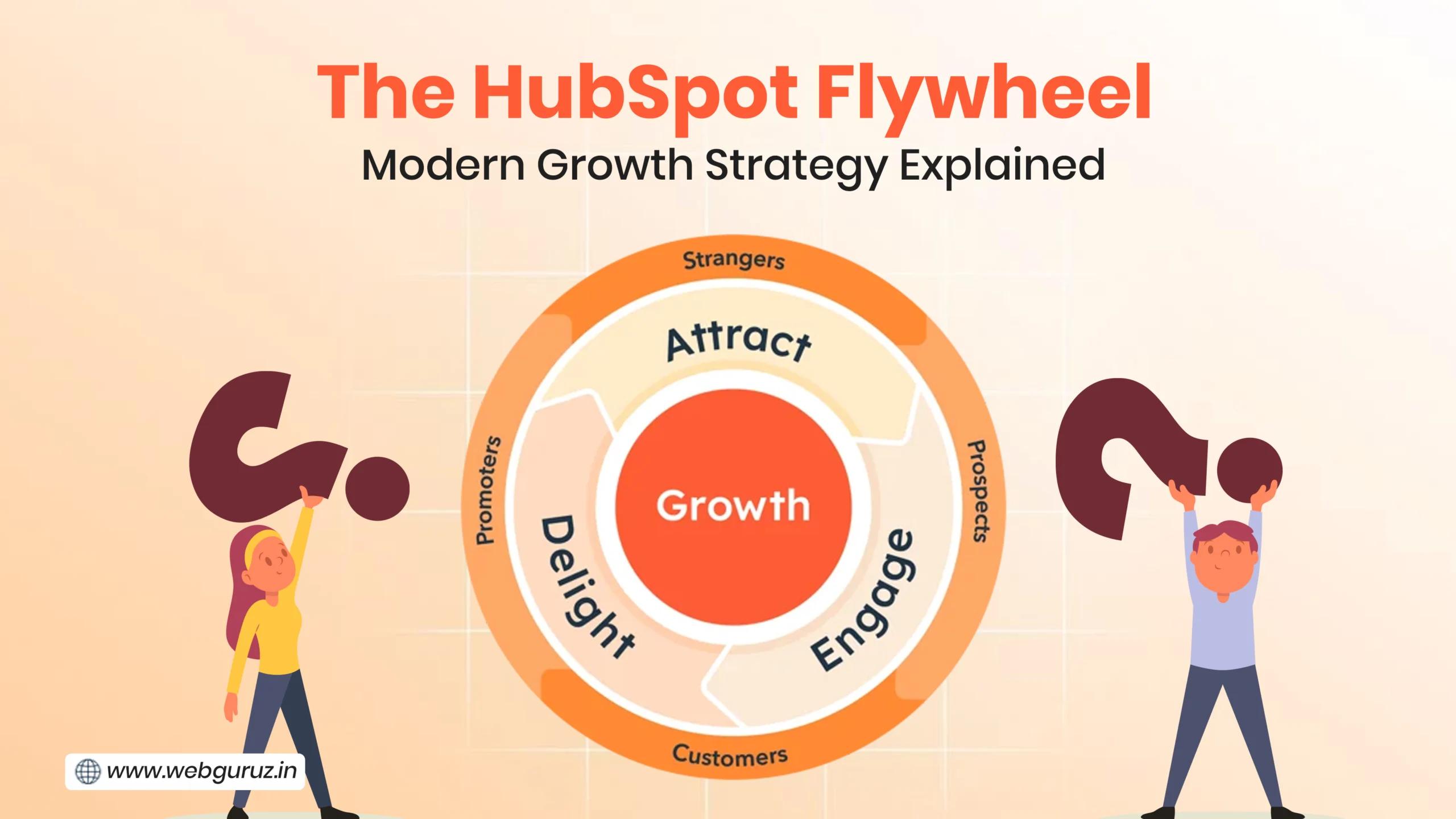
The flywheel is a physics concept. A flywheel is a heavy wheel that stores rotational energy, the more force you apply to spin it, the more momentum it builds, and the more it resists slowing down. Apply force consistently to reduce the friction that slows it, and it keeps spinning with less and less effort over time.
HubSpot applied this concept to business growth. The flywheel has three stages (Attract, Engage, and Delight) arranged in a circle, not a line. Customers who are delighted become advocates who help attract new prospects. Those prospects, properly engaged, become customers. Those customers, properly delighted, drive more growth. The wheel keeps spinning.
Attract is about earning the attention of the right people, not buying or forcing it. This happens through genuinely useful content, search-optimized pages, social media that educates rather than advertises, and a brand presence that people seek out rather than stumble upon. The goal is qualified traffic: people who actually want what you offer. Inbound lead generation built on this approach consistently costs 62% less than outbound tactics, not a marginal saving but a structural cost advantage that compounds over time.
Engage is about building relationships, not just closing transactions. When prospects reach your business, they should experience frictionless, personalized interactions, the right information at the right time, buying processes that do not feel like obstacle courses, and conversations that feel human even when they are partly automated. The goal is qualified leads that convert into happy customers, not just any customers.
Delight is where the real magic happens and where most businesses underinvest. Delight means providing such genuine value after the sale that customers naturally become promoters. They leave reviews. They refer to colleagues. They talk about you in communities your marketing team has never heard of. Each one of these behaviors adds force to the flywheel, feeding back into the Attract stage without any additional spend.

Understanding the flywheel mechanics tells you exactly where to invest and what to fix.
Your flywheel spins faster when you add force, deliberate investments at each stage that generate more energy. Great content marketing adds force at the Attract stage. A seamless sales process adds force at Engage. A proactive customer success program adds force at Delight.
Your flywheel slows down when friction is present. Friction is anything that creates unnecessary resistance in the customer’s experience. A slow website. A form that asks for too much information. A handoff between sales and service that leaves the customer confused. A support ticket that takes three days to get a response. Every one of these friction points bleeds energy from your flywheel and reduces the momentum you have built.
The job of a well-implemented growth strategy (and the reason working with a HubSpot Platinum Solutions Partner matters so much in practice) is to systematically add force and remove friction at every stage. That requires both the right strategy and the right technical implementation, working together.

The flywheel is a model, but HubSpot is the engine that makes it run. Here is how the platform’s core tools map to each stage.
The HubSpot Inbound Marketing toolkit for attraction is built around content and SEO. The blogging platform, SEO recommendations, and social publishing tools make it straightforward to create and distribute content that earns organic traffic. Landing pages and forms capture that traffic and begin the transition into the Engage stage.
HubSpot Website Development adds another layer here. A site built on HubSpot CMS is not just a website; it is a conversion machine directly connected to the CRM, personalizing content based on who is visiting and providing a full analytics picture from first click to closed deal.
Once someone is in the system, HubSpot’s CRM, Marketing Hub, and Sales Hub take over. HubSpot Automation allows businesses to send the right message at the right time based on a contact’s behavior, without manual effort at every step. Lead scoring identifies who is sales-ready. Sequences keep prospects warm without requiring a sales rep to manually remember every follow-up.
The HubSpot onboarding process itself is a version of this principle in action: getting a new customer successfully set up and seeing value quickly reduces early churn and accelerates their journey toward becoming a promoter. Businesses that invest in structured onboarding (either through HubSpot’s own team or through a dedicated HubSpot Automation Partner) see dramatically better long-term retention and a faster path to the Delight stage.
Service Hub handles the delight stage: ticketing, knowledge bases, customer feedback surveys, and NPS tracking. But the real power is in what happens when Marketing, Sales, and Service all share the same CRM data. A service rep who can see the full history of a customer’s interactions (what they bought, what they clicked on, what they complained about six months ago) delivers a fundamentally different quality of experience than one working from a separate system.
When this is done well, the numbers reflect it. Businesses running the full HubSpot flywheel report a 505% return on investment over three years and close 50% more deals on average. That is not the result of any single feature; it is what happens when all three stages are working together, and the wheel has genuine momentum.

No conversation about the HubSpot flywheel in 2026 is complete without talking about HubSpot Breeze AI. Announced at INBOUND 2024 and expanded significantly through 2025 (with over 200 product updates shipping in a single year), Breeze is HubSpot’s unified AI layer that runs across every hub.
Think of Breeze as the intelligence that sits inside the flywheel and makes every stage more efficient. At Attract, Breeze’s content tools help teams produce blog posts, social copy, and email campaigns faster. At Engage, Breeze Copilot surfaces CRM insights during sales calls, drafts follow-up emails, and scores leads predictively. At Delight, Breeze Agents handle first-line support queries and summarize customer histories before service calls, so every interaction feels informed rather than generic.
The practical outcome is measurable: businesses using Breeze AI report up to a 40% boost in marketing productivity from automation alone. But the deeper impact is on flywheel velocity. When every team member has an AI assistant that understands your specific CRM data (not generic AI, but AI trained on your actual customer history), the quality and speed of every customer interaction improves consistently.
For businesses working with a HubSpot Platinum Solutions Partner to implement Breeze, the advantage is in getting the AI configured correctly from the start: connected to the right data sources, the right agents enabled, and integrated into the workflows where it actually saves time rather than creating new ones.
One of the most common questions businesses ask before committing to HubSpot is whether they need to consolidate everything onto one platform, or whether they can keep their existing tools and layer HubSpot on top.
It is a fair question. Here is a comparison.
| Dimension | Integrated HubSpot Stack | Fragmented Multi-Tool Stack |
|---|---|---|
| Customer Data | Single unified CRM, every team sees the same record | Siloed data across tools, frequent mismatches |
| Reporting | Revenue attribution from first touch to closed deal | Partial views, attribution gaps between platforms |
| Automation | Triggers across Marketing, Sales, and Service in one workflow | Requires Zapier/API bridges, breaks frequently |
| Personalisation | Smart content based on real CRM data | Limited, based on platform-specific behaviour only |
| Onboarding Speed | One platform to learn; one vendor to manage | Longer ramp time across multiple tools |
| AI Integration | Breeze AI is natively embedded across all hubs | Third-party AI add-ons without CRM context |
| Flywheel Alignment | Built for the Attract–Engage–Delight model | No shared model, teams optimise for separate goals |
| Cost at Scale | Predictable subscription; discounts through Solutions Partners | Tool sprawl costs often exceed the HubSpot equivalent |
The core advantage of an integrated stack is not just convenience; it is that the flywheel model fundamentally requires data to flow between stages. If your marketing tool does not talk to your CRM, the Engage stage operates blind. If your CRM does not feed into your Service Hub, the Delight stage is disconnected from the relationship history that makes great service possible. HubSpot Tools are designed so the wheel can actually spin, not just spin in theory.
Understanding the flywheel model is the easy part. Making it generate compounding growth (rather than just becoming a new framework on a slide deck) requires three things.
The right configuration.HubSpot is a powerful platform, and a poorly configured HubSpot portal is worse than a simple spreadsheet. Getting CRM properties set up correctly, pipelines mapped to your actual sales process, and automations built to match your real customer journey, this is the work that proper HubSpot onboarding handles. Skipping it is the single most common reason HubSpot implementations underdeliver.
The right content strategy.The Attract stage only works if the content is genuinely useful to the right audience. That means a real understanding of what your customers are searching for, what questions they have, and what would make them trust your brand enough to engage. A structured HubSpot inbound marketing guide approach (systematic, data-driven, and aligned to the buyer journey) produces consistently different results than ad-hoc blogging and social posting.
The right partner.This is where working with a HubSpot Platinum Solutions Partner makes a material difference. A solutions partner who has implemented HubSpot across dozens of businesses has seen what works and what breaks. They have built the integrations, managed the CRM migrations, configured the AI, and trained the teams. The flywheel model is not complicated, but getting the execution right (especially for businesses migrating from other platforms or building on HubSpot CMS for the first time) requires experience that takes years to develop.
One of the most useful things about the flywheel model is that it tells you exactly what to measure at each stage.
At Attract, the primary signal is qualified organic traffic, not just total pageviews, but the right people finding you through the content and SEO work you have invested in.
At Engage, track lead-to-customer conversion rates and early churn, specifically within the first 90 days. High early churn almost always points to a friction problem upstream, where the Engage stage is bringing in customers who are not a true fit.
At Delight, Net Promoter Score and customer referral rates are the most telling signals. A business with strong NPS and a steady stream of referrals has a flywheel that is genuinely spinning. One with satisfied but silent customers is leaving the most powerful growth lever untouched.
The practical advantage of running all of this through HubSpot is that none of these metrics require a separate analytics platform. They live in the same system where the work is happening, which means the feedback loop between insight and action is as tight as it can possibly be.
The flywheel did not replace the funnel because it was a more elegant diagram. It replaced it because it maps to how growth actually works in a world where buyers are informed, expectations are high, and the cost of a bad customer experience travels fast.
Businesses that are growing most efficiently right now are not simply spending more on ads. They are investing in the infrastructure: the content, the CRM, the automation, and the AI that make their existing customers work for them. That is the flywheel. And there has never been a better toolset, or a better moment, to build one properly.
If you are ready to move from the model to the implementation, the next step is a conversation with a team that has done it across industries and understands the HubSpot platform from the inside out. As a HubSpot Platinum Solutions Partner, WebGuruz Technologies brings both the strategic thinking and the technical expertise needed to make the flywheel work not just in theory, but in practice, inside your business, starting now.
The HubSpot Flywheel is a growth model where happy customers help bring in new customers. Instead of treating the sale as the finish line, the flywheel focuses on creating great customer experiences that lead to referrals, repeat business, and long-term growth.
A funnel ends once someone becomes a customer. A flywheel keeps going. Customers stay at the center of growth by sharing reviews, referrals, and positive experiences that attract more people to your business.
Absolutely. The flywheel works especially well for growing businesses because it helps improve retention, customer relationships, and word-of-mouth marketing without relying only on paid ads.
HubSpot’s Marketing Hub, Sales Hub, Service Hub, CRM, and Breeze AI all support different stages of the flywheel. Together, they help businesses attract leads, nurture relationships, and deliver better customer experiences.
A HubSpot Solutions Partner helps set everything up properly from the start, including CRM structure, automation, integrations, reporting, and onboarding. This makes the flywheel easier to manage and far more effective long term.
Vedanshi
2026-10-23
7 min read
Your business uses HubSpot to manage customer relationships, but disconnected systems create data issues.
Read More
Vedanshi
2026-10-22
7 min read
Ask ChatGPT, Gemini, or Perplexity to recommend a supplier or a software tool, and you get a short list of names, not ten blue links.
Read More
Vedanshi
2026-10-21
7 min read
Building a website takes more than picking colors, dropping in images, and writing copy.
Read More