 sales@webguruz.in
 +1 (213) 715-5368
Vedanshi
2026-10-26
7 min read
7 Ways Modern Web Development Can Turn Your Online Store Into a Growth Engine
Your online store may have great products, competitive prices, and a strong brand, yet sales may still fall short of expectations.
Read More
Published On:2026-10-07
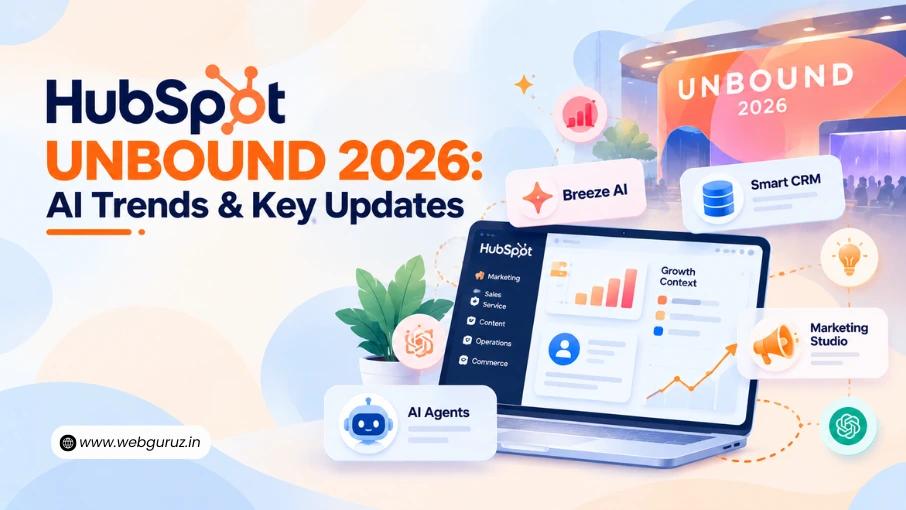
HubSpot UNBOUND 2026 sent a clear message to businesses: growth is becoming more connected.
HubSpot AI is becoming a bigger part of this change, helping businesses connect marketing, sales, customer service, data, automation, and CRM processes. Instead of working as completely separate parts of a business, these functions are moving toward more connected systems that can understand customer needs and help teams take action.
At UNBOUND 2026, HubSpot presented its vision around Growth Context, Smart CRM, AI agents, Marketing Studio, and its expanded partnership with OpenAI. The event focused less on simply adding more software and more on how businesses can use connected data, technology, and people to produce better outcomes.
For businesses planning their next stage of growth, the bigger question is not whether to use new technology. It is how to use it without creating more complexity.
One of the biggest ideas presented at UNBOUND 2026 was Growth Context.
HubSpot describes Growth Context as the business, customer, team, and process information available to its platform. The idea is simple: AI becomes more useful when it understands the situation behind the data, not just isolated information.
Consider a sales proposal. An AI tool with only a company name and contact details may create something generic. But a system that understands previous conversations, customer needs, sales activity, company information, and deal stage can create a far more relevant proposal.
This is the thinking behind Growth Context, which HubSpot is applying across its Smart CRM, Breeze Assistant, and other tools. HubSpot reports that early customers using Growth Context created 3.6× more marketing-qualified leads, won 3.2× more deals, and closed more than twice as many tickets. These are vendor-reported results, not universal benchmarks.
HubSpot introduced Marketing Studio as a shared workspace for marketers to build and nurture demand. It connects campaign planning with tools such as content and campaign agents.
This is where HubSpot Marketing Automation becomes especially relevant.
Marketing automation has already helped businesses manage email campaigns, lead nurturing, contact updates, and repetitive workflows. The next step is connecting these activities more closely.
For example, a campaign may involve:
Instead of managing each activity separately, businesses can connect them into a single process.
HubSpot’s Campaign Agent is designed to help plan campaigns and create supporting assets using information such as the campaign goal, audience, brand identity, CRM data, and previous campaign performance. Users can review and edit the generated drafts before publishing.
The benefit is not just speed. A connected campaign can make it easier for marketing teams to maintain consistency and respond to customer behavior.

Earlier AI features focused on answering questions, creating content, summarizing information, or completing individual tasks. HubSpot is now moving toward AI that can support larger workflows.
The redesigned Breeze Assistant is a key example. HubSpot says it can assign appropriate agents and produce proposals, reports, campaign plans, and other work.
HubSpot also highlighted custom agents and connections with tools such as Gong, G2, and Asana.
This matters because every business has different processes. A SaaS company may need different workflows from a real estate or healthcare business.
The bigger shift is that AI is becoming more connected to business processes and company context, rather than simply generating content.
HubSpot is also making its CRM more self-updating with the new Smart CRM. The platform can automatically capture calls, emails, and meetings, helping keep customer records up to date without requiring teams to enter every interaction manually.
This can address a common CRM challenge: when important information is missing, reporting, lead follow-up, customer service, and business decisions can all be affected.
Context Home brings the information behind HubSpot’s AI and agents into one place. It shows what the platform knows about the business, customers, teams, and processes while helping users identify missing or inaccurate information.
Automation is often described as a way to save time, but that is only part of its value. HubSpot CRM Automation can help businesses make sure important actions happen consistently.
A company with hundreds or thousands of contacts cannot manually check every record, remember every follow-up, or monitor every customer interaction.
Automation can support tasks such as:
However, automation needs clear rules.
A poorly designed workflow can send the wrong message, create unnecessary alerts, or update records incorrectly. Businesses should connect the right data, processes, and actions. Good automation supports people instead of simply creating more activity.

HubSpot also showed how AI is moving beyond marketing.
The company highlighted tools such as Prospecting Agent, Deal Progression, Revenue Agent, and Customer Agent. These tools are designed to support different parts of the customer and revenue journey.
The common factor is context.
When marketing, sales, and service teams work with connected information, they can build a clearer picture of the customer journey. This can reduce the need for customers to repeat the same information and help internal teams work from the same data.
Another major announcement was the expanded partnership between HubSpot and OpenAI.
HubSpot announced that it was the first CRM to integrate with ChatGPT Ads, allowing businesses to create, manage, and measure ChatGPT advertising campaigns from HubSpot. The integration can connect advertising activity with CRM data, lead capture, workflows, and performance reporting.
This reflects a wider change in the customer journey.
People are increasingly using AI systems to ask questions, compare options, research products, and make decisions.
For businesses, this means customer acquisition may happen across more than traditional search engines and websites.
AI is also changing how people find information.
Traditional SEO has focused heavily on rankings, clicks, keywords, and organic traffic. These metrics still matter, but they are becoming only part of the visibility picture.
Businesses now need to consider how their brand appears in AI-powered search and answer experiences.
This is where Google AI SEO Services can support a broader search strategy by focusing on areas such as content structure, search intent, technical health, useful information, and the signals that help search systems understand a website.
The goal should not be to create content simply to satisfy an algorithm.
It should be to make information clear, useful, trustworthy, and easy for both people and search systems to understand.
HubSpot itself has also moved into this area with its AEO offering, which helps businesses track and improve how they appear in AI answer engines such as ChatGPT, Gemini, and Perplexity.
The larger point is simple: search visibility is becoming broader than traditional rankings.
It may seem that AI makes content less important. In reality, the need for useful content may become even greater.
This makes HubSpot Content Hub relevant to the wider changes discussed at UNBOUND.
Content still needs to answer real customer questions. It needs to be accurate, easy to understand, useful, and connected to the buyer’s needs.
AI can help teams create and manage content faster, but speed should not be the only measure of success.
Businesses still need:
Publishing hundreds of weak pages does not automatically create authority.
A smaller collection of useful resources can provide more value when each piece has a clear purpose.
UNBOUND 2026 offers several practical lessons for business leaders.
First, customer data needs to be connected.
If important information is spread across multiple systems, teams may struggle to understand the complete customer journey.
Second, automation should follow a clear process.
Adding automation to a broken process can make the problem harder to manage.
Third, AI should solve a real business problem.
Instead of asking, “Where can we use AI?” businesses should ask, “Which problem can we solve better with AI?”
Fourth, visibility needs to be measured more broadly.
Website traffic and rankings remain useful, but businesses should also consider brand visibility across AI search, traditional search, advertising, social channels, and other customer touchpoints.

As CRM platforms become more intelligent, businesses also need to rethink how they manage them.
A CRM strategy should cover more than contact records.
It should define:
For businesses going through this transition, HubSpot Consulting Services can help create a clearer roadmap around CRM structure, automation, integrations, and business processes.
The goal is to make the system easier to manage and more useful for the teams that depend on it. So, before creating any workflow, businesses should ask four basic questions:
What should happen? Why should it happen? Who owns it? What data is required?
These questions can prevent many automation problems later.
HubSpot UNBOUND 2026 highlighted a clear shift toward more connected business technology. CRM, automation, AI, marketing, sales, and customer service are increasingly working together rather than operating as separate systems.
The idea of Growth Context brings this shift into focus. When technology has better context about a company’s customers, teams, data, and processes, it can provide more relevant support and help teams make better decisions.
Still, technology alone does not drive growth. Businesses need clean data, clear processes, useful content, and teams that know how to use their tools effectively. HubSpot AI can support these areas, while HubSpot Services can help businesses implement and connect the right solutions around their specific needs.
The main takeaway from UNBOUND 2026 is simple: businesses do not need more tools for the sake of having more tools. They need the right technology, data, people, and processes working together.
HubSpot UNBOUND 2026 was HubSpot’s major 2026 event focused on AI, CRM, marketing, sales, service, automation, and the future of business growth.
Growth Context refers to the business, customer, team, and process information that HubSpot uses to make its AI and other tools more relevant to a company’s needs.
HubSpot is moving beyond AI that simply answers questions toward AI that can support workflows, assign agents, create business outputs, and take action using CRM context.
No. Traditional automation remains useful for predictable, rule-based processes. AI can add another layer of assistance where tasks require more context or flexible decision-making.
AI needs reliable business information to produce useful results. Poor or incomplete CRM data can lead to less relevant outputs and weaker automation.

Vedanshi
2026-10-26
7 min read
Your online store may have great products, competitive prices, and a strong brand, yet sales may still fall short of expectations.
Read More
Vedanshi
2026-10-23
7 min read
Your business uses HubSpot to manage customer relationships, but disconnected systems create data issues.
Read More
Vedanshi
2026-10-22
7 min read
Ask ChatGPT, Gemini, or Perplexity to recommend a supplier or a software tool, and you get a short list of names, not ten blue links.
Read More