 sales@webguruz.in
 +1 (213) 715-5368
Vedanshi
2026-10-23
7 min read
Custom HubSpot Integrations: Benefits, Examples, and Best Practices
Your business uses HubSpot to manage customer relationships, but disconnected systems create data issues.
Read More
Published On:2026-06-26
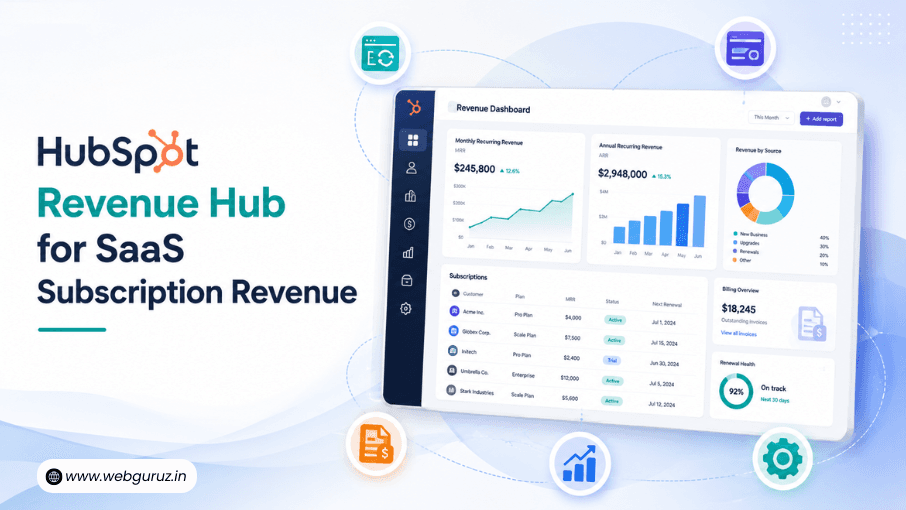
Running a SaaS business isn’t just about acquiring new customers. Long-term success depends on managing subscriptions, reducing churn, forecasting revenue accurately, and creating a smooth experience from the first quote to every renewal.
As companies scale, manual processes often become a bottleneck. Teams end up juggling spreadsheets, disconnected billing systems, and multiple software platforms just to keep track of recurring revenue. That’s where HubSpot Revenue Hub for SaaS comes in. By bringing quoting, billing, subscriptions, payments, and reporting into one connected ecosystem, it helps businesses spend less time on administration and more time on growth.
According to Gartner, by 2028, 80% of B2B sales interactions between suppliers and buyers are expected to occur in digital channels. For SaaS businesses, this makes streamlined quoting, subscription management, and automated revenue workflows more important than ever.
If you’re evaluating the Revenue Hub as your next quote-to-cash solution, this guide explains how it supports subscription businesses and why it has become an important tool for modern revenue operations.

Selling software on a subscription model brings unique operational challenges. Winning a customer is only the beginning, the real work lies in managing the ongoing relationship.
Many SaaS companies struggle with:
When these processes rely on manual effort, mistakes become more likely and valuable time is lost.
A connected quote-to-cash process helps eliminate many of these issues by ensuring that customer information flows seamlessly from sales to billing and beyond.
For businesses investing in HubSpot Revenue Hub implementation, this means fewer disconnected systems and greater visibility across the entire customer lifecycle.

For subscription businesses, two of the most important metrics are Monthly Recurring Revenue (MRR) and Annual Recurring Revenue (ARR). They provide a clear picture of predictable income and help leaders make informed decisions about hiring, investment, and future growth.
The challenge is that calculating these metrics manually becomes increasingly difficult as the customer base expands.
With HubSpot Revenue Hub for SaaS, subscription data, payments, and customer records remain connected, reducing the need for spreadsheet-based reporting and making recurring revenue easier to monitor.
Unlike businesses that sell one-time products, SaaS organizations must continuously track changes such as:
Having these events connected within a single HubSpot revenue platform gives leadership teams a more accurate view of business performance and future revenue potential.
| Revenue Task | Manual Process | Using HubSpot Revenue Hub |
|---|---|---|
| Quote creation | Built using documents or spreadsheets | Streamlined with integrated HubSpot quote management |
| Subscription tracking | Maintained through spreadsheets or reminders | Centralized with HubSpot subscription management capabilities |
| Billing | Managed in separate systems | Simplified with connected HubSpot billing and payments workflows |
| Payment visibility | Requires checking multiple tools | Available within a unified revenue workflow |
| Renewal tracking | Calendar reminders and manual follow-ups | Automated lifecycle management |
| Revenue reporting | Data gathered from multiple sources | Centralized dashboards with real-time insights |
This unified approach is one reason many organizations seek HubSpot Revenue Hub consulting before scaling their operations. A properly configured system helps reduce administrative overhead while improving reporting accuracy.
Winning a customer is only the beginning of the journey. Keeping that customer engaged and growing their account over time is where sustainable SaaS success is built.
Effective subscription lifecycle management means tracking every important milestone, from initial purchase and onboarding to renewals, upgrades, and long-term retention.
One of the strengths of the Revenue Hub is its ability to connect these activities within the same platform. Combined with HubSpot Hubs, businesses can align customer information across different teams instead of storing it in isolated systems.
For example, after a customer signs a contract, the platform can support automated onboarding steps, trigger internal notifications, and maintain a centralized record of subscription details. Teams no longer have to search through multiple applications to understand a customer’s history.
Many organizations also work with a HubSpot Revenue Hub expert during deployment to ensure subscriptions, workflows, and reporting are configured correctly from day one. Proper HubSpot Revenue Hub onboarding helps businesses avoid process gaps and establish scalable revenue operations as they grow.
As subscription volumes increase, having one connected source of truth becomes invaluable, not just for finance but for sales, customer success, and leadership teams alike.
For most SaaS companies, the biggest growth opportunity isn’t always acquiring new customers; it’s retaining existing ones and helping them grow. Renewals, upgrades, cross-sells, and add-ons can significantly increase customer lifetime value while costing less than acquiring a brand-new client.
Unfortunately, many businesses still manage renewals through spreadsheets or calendar reminders. That approach might work when you have 20 customers, but it quickly becomes unsustainable when you’re managing hundreds or thousands of subscriptions.
With HubSpot Revenue Hub for SaaS, renewal dates, contract details, and subscription history stay connected to the customer record. Teams can build automated reminders, monitor upcoming renewals, and identify opportunities for expansion revenue without relying on manual tracking.
A business that starts with a basic software package today might upgrade to an enterprise plan six months later. Having that visibility in one place helps sales and customer success teams engage customers at the right time with the right offer
More importantly, integrating these workflows into a broader Sales Hub strategy ensures that sales representatives have access to the latest customer information before reaching out, resulting in more informed conversations and better outcomes.
Reliable forecasting is one of the biggest advantages of running a subscription-based business, but only if your data is accurate.
When quotes, subscriptions, invoices, and payments live in separate systems, forecasting often becomes a manual exercise involving exported spreadsheets and last-minute calculations.
The Revenue Hub helps solve this by bringing revenue data together in one platform. Leaders can track pipeline performance, recurring revenue trends, and payment activity without piecing together information from multiple sources.
This makes it easier to answer questions like:
Many organizations also choose HubSpot Revenue Hub integration services to connect finance systems and other business applications, creating an even more complete picture of revenue performance.

Technology alone doesn’t guarantee success. The most effective SaaS companies pair the right platform with well-designed revenue operations.
Here are some best practices to consider:
Keep sales, billing, subscription, and customer information connected so every team works from the same source of truth.
Reduce manual effort by automating quote approvals, renewal reminders, payment notifications, and internal task assignments.
Sales, finance, marketing, and customer success should collaborate using common metrics rather than operating in silos.
A consistent quote-to-cash solution reduces delays, minimizes errors, and creates a better customer experience.
Monitor KPIs, identify bottlenecks, and continuously improve workflows as your business evolves.
Many organizations partner with providers offering HubSpot Revenue Hub Services to implement these practices efficiently and tailor the platform to their specific business model.

Having data is valuable, but presenting it in a meaningful way is what enables smarter decisions.
A well-designed KPI dashboard should give leadership teams instant visibility into the health of the business.
Some of the most useful metrics include:
When paired with Marketing Hub, these operational metrics can also be compared with campaign performance and lead generation data, helping businesses understand which marketing efforts contribute most effectively to recurring revenue growth.
Subscription businesses thrive when revenue operations are predictable, scalable, and easy to manage. As customer bases grow, relying on disconnected systems and manual processes can slow teams down and make forecasting more difficult.
By adopting HubSpot Revenue Hub for SaaS, organizations can streamline subscription management, automate key parts of the quote-to-cash process, improve reporting, and create a better experience for both customers and internal teams. Whether you’re tracking renewals, managing recurring billing, or forecasting future revenue, having everything connected in one HubSpot revenue platform provides greater clarity and efficiency.
For companies looking to scale without increasing operational complexity, investing in the right tools (and the right implementation strategy) can make all the difference.
It brings quoting, subscriptions, billing, payments, and reporting together in one platform, making it easier to manage recurring revenue and reduce manual work.
Yes. Businesses can automate reminders, monitor renewal dates, and keep subscription information connected to customer records, making renewals easier to manage.
Absolutely. It supports key stages of the quote-to-cash process, from creating quotes and collecting approvals to managing invoices, payments, and subscriptions.
While some businesses can set it up independently, working with a HubSpot Revenue Hub expert or using professional Revenue Hub implementation services can help ensure the platform is configured correctly and aligned with your business goals.
Yes. Revenue Hub works seamlessly with other HubSpot Hubs, allowing businesses to connect sales, marketing, service, and revenue operations for a more unified customer experience.
Vedanshi
2026-10-23
7 min read
Your business uses HubSpot to manage customer relationships, but disconnected systems create data issues.
Read More
Vedanshi
2026-10-22
7 min read
Ask ChatGPT, Gemini, or Perplexity to recommend a supplier or a software tool, and you get a short list of names, not ten blue links.
Read More
Vedanshi
2026-10-21
7 min read
Building a website takes more than picking colors, dropping in images, and writing copy.
Read More