 sales@webguruz.in
 +1 (213) 715-5368
Vedanshi
2026-10-23
7 min read
Custom HubSpot Integrations: Benefits, Examples, and Best Practices
Your business uses HubSpot to manage customer relationships, but disconnected systems create data issues.
Read More
Published On:2026-06-12
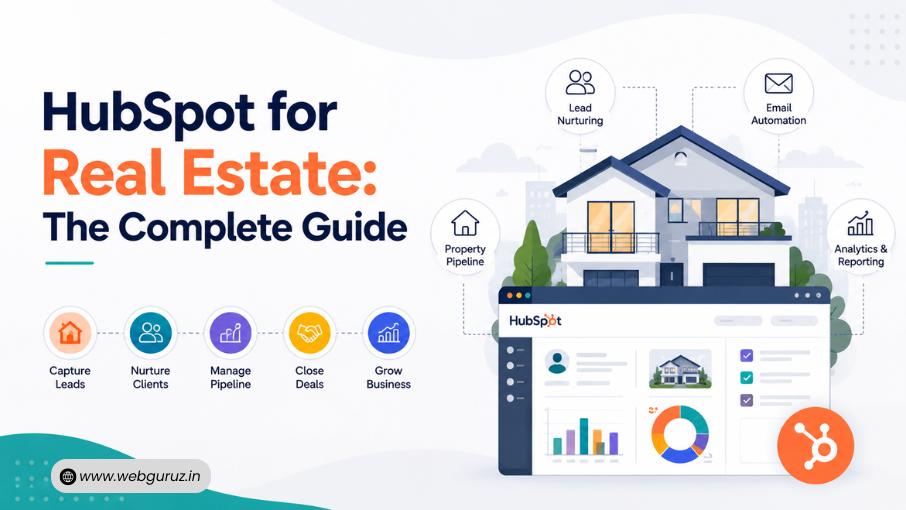
Real estate is one of the most labor-intensive businesses that exists. At any given time, an agent or team is managing prospective buyers at different stages of their search, sellers at different points in the listing process, past clients who might refer or return, and a pipeline of new inquiries arriving from half a dozen sources simultaneously. Managing all of that from a combination of spreadsheets, sticky notes, and disconnected platforms does not scale, and the data makes clear just how expensive the gaps are.
Agents who respond to web leads within five minutes are 21 times more likely to qualify that lead than those who wait just 30 minutes, according to Real Trends and InsideSales.com research. Yet the industry average response time in real estate sits at 5.7 hours. That gap (between the speed buyers expect and the speed most teams deliver) is exactly what HubSpot for Real Estate is designed to close.
This guide covers how HubSpot supports every stage of the real estate business: generating and capturing leads, automating follow-up, managing deals through to close, retaining clients post-transaction, and building the kind of referral engine that compounds over time.

The case for a dedicated Real estate CRM is straightforward: CRM users in real estate see a 29 to 41% lift in conversion rates over agents who do not use one consistently, according to NAR and SearchLab 2026 research. The harder question is which CRM to use, and why HubSpot specifically.
The honest answer is that HubSpot is not purpose-built for real estate the way some niche platforms are. It does not come with built-in MLS integration or pre-loaded property listing templates. What it does have is something arguably more valuable: a genuinely flexible platform that can be configured precisely around how a specific team or agency operates, combined with marketing, sales, service, and content tools that all work from the same contact database.
RE/MAX Romania increased leads by 114% through inbound marketing campaigns and HubSpot automation, increased automated emails by 100% through nurturing campaigns, and grew their customer base by 24% through improved sales and marketing alignment with pipeline management. That is not a theoretical outcome; it is the documented result of a team that committed to configuring HubSpot for Real Estate properly and using it consistently.
The platform also maintains 99.95%+ service uptime, which matters for a business where a missed notification about a new lead can mean a lost deal.

The real estate sales cycle is not a straight line. A buyer might inquire, go quiet for three months, re-engage when their circumstances change, and then move quickly to close. A seller might list, withdraw, and re-list a year later. The system managing these relationships needs to handle long, non-linear timelines with consistent follow-up and zero dropped balls. Here is how HubSpot handles each stage of that journey.
Every lead that enters the system without being captured in the CRM is revenue that has already been lost. HubSpot for Real Estate addresses this at the source, connecting every channel where leads arrive to a single, unified contact database.
HubSpot integrates with major real estate platforms through Zapier and native APIs, automatically creating contact records when leads inquire about listings. It also connects with IDX providers to sync property information and track which listings generate the most interest. This means a lead from Zillow, a form submission on the agency website, a social media ad inquiry, and a referral from a past client all land in the same place, with the source, property interest, and inquiry context already attached to the record.
Website visitor behavior is another signal that HubSpot CRM for Real Estate captures even before a form is filled in. A prospective buyer who visits five property pages and spends twelve minutes on the three-bedroom listings is telling you something about their preferences before they have said a word. That behavioral data is visible in the contact record the moment they do submit an inquiry, giving the responding agent genuine context rather than a cold call from a name and email address.
Real estate lead generation depends on speed. Businesses that nurture leads generate 50% more sales-ready leads at 33% lower cost, according to Forrester research, and nurtured leads make 47% larger purchases than non-nurtured ones. HubSpot’s automated capture and immediate response capability is the infrastructure that makes nurturing at this scale possible.
Capturing leads is only the first problem. Following up with them fast enough, often enough, and with the right message is where most Real estate lead management falls apart.
HubSpot marketing automation handles this through workflow sequences that trigger the moment a lead is captured. A new inquiry from the website gets an immediate acknowledgment email (personalized with the property they inquired about, not a generic auto-reply) followed by a structured follow-up sequence over the next 14 days that includes email, task reminders for personal outreach, and behavioral triggers that adapt the sequence based on what the lead actually does.
According to NAR lead data, 78% of homebuyers end up working with the first agent who responds to them. The automation built into HubSpot CRM automation is what makes it possible to consistently be that first response, even when leads arrive at 11pm on a Friday.
Long-cycle nurture is where HubSpot CRM workflows prove their value beyond the initial response. A buyer who is not ready to act for six months needs a very different communication sequence than one who has a 60-day timeline. HubSpot allows agents to segment their lead database by timeline, property type, price range, and location preference, and deliver different content to each segment automatically, without anyone manually managing which email goes to whom.
For HubSpot CRM for real estate agents specifically, the mobile app is worth mentioning separately. Field agents who spend most of their day at showings, listings, and client meetings need a CRM that works from their phone, not a desktop platform they will update when they get back to the office. HubSpot’s mobile app gives agents access to their full contact database, deal pipeline, and task list from anywhere, with activity logging that updates the CRM record in real time.
A real estate pipeline looks different from a standard sales pipeline. There are separate journeys for buyers and sellers. There are stages (pre-approved, touring, offer submitted, under contract, and closed) that do not map to generic deal stages. And there are multiple parties involved in each transaction whose relationships need to be tracked and managed simultaneously.
Configuring deal pipelines that mirror the actual transaction process is where HubSpot development work for real estate agencies typically begins, rather than leaving agents to work around a generic framework. HubSpot allows teams to create separate pipelines for buyers versus sellers, with stages like Pre-Approved, Touring, Offer Submitted, and Under Contract, with automated actions when deals move stages, such as triggering inspection reminders or commission calculations.
The reporting layer on top of this pipeline is where Real estate deal management becomes genuinely useful for team leaders and principals. Pipeline velocity reports show how long deals are spending at each stage, revealing where the bottleneck is in the team’s process, not just the market. Individual agent performance dashboards show conversion rates by lead source, average time from inquiry to first appointment, and deal close rates, giving managers the data they need to coach effectively rather than relying on anecdote.
At the deal management stage, HubSpot automation services include automatic stage progression notifications, deadline reminders for time-sensitive transaction milestones, and coordination workflows that notify relevant parties (mortgage brokers, solicitors, other agents) when a deal moves to a new stage. The administrative overhead of keeping a transaction on track is significant in real estate, and automation absorbs a meaningful portion of it.
66% of sellers found their agent through a referral or past relationship, and 72% of sellers only interviewed one agent before listing, according to NAR’s 2025 Profile of Home Buyers and Sellers. These numbers tell a clear story: the relationship that exists after a transaction closes is worth more than almost any lead generation channel if it is maintained.
Most agencies manage post-transaction client relationships poorly. A client receives a closing gift and a thank-you card and then hears from the agency at Christmas with a calendar. That is not a relationship; it is an annual reminder that the agency exists.
Post-transaction engagement is where HubSpot for Real Estate replaces the annual calendar with something that actually maintains a relationship. Anniversary of purchase emails, quarterly market update reports for the client’s specific neighborhood, new listing alerts for the property type and area they searched in, and annual check-ins timed to the likely refinancing or upgrade window; all of these can be automated in HubSpot and personalized with data that already exists in the contact record.
For agencies coming from legacy systems or spreadsheet-based contact management, HubSpot CRM migration is often where this post-transaction relationship value is first realized. A historical database of past clients that has never been systematically nurtured suddenly becomes an automated revenue stream when it is imported into HubSpot with the right segmentation and sequences in place.
For agencies with multiple agents, the operational layer of the CRM matters as much as the client-facing one. Lead routing (ensuring that new inquiries go to the right agent based on geography, property type, or workload) is something most agencies manage manually. HubSpot CRM automation handles this through round-robin assignment rules, property-type-based routing logic, and workload-balancing rules that ensure no agent is buried while another is underutilized.
Getting the setup right from day one is precisely why HubSpot Onboarding for real estate agencies involves more configuration depth than the standard HubSpot setup. Pipeline stages, lead routing, team notification workflows, and reporting dashboards built correctly from the outset (rather than one by one as problems emerge) is what separates implementations that produce results immediately from those that require months of iterative fixes.
For real estate agencies, HubSpot Services engagements typically cover the full stack: CRM configuration, pipeline architecture, workflow automation, integration with listing platforms and portals, reporting setup, and agent training. HubSpot CRM developers who have configured the platform for property businesses understand the nuances (the separate buyer and seller pipelines, the transaction coordination workflows, the post-close nurture sequences) that a generic HubSpot setup misses entirely.

Real estate automation is not about replacing the human relationship that drives this business. A buyer choosing between properties worth hundreds of thousands of dollars wants to work with a person they trust; no automation changes that. What automation does is ensure that the right human is available at the right moment, armed with the right information, having never let a lead go cold or a follow-up slip.
The numbers support this clearly. Companies using marketing automation see a 451% increase in qualified leads, and automated lead management increases revenue by 10% within 6 to 9 months, according to Gartner research. For a real estate business where the value of a single closed deal justifies significant operational investment, those returns are not difficult to achieve.
The agencies and teams seeing the strongest results from HubSpot for Real Estate are the ones that have invested in getting the configuration right, not just activating the platform but building the workflows, pipelines, and automation sequences that reflect how their business actually operates. That investment pays forward into every lead that enters the system and every client relationship that the agency needs to maintain.
Everything covered in this HubSpot for Real Estate: A Complete Guide to Lead Generation, Automation & Deal Management guide points to one conclusion: the tools that real estate businesses need to compete in 2026 (fast lead response, consistent follow-up, structured pipelines, and long-term client retention) are all available within HubSpot’s platform. The variable is how well the platform is configured to match the specific way a team or agency works.
A generic HubSpot setup produces generic results. A platform configured by people who understand both HubSpot’s capabilities and the real estate business’s specific requirements produces a system that compounds, generating more referrals from past clients, converting more of the leads already coming in, and giving agents the operational clarity to focus on relationships rather than administration.
Yes. While HubSpot wasn’t built exclusively for real estate, it’s flexible enough to support lead generation, follow-up automation, deal tracking, client retention, and team management all within one platform.
Absolutely. HubSpot can automatically send acknowledgment emails, assign leads to agents, create follow-up tasks, and trigger nurture sequences the moment a new inquiry comes in, helping you stay ahead of the competition.
HubSpot allows agencies to build custom pipelines for buyers and sellers, track deals through every stage, automate reminders, and monitor performance through reporting dashboards that provide full visibility into the sales process.
Yes. HubSpot makes it easy to stay connected with past clients through automated anniversary emails, market updates, check-ins, and personalized communication that keeps your agency top of mind long after the transaction closes.
They do. HubSpot’s mobile app gives agents access to contacts, deals, tasks, notes, and activity history from anywhere, making it easier to manage client relationships while out at showings, listings, and meetings.
Vedanshi
2026-10-23
7 min read
Your business uses HubSpot to manage customer relationships, but disconnected systems create data issues.
Read More
Vedanshi
2026-10-22
7 min read
Ask ChatGPT, Gemini, or Perplexity to recommend a supplier or a software tool, and you get a short list of names, not ten blue links.
Read More
Vedanshi
2026-10-21
7 min read
Building a website takes more than picking colors, dropping in images, and writing copy.
Read More