 sales@webguruz.in
 +1 (213) 715-5368
Vedanshi
2026-10-23
7 min read
Custom HubSpot Integrations: Benefits, Examples, and Best Practices
Your business uses HubSpot to manage customer relationships, but disconnected systems create data issues.
Read More
Published On:2026-06-17
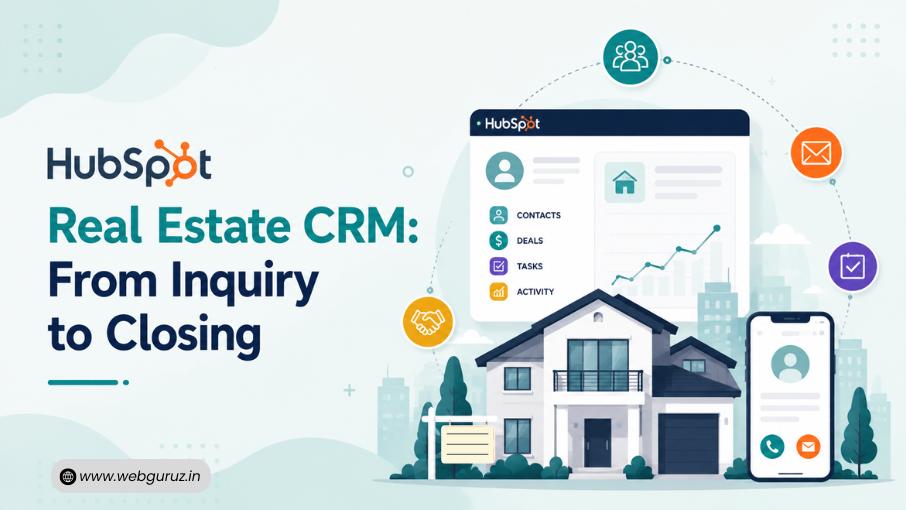
Every real estate transaction starts the same way: someone, somewhere, expresses interest. A form submission, a phone call, a walk-in at an open house, a referral from a past client. What happens in the days and weeks after that first moment of interest determines whether it becomes a closed deal or a lead that quietly goes cold.
Most agencies lose more deals in this gap than they realize. Not because the agents are not good at their jobs, but because the systems managing the handoff between “someone is interested” and “someone is ready to buy” are inconsistent, manual, and entirely dependent on individual memory. A genuinely effective Real estate CRM closes that gap, and HubSpot, configured correctly for a property business, is one of the most capable platforms available for doing it.
This guide walks through the real estate sales pipeline stage by stage, showing exactly where HubSpot changes the outcome, from the first inquiry through to a closed transaction and the relationship that follows.

Sales pipelines in most industries follow a relatively linear path: lead, qualified, proposal, negotiation, and closed. Real estate does not work this way. A buyer might tour properties for eight months before making an offer. A seller might list, pull the listing, and re-list a year later with a different agent. Multiple parties, buyers, sellers, mortgage brokers, solicitors, and other agents are often involved in a single transaction simultaneously, each needing different information at different times.
A generic CRM forces this complexity into a framework it was never designed for. HubSpot real estate CRM configurations solve this by building pipelines around how property transactions actually move, separate buyer and seller journeys: stages that reflect real milestones like Pre-Approved, Touring, Offer Submitted, and Under Contract and automation that responds to the specific events that move a deal forward in this industry.
The result is a system that mirrors reality rather than forcing reality into a tool’s default assumptions, which is the foundation everything else in this guide builds on.

Every real estate lead follows a journey, from the moment an inquiry is submitted to the point where that client becomes a repeat customer or referral source. The challenge is managing each stage consistently without relying on manual processes. A well-structured HubSpot for real estate environment helps agencies capture, nurture, convert, and retain leads through a connected lifecycle designed to support both operational efficiency and long-term growth.
The first failure point in most real estate pipelines is not poor follow-up; it is inconsistent capture. Leads arrive through the agency website, Zillow, Realtor.com, social media ads, referrals, and walk-ins, and if even one of those channels is not feeding into a central system, leads from that channel are being managed inconsistently or not at all.
Native integrations and Zapier connections are how HubSpot for real estate addresses this, funneling every inquiry, regardless of source, into a single contact record. A lead from a Facebook ad about a specific listing arrives with the property context, the ad campaign, and the channel already attached. A referral from a past client arrives tagged with who referred them. None of this requires manual entry, and none of it depends on an agent remembering to log it.
Behavioral data adds a second layer of intelligence here. A prospective buyer who has visited the same listing three times, or who has spent significant time browsing properties in a specific price range and neighborhood, is showing intent that a form submission alone does not capture. That behavioral history is visible in the contact record from the moment of first inquiry, giving the responding agent genuine context rather than a name and a phone number.
Speed matters more in real estate lead response than almost any other industry. Buyers researching properties are often in contact with multiple agents simultaneously, and the agent who responds first (with relevant, helpful information rather than a generic “thanks for your interest”) has a structural advantage that compounds through the rest of the relationship.
This is where HubSpot marketing automation and HubSpot CRM workflows operate together. The moment an inquiry is captured, an automated response goes out immediately (personalized to the specific property or search criteria the lead expressed interest in), while simultaneously creating a task for the assigned agent and starting a structured follow-up sequence. The automation handles the immediate acknowledgment, so the human follow-up, when it happens, is a genuine conversation rather than a race against the clock.
For agencies with multiple agents, lead routing logic determines who gets notified. HubSpot CRM developers configure this routing based on geography, property type, price range, or current workload, ensuring leads go to the agent best positioned to convert them rather than whoever happens to check their inbox first.
Not every lead is ready to act immediately. A significant portion of real estate inquiries come from buyers who are six to twelve months away from making a move, researching, getting a feel for the market, and not yet ready for active engagement. The mistake most agencies make is treating these leads the same as ready-to-act buyers, either overwhelming them with sales pressure or, more commonly, letting them go quiet entirely.
This is precisely what marketing automation built for long-cycle nurture solves. Leads can be segmented by timeline, property type, price range, and location preference, with each segment receiving a different communication cadence and content mix. A buyer six months out might receive monthly market updates and new listing alerts for their criteria. A buyer with a 30-day timeline gets a more active, higher-touch sequence. None of this requires an agent to manually track where each lead is in their journey, the system tracks it through behavioral signals and adjusts automatically.
The engine behind this nurture infrastructure is HubSpot Marketing Hub; campaign management, email sequencing, and behavioral segmentation all working from the same contact data that the sales pipeline uses, so marketing and sales are never working from different pictures of the same lead.
Once a buyer is actively touring properties or a seller is actively listed, the transaction enters its most operationally intensive phase. Showings need scheduling. Offers need tracking. Inspections, appraisals, and financing milestones all have deadlines that, if missed, can jeopardize the entire transaction.
A well-configured real estate CRM turns this phase from a manual coordination exercise into a managed pipeline with built-in accountability. Each deal moves through stages with automated actions triggered at each transition. When an offer is submitted, a task is created for the agent to follow up within a defined window. When a deal moves to Under Contract, automated reminders for inspection deadlines, appraisal scheduling, and financing milestones keep the transaction on track without anyone needing to manually maintain a checklist.
Building custom properties specific to real estate transactions (closing dates, commission splits, co-broker information, and property addresses linked to listing records) is typical HubSpot CRM development work at this stage, ensuring the CRM reflects the actual data points that matter for a property transaction rather than the generic deal fields a standard CRM provides.
For agencies coordinating with external parties (mortgage brokers, solicitors, co-listing agents), HubSpot Service Hub provides the communication and ticketing infrastructure to keep these relationships organized, with every interaction logged against the relevant deal record so nothing gets lost in email threads. This kind of cross-party coordination is one of the more specialized HubSpot Services capabilities that real estate agencies tend to underuse.
The moment a deal closes is often treated as the end of the relationship in the CRM, the deal is marked won, and attention moves to the next pipeline. This is a significant missed opportunity. The period immediately after closing is when client satisfaction is highest, referral requests land best, and the foundation for a long-term relationship is set.
Automated post-closing sequences (a thank-you message, a request for a review, and a check-in at the 30-day and 90-day marks) keep the relationship active without requiring the agent to remember to reach out. HubSpot automation solutions at this stage transition the contact from an active deal into a long-term nurture track: anniversary reminders, market update emails for their specific neighborhood, and re-engagement sequences timed to typical refinancing or upgrade windows.
This is also where referral generation becomes systematic rather than incidental. A satisfied past client who receives a well-timed, genuinely helpful market update is far more likely to refer a friend or family member than one who has not heard from the agency since closing day.

Everything described above depends on the underlying configuration being right, and this is where the gap between a HubSpot account that is technically active and one that is genuinely transforming the sales pipeline becomes clear.
Everything covered in this From Inquiry to Closing: How a Real Estate CRM Built on HubSpot Transforms the Sales Pipeline guide comes down to one principle: the gap between a lead expressing interest and a deal closing is where most real estate revenue is won or lost, and that gap is almost entirely a systems problem, not a talent problem.
Agents who are great at building relationships and closing deals are held back when the infrastructure around them (lead capture, follow-up, nurture, and transaction coordination) depends on memory and manual effort. HubSpot real estate CRM configurations remove that dependency, giving agents more time for the relationships that actually require a human, while the system handles everything that does not.
In most cases, it isn’t because agents lack skill. Leads are often lost due to delayed follow-ups, inconsistent communication, or disconnected systems that make it difficult to track every opportunity effectively.
HubSpot can automatically capture leads from multiple sources, send instant responses, assign leads to the right agent, and trigger follow-up tasks, helping agencies engage prospects while interest is highest.
Yes. HubSpot can be customized with separate pipelines, automations, and communication journeys for buyers and sellers, ensuring each client receives relevant information throughout their journey.
Many buyers and sellers take months before making a decision. HubSpot helps agencies stay connected through automated nurturing, market updates, listing alerts, and personalized communication without overwhelming prospects.
A well-configured HubSpot system continues the relationship through review requests, follow-up communications, market updates, and referral campaigns, helping agencies generate repeat business and referrals long after closing.
Vedanshi
2026-10-23
7 min read
Your business uses HubSpot to manage customer relationships, but disconnected systems create data issues.
Read More
Vedanshi
2026-10-22
7 min read
Ask ChatGPT, Gemini, or Perplexity to recommend a supplier or a software tool, and you get a short list of names, not ten blue links.
Read More
Vedanshi
2026-10-21
7 min read
Building a website takes more than picking colors, dropping in images, and writing copy.
Read More