 sales@webguruz.in
 +1 (213) 715-5368
Vedanshi
2026-10-09
7 min read
How to Use HubSpot AI Agents to Automate Sales, Marketing, and Customer Support
A sales team spends hours researching prospects. Marketing repeats the same tasks across campaigns.
Read More
Published On:2026-09-18
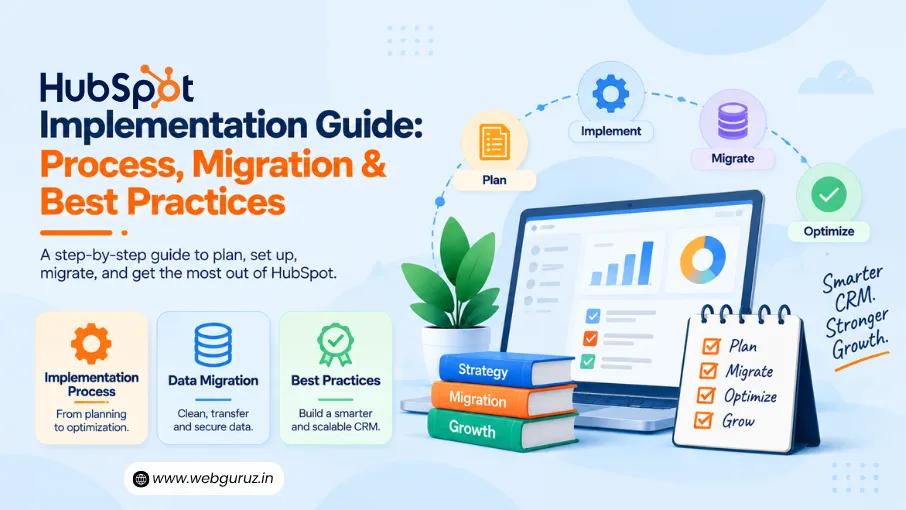
Most failed HubSpot rollouts don’t fail because of the software. They fail because nobody mapped the process, cleaned the data, or planned how teams would actually use it before flipping the switch. The result is a CRM full of duplicate contacts, pipelines that don’t match the real sales process, and automations nobody trusts enough to rely on.
A HubSpot Implementation is what separates those two outcomes. It’s the difference between a platform teams work around and one that works for them, covering the process design, onboarding, data migration, CRM automation, and reporting that turn HubSpot from a tool you bought into a system your business actually runs on. This guide breaks down each piece, along with the best practices that keep it working long after launch.
HubSpot Implementation is the process of configuring and adapting HubSpot around a company’s business processes, customer journey, data structure, and growth objectives. It goes beyond creating an account, importing contacts, or switching on features.
A proper implementation typically brings together:
It’s worth drawing a line here between implementation and onboarding, since the two get used interchangeably. HubSpot Onboarding, on the other hand, is the shorter, lighter process of helping a team get familiar with HubSpot and start using its core features; it’s often enough for a small business with straightforward needs. Implementation is the deeper work of designing the system around how the organization actually operates and configuring the platform to support that. It becomes necessary once things get more complex: multiple sales pipelines, varied customer journeys, existing CRM data that needs migrating, or workflows that need to connect marketing, sales, and service.
The goal, in either case, is the same, a usable, scalable environment that’s aligned with business objectives rather than one teams have to work around.

One of the most common implementation mistakes is starting with the platform instead of the business.
Teams begin creating properties, pipelines, workflows, and dashboards before deciding what the CRM actually needs to accomplish. The result can be a system that technically works but doesn’t reflect how the business operates.
Before configuration begins, businesses should establish:
Business goals → Processes → Data structure → CRM architecture → Automation → Reporting
This planning stage should identify:
This is where experienced HubSpot experts can add value. Instead of simply configuring features, they can help translate business requirements into a CRM structure that teams can actually use.
Data deserves particular attention before implementation or migration begins. Moving inaccurate or duplicated records into a new CRM does not solve a data-quality problem. It simply moves the problem into a new system.
Gartner research found that poor data quality costs organizations an average of $12.9 million every year, a figure cited widely across data-management literature.
HubSpot’s current tools support auditing existing data, mapping fields and objects, transferring information, cleaning data, and even reverting a transfer when needed. That makes data preparation an important part of implementation rather than a task to leave until the end.
A strong implementation should therefore establish what data is worth moving, how it should be structured, what needs to be cleaned, and how it will be maintained after migration. And that foundation becomes even more important when the next stages involve CRM automation, reporting, integrations, and AI.

A successful HubSpot implementation should follow a defined process rather than a series of disconnected configuration tasks. The exact steps will vary depending on the company’s size, existing systems, and goals, but the implementation generally moves from planning and setup to migration, automation, testing, and adoption.
Start by identifying what HubSpot needs to accomplish.
A company might want to replace an outdated CRM, bring marketing and sales data together, improve lead management, automate repetitive processes, or create better visibility into the customer journey.
Document the current process before changing it. Map how leads enter the business, how they are qualified, how deals move through the pipeline, and what happens after a customer converts. This gives the implementation team a clear picture of what HubSpot needs to support.
The next step is deciding how information should be organized inside HubSpot.
This can include:
The structure should reflect the business’s actual processes. Creating unnecessary properties or complicated pipelines can make the CRM harder for teams to maintain.
A well-designed foundation also makes future HubSpot Services easier to expand because new automation, reporting, and integrations can be built on a consistent data model.
If a business is moving from another CRM or marketing platform, migration requires more than exporting and importing records.
Before transferring data, teams should map existing fields to their HubSpot equivalents, identify duplicate or outdated records, determine which historical information needs to be retained, and decide how existing relationships between contacts, companies, and deals should be handled.
For larger or more complicated migrations, working with a HubSpot Migration Partner can reduce the risk of data loss and structural problems.
Migration should also include testing. A small sample of records can be transferred first to verify field mapping, associations, formatting, and data accuracy before the full migration takes place.
Once the CRM structure and data are in place, automation can be built around the processes identified during planning.
For example, HubSpot can automate lead assignment, follow-ups, lifecycle-stage updates, internal notifications, lead nurturing, and other repetitive activities.
This is where HubSpot CRM Automation becomes particularly valuable. However, automation should follow a clear business rule. Automating a poorly designed process only allows that process to happen faster.
Before the system is rolled out to the entire organization, test the critical parts of the implementation.
Check whether:
Testing real-world scenarios is especially important. A workflow may look correct in isolation but behave differently when several conditions, integrations, or lifecycle stages interact.
Implementation doesn’t end when the system goes live. Industry data shows CRM implementations fail at meaningfully high rates when adoption and process aren’t planned for. Figures compiled across multiple studies place the top root causes at poor user adoption (43%), bad data quality (34%), and insufficient training (22%), with the highest-risk period being months 3 to 6 after go-live, when initial training fades and old habits reassert themselves.
Teams need to understand how HubSpot fits into their daily work and why the new processes exist. Training should therefore focus on practical activities rather than simply explaining where different features are located.
Most businesses don’t use HubSpot in isolation. Their CRM may need to exchange data with accounting platforms, customer support tools, sales applications, websites, payment systems, or other business software.
During implementation, these integrations should be planned alongside the CRM structure rather than added as an afterthought. Teams should define what data needs to move between systems, which platform should be the source of truth, how often information should sync, and what should happen when a sync fails.
Poorly planned integrations can create duplicate records, conflicting data, or broken workflows. A well-designed integration strategy, on the other hand, allows HubSpot to become a central part of the company’s technology stack without creating additional manual work.

Migration and automation are two areas where a HubSpot implementation can either create long-term value or introduce unnecessary complexity. The key is to treat both as parts of the overall CRM strategy rather than isolated technical tasks.
A migration should begin with an audit of the existing CRM and not with an immediate data export.
Identify which records are active, which fields are actually being used, where duplicates exist, and which historical information needs to be retained. Then map the existing structure to HubSpot before transferring anything.
For companies moving from another CRM, a HubSpot Migration Partner can help manage complex data relationships, custom fields, pipelines, and integrations while reducing disruption to ongoing operations.
The same principle applies to a HubSpot CMS Migration. Moving website content into HubSpot should involve more than transferring pages. URLs, metadata, redirects, forms, templates, tracking, and other important website elements need to be considered so the migration doesn’t create avoidable SEO or user-experience issues.
Automation works best when it supports a process that is already clearly defined.
Consider a simple lead-management workflow:
New lead → qualification → assignment → follow-up → sales opportunity
Each stage can trigger an appropriate action, such as updating a property, notifying a salesperson, enrolling the contact into a nurture sequence, or creating a task.
But not every action needs to be automated. Some decisions require human judgment, particularly when a lead is high-value or a process has exceptions.
A good implementation therefore balances automation with human oversight.
As companies become more comfortable with HubSpot, they may create dozens or even hundreds of workflows. Without proper governance, this can make the portal difficult to understand and maintain.
Before creating a new workflow, ask:
Documenting these decisions can prevent automation from becoming a collection of disconnected rules.
This is also where HubSpot Consultants can provide ongoing value. Their role isn’t simply to build workflows; it can include reviewing the overall setup, identifying unnecessary complexity, and helping teams keep the CRM aligned with changing business requirements.
The strongest HubSpot implementations are therefore not the ones with the most automation. They are the ones where every workflow, data structure, and integration has a clear purpose.
A HubSpot implementation should be measured by business outcomes, not simply by whether the platform has been configured.
Depending on the company’s goals, useful measures can include:
These metrics should be established before implementation so the business has a clear baseline for comparison. Regular reviews can then show whether HubSpot is actually improving the processes it was implemented to support.
A successful HubSpot implementation is not about switching on as many features as possible. It is about creating a CRM that reflects how your business actually operates.
From planning the CRM structure and preparing data to migration, automation, testing, and team adoption, every stage affects how effectively your teams can use the platform. Well-designed HubSpot Services can reduce manual work, improve data quality, strengthen reporting, and give teams a more reliable view of the customer journey.
As businesses grow, HubSpot should grow with them. Regular audits, workflow reviews, data management, and thoughtful optimization can help prevent the CRM from becoming unnecessarily complicated.
The goal is simple: build a HubSpot environment that works for your business today while remaining flexible enough for what comes next.
The timeline depends on the complexity of the business, the amount of data being migrated, the number of integrations, and the level of customization required. A basic setup can be relatively quick, while a complex implementation may take considerably longer.
HubSpot onboarding helps users get started with the platform and understand its core capabilities. Implementation goes further by designing and configuring HubSpot around specific business processes, data requirements, automation, integrations, and reporting.
Not necessarily. Migration is a good opportunity to review existing data and remove duplicates, outdated records, and unnecessary fields before transferring information. The goal should be to migrate useful, accurate data rather than simply moving everything.
Yes. HubSpot can be configured to automate processes such as lead assignment, follow-ups, lifecycle-stage updates, notifications, and lead nurturing. The automation should be based on clearly defined business processes.
Working with HubSpot experts can be particularly useful when the implementation involves complex migrations, multiple pipelines, custom CRM requirements, integrations, advanced automation, or a large number of users.

Vedanshi
2026-10-09
7 min read
A sales team spends hours researching prospects. Marketing repeats the same tasks across campaigns.
Read More
Vedanshi
2026-10-07
7 min read
HubSpot UNBOUND 2026 sent a clear message to businesses: growth is becoming more connected.
Read More
Vedanshi
2026-10-07
7 min read
For years, ranking on Google’s first page was one of the clearest goals in search marketing. But search is no longer limited to a list of blue links.
Read More