 sales@webguruz.in
 +1 (213) 715-5368
Vedanshi
2026-10-19
7 min read
10 Best AI SEO Agencies in the USA to Skyrocket Your AI Search Visibility in 2027
More buyers now ask ChatGPT, Gemini, Perplexity, or Google AI Mode for recommendations before they ever visit a website.
Read More
Published On:2026-08-12
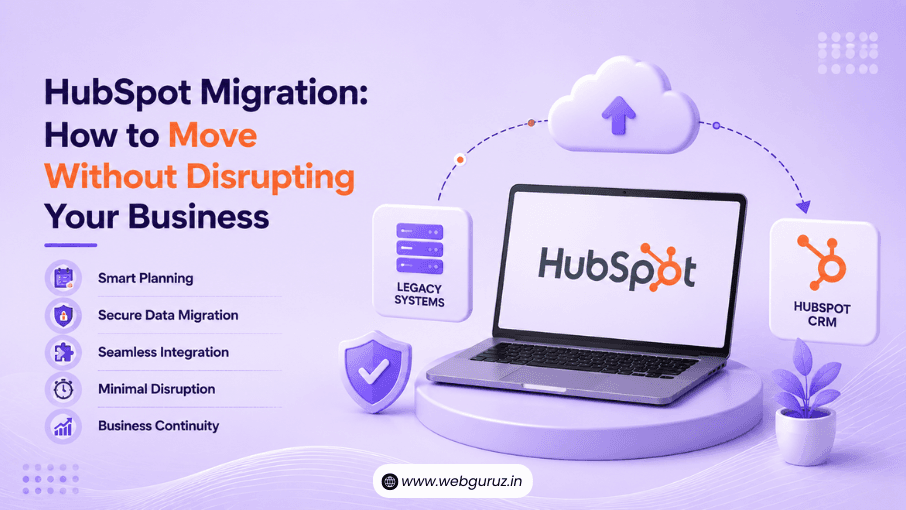
As businesses grow, the systems they rely on often struggle to keep up. Customer data becomes scattered, teams begin using different tools, reporting takes longer, and everyday tasks become more complicated than they should. At that point, many organizations realize it’s time for a HubSpot Migration.
But moving to a new platform isn’t simply about transferring contacts and records. A successful migration is an opportunity to improve how your business operates, connect your teams, and create a system that supports future growth. With the right planning, businesses can make the transition smoothly while minimizing disruption for employees and customers.
One of the biggest mistakes businesses make is treating migration as a technical project instead of a business project.
Before moving any data, ask yourself why you’re making the change. Are your teams working in separate systems? Is reporting becoming difficult? Are manual tasks slowing everyone down? Or has your business simply outgrown the way your current platform works?
Answering these questions first helps you build a migration plan that solves real business problems instead of simply replacing one system with another.
No two businesses have the same processes, goals, or technology stack, so no two migration projects should follow the exact same approach.
For example, a Salesforce to HubSpot Migration often involves preserving complex sales pipelines, custom objects, and historical customer data while simplifying everyday CRM management. Another business may have completely different priorities depending on its existing systems and future goals.
Instead of copying every workflow into HubSpot, use migration as an opportunity to remove unnecessary complexity and improve the way your teams work together.
Migrating outdated or inaccurate information into a new CRM only carries existing problems into a new platform. So, before you begin migrating, review your customer records carefully. Remove duplicate contacts, archive outdated information, standardize naming conventions, and verify important customer details. Starting with clean data improves reporting, strengthens automation, and gives your teams greater confidence in the new system from day one.
This preparation may take extra time, but it often prevents far bigger problems after launch. Many businesses believe migration is complete once customer records appear inside HubSpot.
In reality, data transfer is only one part of the project.
| Migration Stage | Primary Focus | Why It Matters |
|---|---|---|
| Planning | Define business goals. | Keeps the project focused on outcomes. |
| Data Preparation | Review and clean records. | Improves reporting accuracy. |
| System Setup | Configure pipelines and workflows. | Supports your current business processes. |
| User Training | Prepare employees before launch. | Increases adoption and confidence. |
| Testing | Validate data and automations. | Identifies issues before go-live. |
| Optimization | Review and improve continuously. | Keeps HubSpot aligned with business growth. |
Looking at migration this way helps businesses build a platform that supports long-term success rather than simply replacing old software.

For many businesses, migration isn’t limited to customer records. The website also plays an important role in marketing, lead generation, and customer experience.
A HubSpot CMS Migration allows businesses to bring their website, CRM, and marketing tools together on one connected platform. Managing everything in one place makes it easier to publish content, track performance, and give both marketing and sales teams access to the same information.
Many organizations also choose a WordPress to HubSpot Content Hub Migration when they want a more connected content management experience. Instead of managing separate systems, they can create, publish, and measure content from within the same platform that powers their CRM.
Moving to HubSpot doesn’t mean replacing every tool your business already uses. Most growing organizations rely on multiple platforms for finance, operations, customer support, or inventory management, and those systems still need to work together after migration.
Planning integrations early prevents data silos and reduces manual work. For businesses that rely on Microsoft Dynamics 365 Integration, it’s important to map how information will flow between platforms before migration begins. A connected technology stack ensures every team has access to accurate, up-to-date information without constantly switching between systems.
Every business has its own sales process, approval workflows, reporting requirements, and customer journey. Simply recreating your old CRM inside HubSpot often means carrying old inefficiencies into a new platform.
This is why many organizations invest in HubSpot Development after migration. Instead of copying existing processes, they use the opportunity to build custom properties, automate repetitive tasks, create meaningful dashboards, and configure workflows that reflect how the business operates today.
Migration shouldn’t just modernize your software; it should improve the way your teams work every day.

The right migration approach depends on the systems your business already uses and the challenges you’re trying to solve.
For example, a Zoho to HubSpot Migration may focus on bringing sales, marketing, and customer data into one centralized CRM while simplifying day-to-day operations. Another organization may have completely different priorities depending on its existing workflows, reporting needs, and growth plans.
Rather than following a standard migration template, businesses achieve better results when they build a strategy around their own processes and long-term objectives.
Many businesses discover that migration is the perfect time to simplify their customer database and improve how information is managed.
A well-planned HubSpot CRM Migration goes beyond moving contacts and companies. It includes reviewing pipelines, cleaning historical data, organizing custom properties, and ensuring every team works from the same reliable source of information. Starting with a structured CRM makes reporting more accurate and future automation much easier to manage.
Even with careful planning, migration projects involve many moving parts. Data mapping, workflow configuration, user permissions, testing, and employee adoption all need to come together for the project to succeed.
Working with an experienced HubSpot Migration Partner helps businesses reduce risk throughout the process. From planning and testing to post-launch support, an experienced partner can identify potential issues early and ensure the migration supports long-term business goals rather than simply completing a technical transfer.

Launching HubSpot is an important milestone, but it’s not the end of the journey.
After migration, businesses should continue reviewing workflows, gathering employee feedback, monitoring reports, and refining processes as teams become familiar with the platform. Small improvements made during the first few months often have the biggest impact on long-term adoption and productivity.
Organizations planning a Freshworks to HubSpot Migration often use this post-launch period to optimize automations, improve reporting, and streamline customer management as their teams become comfortable with the new platform.
A successful HubSpot Migration is about much more than transferring data from one platform to another. It’s an opportunity to simplify processes, improve data quality, connect business systems, and create a stronger foundation for future growth.
Whether you’re migrating your CRM, modernizing your website, or connecting the rest of your technology stack, success depends on thoughtful planning rather than rushing the process. Businesses that take the time to prepare, clean their data, train their teams, and optimize their workflows are far more likely to achieve lasting value from their investment.
The timeline depends on factors such as data volume, customizations, integrations, and the complexity of your existing systems. While smaller projects may take a few weeks, larger migrations often require additional planning, testing, and user training.
Yes. Businesses migrate to HubSpot from many different CRM platforms. The migration process varies depending on your existing setup, business requirements, and the amount of data that needs to be transferred.
HubSpot CRM Migration focuses on moving customer records, pipelines, workflows, and sales processes. HubSpot CMS Migration involves transferring your website, blogs, pages, and digital content to HubSpot’s content management platform.
Cleaning your data before migration helps remove duplicate records, improve reporting accuracy, strengthen automation, and ensure your team starts with reliable information inside HubSpot.
A migration partner helps plan, manage, and validate every stage of the project—from data preparation and system configuration to testing and post-launch support—helping reduce disruption and improve long-term adoption.

Vedanshi
2026-10-19
7 min read
More buyers now ask ChatGPT, Gemini, Perplexity, or Google AI Mode for recommendations before they ever visit a website.
Read More
Vedanshi
2026-10-15
7 min read
A growing share of buyers now get their first answer from ChatGPT, Google AI Mode, Perplexity, or Copilot instead of a list of links.
Read More
Vedanshi
2026-10-14
7 min read
Your HubSpot integration may be working perfectly right now. Data syncs, contacts update, and business workflows run as expected.
Read More