 sales@webguruz.in
 +1 (213) 715-5368
Vedanshi
2026-10-09
7 min read
How to Use HubSpot AI Agents to Automate Sales, Marketing, and Customer Support
A sales team spends hours researching prospects. Marketing repeats the same tasks across campaigns.
Read More
Published On:2026-09-09
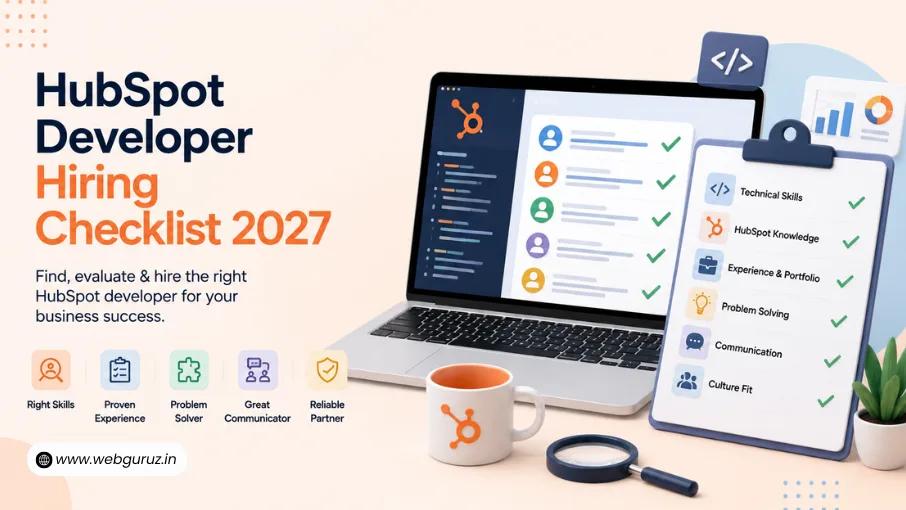
Hiring a HubSpot developer used to be a fairly straightforward process. You looked for someone who understood HubSpot, knew how to work with APIs and CRM data, had experience with custom development, and ideally held relevant certifications.
That checklist is no longer enough.
As we move into 2027, HubSpot development is becoming more closely connected to AI, automation, custom CRM experiences, integrations, and increasingly sophisticated ways of working with the platform. HubSpot’s current developer ecosystem already includes APIs, CLI-based development, React, custom objects, custom-coded actions, custom cards, and tools designed around AI-assisted development.
That changes what businesses should look for when hiring a HubSpot developer.
A certification can show that someone has invested in learning the platform. It does not, by itself, tell you whether they can architect a complex CRM solution, troubleshoot an integration, build a scalable CMS experience, work with modern development tools, or make sensible decisions about where AI should and shouldn’t be used.
So if you’re planning a HubSpot project for 2027 and beyond, this guide will help you find your best HubSpot environment for your business needs.
In this blog we will discuss:
Before posting a job description or contacting an agency, start with the problem you’re trying to solve.
Not every HubSpot project requires custom development. Some can be handled through native configuration, HubSpot Consulting Services, onboarding, or standard automation. Others require someone who can work at a much deeper technical level.
For example, you may need a developer if you’re dealing with:
HubSpot’s own developer training reflects this broader scope. Its CRM customization program covers custom objects, associations, custom-coded actions, and custom cards, while its integration training focuses on APIs and extending HubSpot’s CRM and Hubs.

The definition of HubSpot Development has expanded considerably. A modern developer may work across the CRM, CMS, integrations, automation, applications, and custom user experiences rather than focusing on one isolated part of the platform.
A developer should be comfortable working with the underlying CRM structure, not just changing fields or building basic workflows. That can include custom objects, associations, custom cards, custom-coded actions, and other extensions that allow businesses to adapt HubSpot around their processes. HubSpot’s current developer training specifically identifies these as core areas of CRM customization.
If HubSpot needs to exchange information with your ERP, billing platform, data warehouse, website, internal application, or another CRM, technical integration skills become essential.
HubSpot’s own integration curriculum highlights familiarity with the CRM, its Hubs, and API endpoints as foundational to building quality integrations. A capable developer should also understand authentication, data structures, error handling, and how to troubleshoot an integration when something inevitably goes wrong.
Native automation can handle a lot. But businesses sometimes reach a point where standard functionality doesn’t quite match the process they need.
That’s where HubSpot Automation Services, custom-coded actions, APIs, and more advanced workflow logic can become relevant.
The important question isn’t whether a developer can build an automation.
It’s whether they know when custom development is actually necessary.
For businesses using HubSpot for their website, a developer may also be responsible for custom modules, templates, themes, components, and other CMS functionality.
That means HubSpot CMS Developmentshould be evaluated separately from general CRM knowledge.
A developer who is excellent at CRM integrations isn’t automatically the right person to build a sophisticated CMS experience.
A strong portfolio can tell you what a developer has built. The right questions can tell you how they think.
Start with how they approach HubSpot Onboarding. A strong developer should understand that good development begins with understanding the existing setup, business processes, users, and technical requirements before writing any code.
From there, test across these areas:
| What to evaluate | What you should look for |
|---|---|
| CRM architecture | Understands objects, properties, associations, permissions, and data structure |
| Development skills | Can work with APIs, custom code, integrations, and modern development tools |
| Automation | Knows when native workflows are enough and when custom development is justified |
| CMS | Can handle custom modules, themes, templates, and modern CMS development |
| Migration | Has experience moving or restructuring data without compromising its integrity |
| AI readiness | Understands AI-assisted development, agent tools, MCP, security, and human oversight |
| Maintenance | Plans for testing, documentation, version changes, and long-term support |
That last point matters more than it might seem. HubSpot now uses date-based API versioning, with new versions released on a six-month cycle and supported for 18 months. Existing v4 APIs are scheduled to become unsupported on March 30, 2027.
So in 2027, a developer who can build something that works today but can’t plan for platform changes may create a technical problem rather than solve one.
AI is no longer something a HubSpot developer can simply ignore. HubSpot’s current developer platform includes Breeze Agent Tools and MCP, while its Developer MCP Server allows developers to work with AI coding tools to create apps, CMS assets, and serverless functions and troubleshoot development work. This shift toward HubSpot AI-powered solutions is reshaping what developers are expected to know, not just what they’re expected to build.
That doesn’t mean AI replaces development expertise. It makes technical judgment more important.
When hiring, ask how the developer uses AI in their workflow. Can they use it to speed up repetitive work while still reviewing the code, testing the result, protecting sensitive data, and making architectural decisions themselves?
A good developer should be able to tell you where AI helps, where it creates risk, and where human judgment still needs to lead.

Not every HubSpot project requires a full-time developer.
If you need help designing your CRM strategy, HubSpot Consulting Services may be more appropriate. If you’re setting up a new portal, HubSpot Implementation may cover much of what you need. If you’re connecting systems, rebuilding your CMS, migrating data, or creating custom functionality, development expertise becomes more important.
For larger projects, combining these capabilities can make more sense than expecting one person to handle strategy, architecture, development, migration, and ongoing optimization alone.
The right choice depends on the complexity of the problem, not simply the size of your budget.
Once you know what kind of expertise you need, the next question is where to look.
HubSpot’s own Solutions Directory is a reasonable starting point. It lists certified partners and developers who’ve been vetted by HubSpot directly, and you can filter by specialty and location.
Freelance platforms work well for smaller, well-defined projects, a specific integration, a CMS fix, or a one-off build. They’re less reliable for ongoing work or anything that requires deep familiarity with your business over time.
Agencies and development partners make more sense when a project spans multiple areas: CRM architecture, integrations, CMS, and AI-assisted workflows all at once. Migration projects are a good example: HubSpot migration services usually require more coordination than a single-person build can reasonably handle.
For longer-term, high-complexity needs, an in-house developer offers the deepest alignment with your business, but it’s also the slowest and most expensive path to fill.
None of these sources replace the evaluation work. Wherever you find a candidate, the same questions apply: what have they built, how do they think through a problem, and how do they use AI without depending on it blindly?
Be cautious if a candidate:
A good services partner should be able to explain technical decisions in business terms, not just show you technical features.

The best Hubspot CRM Developers aren’t simply people who know how to customize HubSpot. They’re people who understand how your business works, how HubSpot’s technology works, and how those two need to evolve together.
Look for someone who can work across CRM architecture, automation, integrations, CMS development, migration, and AI-enabled capabilities while still knowing when not to build something custom.
Before You Hire, Ask These Five Questions
If a developer can answer those questions clearly, you’re learning much more than a list of certifications could tell you.
By 2027, hiring a certified HubSpot developer is no longer simply about finding someone who knows the platform.
It’s about finding someone who can build for where the platform is going.
HubSpot’s move toward AI-ready development, agent tools, MCP, modern projects, and data-based APIs means the technical bar is changing.
The right HubSpot Services should therefore bring more than certification. They should bring strong development fundamentals, CRM understanding, business awareness, adaptability, and the judgment to use AI without depending on it blindly.
Choose for what your HubSpot environment needs next, not just what it needs today.
A certified HubSpot developer builds and customizes things inside HubSpot. That can mean setting up your CRM, connecting HubSpot to other tools, building custom features, or working on your website inside HubSpot’s CMS.
Not really. A certification shows someone learned the basics. It doesn’t show you they can solve real problems, fix a broken integration, or use AI tools the right way. You still need to check their actual project experience.
It depends on what you need. If you need help planning your CRM strategy, a consultant is usually the better fit. If you need custom code, integrations, or CMS work built, that’s when you need a developer.
There’s no magic number of years. What matters more is whether they’ve done work like yours before. Ask about their real projects, not just how long they’ve used HubSpot.
Yes, more and more. HubSpot now has AI tools built into its platform. A good developer should know how to use AI to work faster, but they should still check the code themselves and make the final calls.
Vedanshi
2026-10-09
7 min read
A sales team spends hours researching prospects. Marketing repeats the same tasks across campaigns.
Read More
Vedanshi
2026-10-07
7 min read
HubSpot UNBOUND 2026 sent a clear message to businesses: growth is becoming more connected.
Read More
Vedanshi
2026-10-07
7 min read
For years, ranking on Google’s first page was one of the clearest goals in search marketing. But search is no longer limited to a list of blue links.
Read More