 sales@webguruz.in
 +1 (213) 715-5368
Vedanshi
2026-10-09
7 min read
How to Use HubSpot AI Agents to Automate Sales, Marketing, and Customer Support
A sales team spends hours researching prospects. Marketing repeats the same tasks across campaigns.
Read More
Published On:2026-08-18
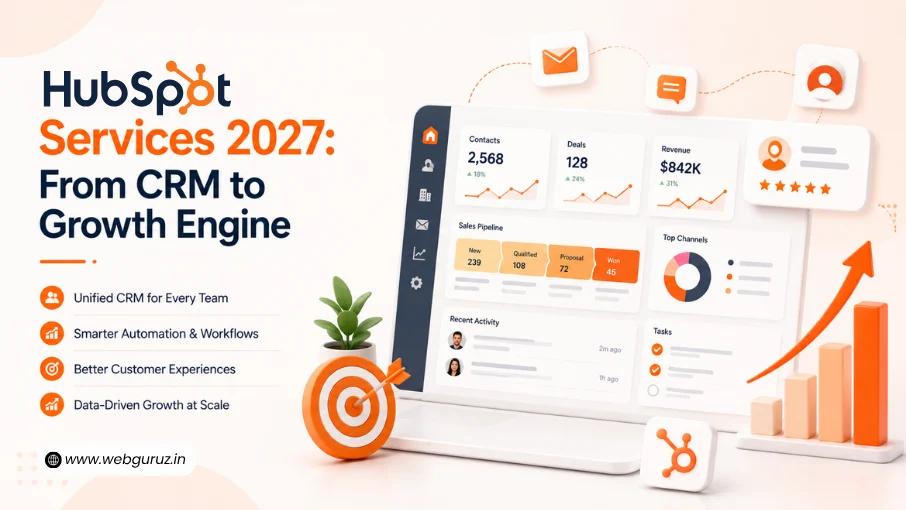
A CRM was once viewed as a place to store contacts, track deals, and manage customer information. For many businesses, that was enough.
It won’t be enough in 2027. Customer expectations are evolving faster than ever. Buyers expect personalized experiences, sales teams need real-time insights, marketers rely on automation, and business leaders want accurate forecasting backed by connected data. At the same time, artificial intelligence is transforming how businesses attract, engage, and retain customers.
This shift is redefining what businesses should expect from HubSpot Services. Instead of simply implementing a CRM, organizations are building connected systems where marketing, sales, service, content, and AI work together to improve every stage of the customer journey.
The businesses that succeed over the next few years won’t be those with the most software. They’ll be the ones with the smartest systems.
One of the biggest misconceptions businesses still have is that a CRM exists to record what has already happened.
That’s no longer true.
Modern CRM platforms are becoming intelligent business systems that help teams decide what should happen next. Rather than simply storing customer information, they analyze interactions, identify opportunities, automate repetitive work, and help every department make better decisions from the same source of truth.
This evolution is changing how organizations approach HubSpot Consulting Services. Instead of asking, “How do we implement HubSpot?“, businesses are beginning to ask a much more valuable question:
“How do we build a system that helps every team work smarter?”
That shift in thinking often determines whether a CRM becomes another piece of software or a genuine driver of business growth.
Many businesses think they need more leads. But the real problem often starts after the leads come in.
Marketing, sales, and customer service all keep different information, while leadership pulls reports from different systems. Each team may work well alone, but when the data isn’t connected, the business struggles.
As AI becomes a bigger part of everyday business, disconnected data becomes an even greater obstacle. AI can only deliver meaningful insights when it has access to complete, accurate, and unified customer information. That’s why modern CRM strategies are shifting away from isolated tools and toward connected platforms that support the entire customer lifecycle. HubSpot has similarly highlighted unified customer data as the foundation for effective AI, enabling personalization, forecasting, and cross-functional collaboration.
For many growing organizations, this is where HubSpot Development becomes increasingly valuable. Instead of adapting business processes to fit disconnected software, businesses can build a CRM environment that reflects how their teams actually work, making it easier to automate processes, improve collaboration, and scale operations.

Every growing business reaches a point where leads increase, customer needs grow, and processes get harder to manage. Teams end up spending more time managing systems than building relationships. Hiring more people may help, but it doesn’t solve the real problem.
By 2027, businesses will increasingly rely on automation not simply to save time, but to improve decision-making across marketing, sales, and customer service. AI-powered workflows can prioritize leads, trigger follow-ups, assign tasks, surface buying signals, and recommend next steps before teams even realize action is needed. HubSpot’s recent AI roadmap reflects this broader move from content generation toward embedded automation, CRM intelligence, and AI-assisted workflows across the customer journey.
Organizations investing in HubSpot Automation Solutions are preparing for this shift by reducing repetitive work while enabling employees to focus on strategy, customer relationships, and business growth.
Technology has never been more powerful, yet many businesses still struggle with disconnected data, systems, and teams. The competitive advantage won’t come from adding more technology but from connecting what businesses already have.
HubSpot is evolving in this direction, bringing customer data, automation, personalization, and AI together on one platform.
So what does a future-ready CRM actually look like? Based on these shifts, a 2027-ready CRM can be understood through six key areas:
| Area | Traditional CRM Approach | 2027-Ready CRM Approach |
|---|---|---|
| Data | Stored | Connected + governed |
| Automation | Task-based | Context-aware |
| AI | Add-on | Embedded |
| Website | Lead generation | CRM-connected experience |
| Reporting | Historical | Predictive + actionable |
| Optimization | Occasional | Continuous |
The key takeaway is simple: being ready for 2027 doesn’t mean having the most advanced CRM. It means having a CRM that can connect data, understand context, support people, and continuously adapt as the business changes.
Many businesses delay moving to a new CRM because they see migration as a technical exercise.
In reality, it’s a business transformation.
Outdated systems, duplicate customer records, disconnected applications, and manual processes don’t just slow operations; they limit a company’s ability to grow. As AI becomes more dependent on clean, connected data, these legacy challenges become even more expensive to ignore. Industry trends increasingly point toward unified customer platforms because AI delivers better results when it has complete business context rather than fragmented information.
This is why HubSpot Migration Services are becoming about far more than just transferring data. They help businesses redesign processes, connect teams, and create a stronger foundation for automation, reporting, and AI-driven decision-making.

For years, websites and CRMs have often been managed as separate systems.
By 2027, that approach will become increasingly inefficient. Businesses will need websites that don’t simply generate leads but actively support the customer journey through personalized experiences, dynamic content, and seamless data flow. As AI continues to personalize digital experiences, the connection between a website and CRM will become a competitive advantage rather than a convenience.
Organizations investing in HubSpot CMS Development are preparing for this shift by creating websites that work as an extension of their CRM instead of operating independently.
One of the biggest reasons CRM projects underperform is adoption. Even the most advanced platform delivers limited value if employees don’t understand how to use it, workflows don’t reflect day-to-day operations, or teams continue relying on old habits.
Successful businesses recognize that technology alone doesn’t drive transformation; people do.
That’s why HubSpot Onboarding has become an essential part of long-term CRM success. Proper onboarding helps every department understand how the platform supports their role, increases user adoption, and creates consistency across marketing, sales, and customer service from the very beginning.
Launching a CRM shouldn’t be viewed as the finish line. It should be the starting point because:
A CRM that isn’t reviewed regularly gradually becomes less effective, even if it worked perfectly when it was first implemented.
This is where HubSpot Audit Services provide long-term value. Regular audits help businesses identify outdated workflows, improve data quality, optimize automation, and ensure the platform continues supporting changing business objectives instead of slowing them down.
When businesses evaluate new technology, the first question is often:
“How much will it cost?”
But the real value of a CRM isn’t measured by subscription fees. It’s measured by faster sales cycles, improved customer retention, better forecasting, increased productivity, and stronger collaboration across teams.
Tools like the HubSpot ROI Calculator help businesses evaluate these long-term gains by comparing technology investments with measurable business outcomes, making it easier to justify strategic decisions instead of focusing only on upfront costs.

Artificial intelligence is transforming CRM, but AI isn’t replacing strategy. It’s amplifying it.
AI can recommend next steps, summarize customer conversations, predict opportunities, and automate repetitive work. However, its recommendations are only as reliable as the information it receives.
That’s why HubSpot AI-Powered Solutions are built around connected customer data rather than isolated AI features. Recent HubSpot updates continue to emphasize that AI performs best when it operates on unified customer profiles, clean data, and connected business processes instead of disconnected applications.
The businesses that gain the greatest advantage from AI won’t simply adopt new tools. They’ll create an environment where every interaction, workflow, and customer record contributes to smarter decision-making across the organization.
The CRM strategies that helped businesses grow over the past decade won’t be enough for the decade ahead.
By 2027, businesses will need more than a system for storing customer information. They’ll need connected platforms that bring together marketing, sales, service, content, automation, and AI to create a seamless customer experience.
Organizations that begin preparing today will be better positioned to adapt as customer expectations continue to evolve. Whether that means modernizing outdated systems, adopting HubSpot marketing automation, connecting business data, or building AI-ready workflows, the goal remains the same: creating a smarter, more agile business.
The future of CRM isn’t about adding more software. It’s about building a connected business where technology empowers people, decisions are driven by trusted data, and every customer interaction creates an opportunity for growth.
Customer expectations, AI adoption, and connected business operations are evolving rapidly. Businesses will need CRM platforms that support automation, unified customer data, personalization, and collaboration across every department.
HubSpot Services help organizations build connected systems by combining CRM, marketing, sales, customer service, content management, automation, and AI into one platform that supports long-term business growth.
Businesses should consider migrating when their current CRM limits productivity, creates disconnected customer data, or makes it difficult to scale operations and adopt AI-driven workflows.
Even the best CRM delivers limited value if teams don’t use it consistently. Proper onboarding, training, and continuous optimization ensure employees adopt the platform and use it effectively.
AI is helping businesses automate routine work, generate insights, improve forecasting, and personalize customer experiences. However, these benefits depend on having accurate, connected customer data that AI can trust.
Vedanshi
2026-10-09
7 min read
A sales team spends hours researching prospects. Marketing repeats the same tasks across campaigns.
Read More
Vedanshi
2026-10-07
7 min read
HubSpot UNBOUND 2026 sent a clear message to businesses: growth is becoming more connected.
Read More
Vedanshi
2026-10-07
7 min read
For years, ranking on Google’s first page was one of the clearest goals in search marketing. But search is no longer limited to a list of blue links.
Read More