 sales@webguruz.in
 +1 (213) 715-5368
Vedanshi
2026-10-23
7 min read
Custom HubSpot Integrations: Benefits, Examples, and Best Practices
Your business uses HubSpot to manage customer relationships, but disconnected systems create data issues.
Read More
Published On:2026-01-30
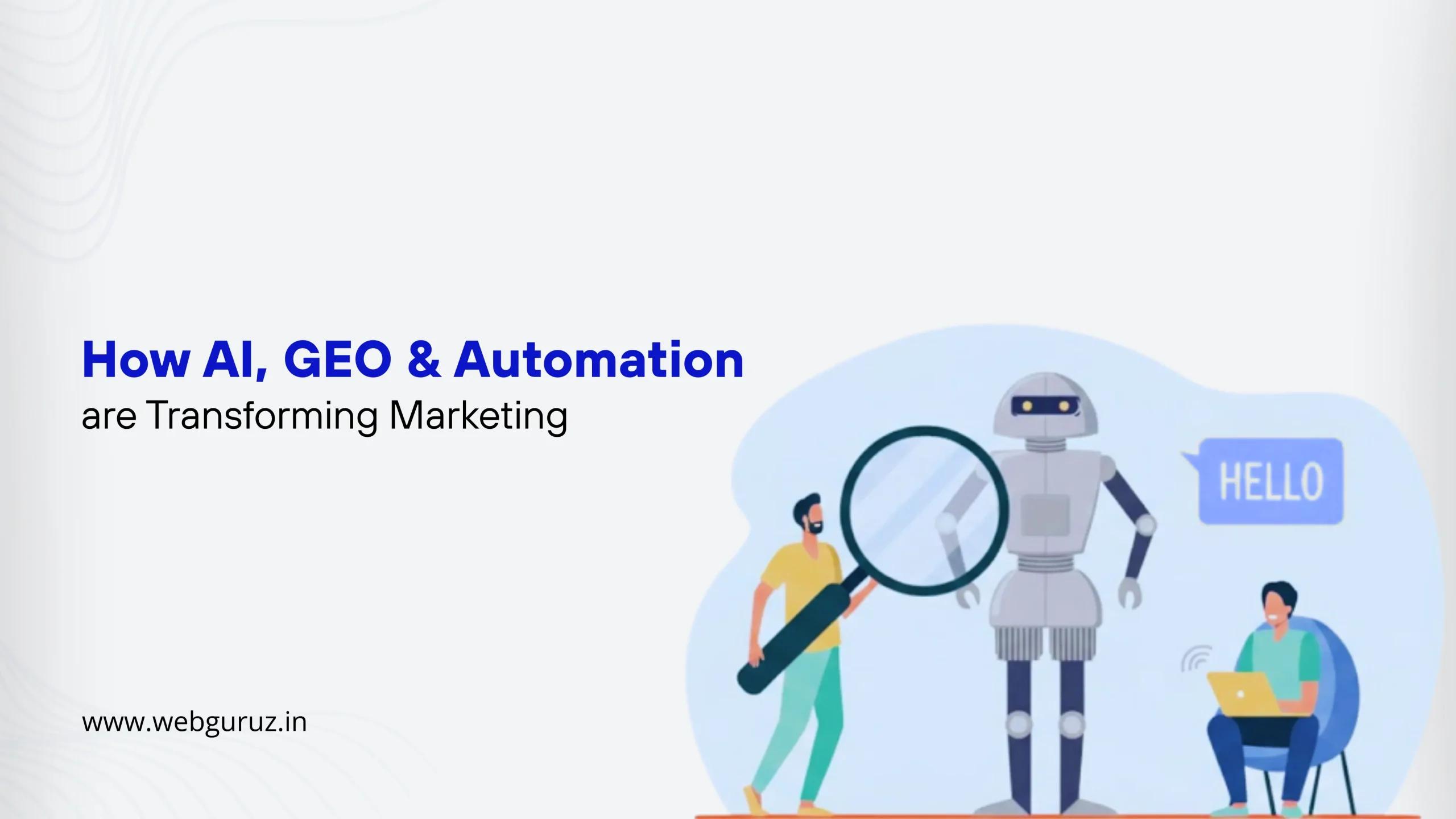
Marketing used to rely heavily on intuition and creative instinct. Campaigns were launched, results were awaited, and optimizations happened after the fact. That approach no longer works.
Today’s fastest-growing brands are using AI, Marketing Automation, and Generative Engine Optimization (GEO) to reshape how they attract, engage, and convert customers. Together, these technologies are not just improving efficiency; they’re redefining how marketing works.
Let’s break down what’s actually changing and why it matters.
Artificial intelligence isn’t about replacing marketers; it’s about enhancing decision-making at scale.
Modern marketing generates massive amounts of data, including website behavior, email engagement, social interactions, purchase history, and customer feedback. Humans can’t analyze all of this in real time. AI can.
That’s why more businesses are adopting AI integration solutions to improve performance across channels.Practical use cases include:
Instead of sending one generic campaign, AI allows marketers to adjust messaging, timing, and format for each user automatically.
Brands seeing real ROI from AI aren’t using it as a gimmick. They’re using it to make faster, smarter decisions and deliver personalization that simply wasn’t possible before.
Marketing automation has existed for years, but Marketing Automation Solutions have evolved far beyond basic email sequences.
Today, automation creates systems that operate continuously, such as nurturing leads, qualifying prospects, and moving users through the funnel without manual effort.
Here’s a common scenario:
A visitor downloads a guide. Automation triggers a welcome email, follows up with educational content, delivers a case study, and later sends a targeted offer. All of this happens automatically once the system is in place.
Modern Marketing Automation now includes:
The real benefit isn’t just efficiency; it’s consistency. Every prospect receives your best message at the right time, regardless of volume.
Companies using advanced automation regularly report saving 10–15 hours per week, freeing teams to focus on strategy, creativity, and growth.
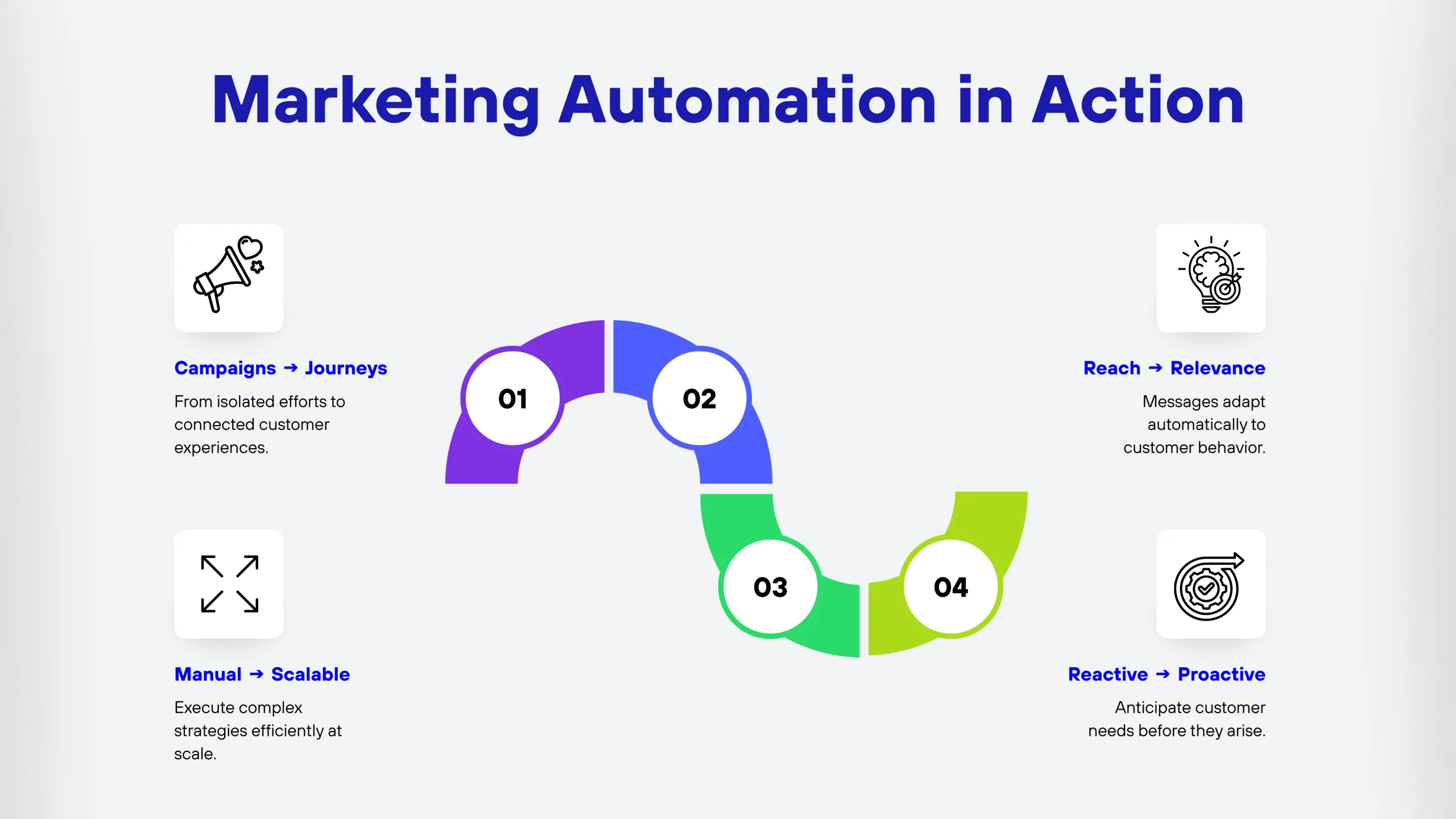
Marketing automation isn’t just improving workflows; it’s redefining digital marketing itself.
Traditional digital marketing depended on manual execution: launching campaigns, monitoring performance, and optimizing after results came in. Automation has flipped that model.
Today, Marketing Automation Solutions power always-on marketing, where campaigns respond to user behavior in real time across multiple channels.
This shift has changed digital marketing in several critical ways:
As a result, modern brands are building AI-driven digital marketing solutions that combine automation, data, and personalization into one scalable system.
Automation has become the backbone of effective digital marketing: connecting tools, channels, and customer data into a single operational framework.
Search behavior has changed dramatically.
Instead of typing short keywords into Google, users are now asking AI tools like ChatGPT or Perplexity detailed, conversational questions. They expect direct answers, not lists of links.
This shift is where GEO becomes essential.
GEO focuses on optimizing content so it appears in AI-generated responses, not just traditional search results. Unlike SEO, which emphasizes keywords and backlinks, Generative Engine Optimization prioritizes:
Brands are now using Generative Engine Optimization tools to analyze whether their content is being surfaced by AI engines and how it’s interpreted.
Think of GEO as the next evolution of search visibility. Google still matters, but AI-powered search is growing fast. Brands optimizing for both gain a significant advantage.
Your audience isn’t limited to Google anymore.
They search on TikTok, Amazon, YouTube, ChatGPT, Pinterest, voice assistants, and platforms that didn’t exist a few years ago. This reality has led to Search Everywhere Optimization.
Search Everywhere Optimization means creating content designed for multiple discovery environments while maintaining a consistent brand message. Each platform has different formats, algorithms, and user intent.
Winning brands adapt content intelligently:
Visibility now depends on being present wherever customers look for answers, not just where marketers are comfortable publishing.
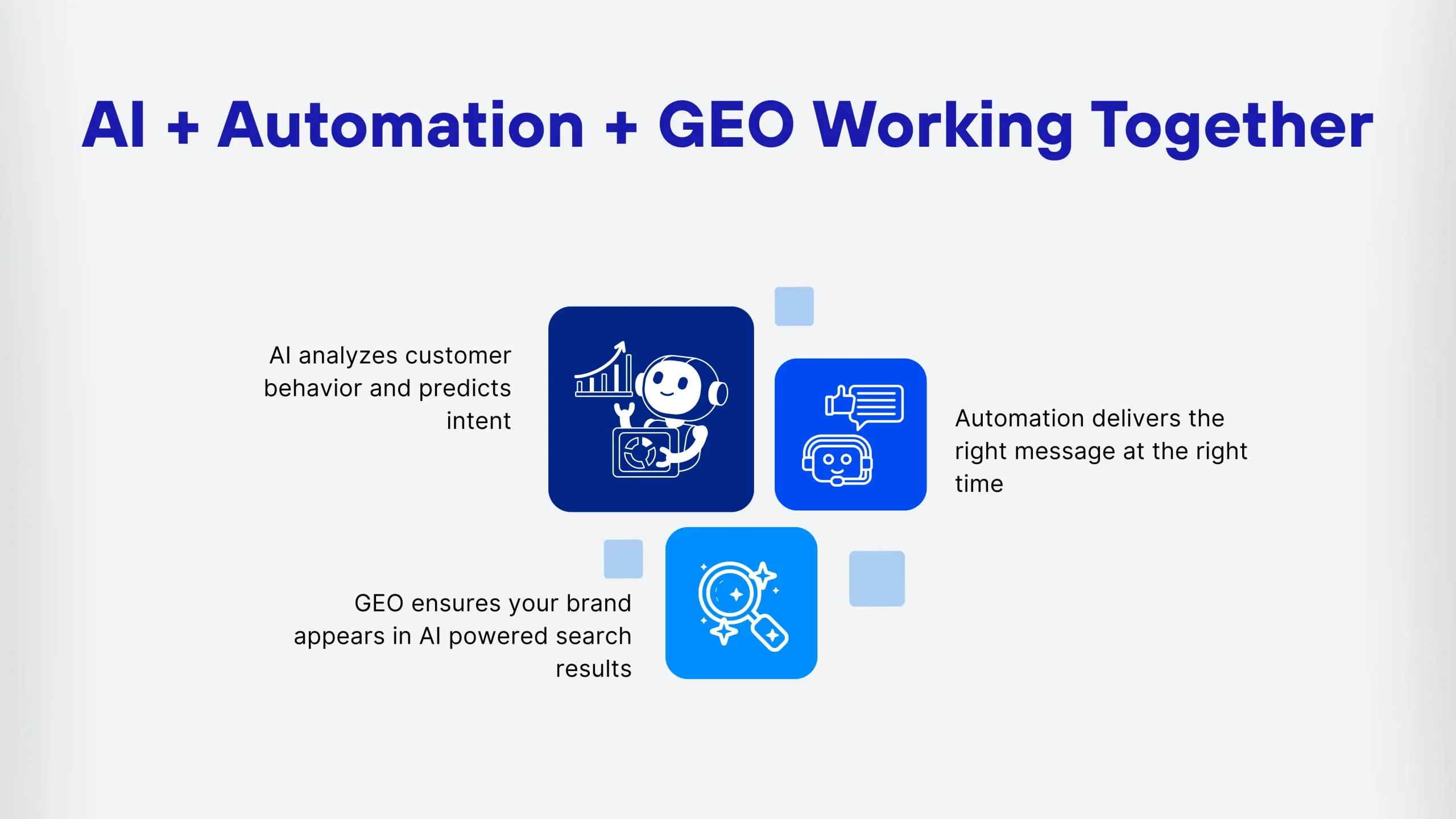
The real magic happens when you combine these three forces.
Imagine this scenario: Your AI system analyzes customer behavior and identifies a trend: people who buy Product A often search for information about Problem X three months later.
Your automation system springs into action, creating a targeted email sequence for everyone who buys Product A. Three months after purchase, they receive helpful content about Problem X, positioning your Product B as the solution.
Meanwhile, your GEO strategy ensures that when these customers ask AI chatbots about Problem X, your brand appears in the response with authoritative, helpful information.
This isn’t hypothetical. Smart marketers are building these integrated systems right now. Advanced AI integration solutions serve as the brain, analyzing data and making predictions. Sophisticated marketing automation solutions act as the hands, executing campaigns flawlessly. GEO ensures you’re visible wherever customers are looking for answers.
Content still matters, but expectations have changed.
Generic blogs written for keywords alone no longer perform. Modern visibility requires GEO-optimized Content Marketing Services that focus on depth, clarity, and trust.
Effective content today:
Content is no longer just for ranking; it’s for being referenced, cited, and trusted by generative engines.
You don’t need to implement everything at once.
The key is to start small, measure results, and build from there. You don’t need a massive budget or a technical team to begin.
Technology doesn’t replace human creativity; it amplifies it.
AI can analyze data and suggest approaches, but it takes human insight to understand what really matters to your customers. Automation can execute flawlessly, but humans need to design the strategy. GEO can get you visibility, but compelling storytelling still requires human creativity.
The marketers winning with these technologies aren’t the ones who let AI do everything. They’re the ones who use these tools to free up time for the work that truly requires human intelligence, such as strategy, creativity, relationship building, and innovation.
A: Not at all. Many platforms now include AI and automation features in their standard plans. You can start with free or low-cost tools and expand as you see results. The ROI often justifies larger investments later.
A: No. AI and automation handle repetitive tasks and data analysis, but they can’t replace human creativity, strategic thinking, or genuine relationship building. The most successful marketers use AI to handle the tedious stuff so they can focus on high-value creative and strategic work.
A: Traditional SEO focuses on ranking in search engine results pages like Google. GEO focuses on appearing in AI-generated responses from tools like ChatGPT or Perplexity. While SEO emphasizes keywords and backlinks, GEO prioritizes comprehensive, authoritative content that AI models can trust and cite.
A: Track metrics like time saved on manual tasks, email open and click rates, conversion rates through automated funnels, lead quality scores, and overall ROI. Compare performance before and after automation to see the impact.
A: Actually, you’re early! Most businesses haven’t started thinking about GEO yet. Starting now gives you a competitive advantage as more people shift to AI-powered search tools.
Vedanshi
2026-10-23
7 min read
Your business uses HubSpot to manage customer relationships, but disconnected systems create data issues.
Read More
Vedanshi
2026-10-22
7 min read
Ask ChatGPT, Gemini, or Perplexity to recommend a supplier or a software tool, and you get a short list of names, not ten blue links.
Read More
Vedanshi
2026-10-21
7 min read
Building a website takes more than picking colors, dropping in images, and writing copy.
Read More