 sales@webguruz.in
 +1 (213) 715-5368
Vedanshi
2026-10-23
7 min read
Custom HubSpot Integrations: Benefits, Examples, and Best Practices
Your business uses HubSpot to manage customer relationships, but disconnected systems create data issues.
Read More
Published On:2026-05-26
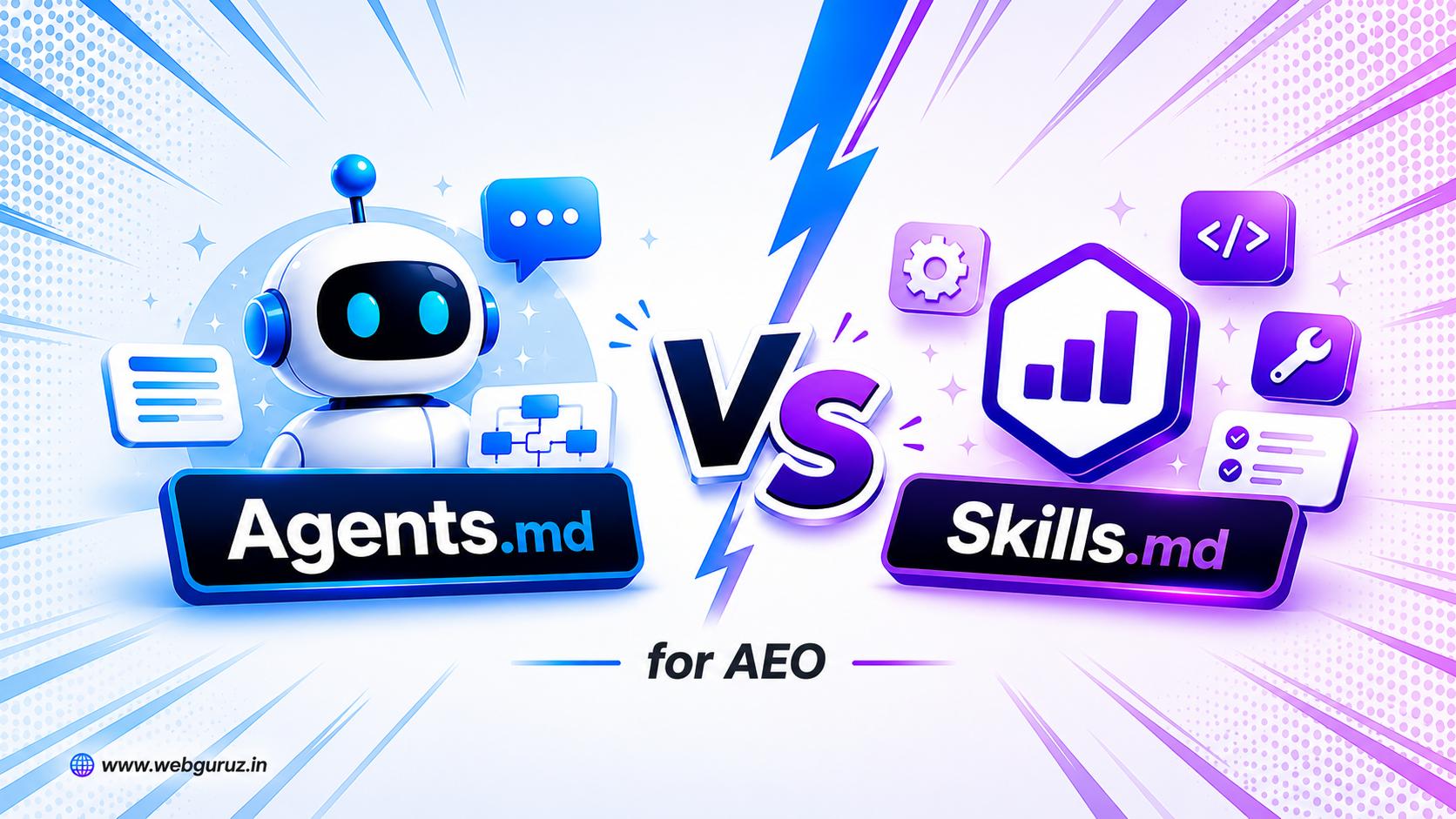
Search is no longer behaving the way businesses spent the last decade preparing for.
For years, digital visibility was built around a relatively stable formula: rank highly on Google, earn clicks, improve traffic, and convert visitors through landing pages and funnels. That model still matters, but it is no longer the full picture. Increasingly, users are discovering brands through AI-generated answers instead of traditional search results. They ask ChatGPT for software recommendations, use Perplexity for research, rely on Google’s AI Overviews for summaries, and interact with AI systems that synthesize information before a website visit ever happens.
This changes the nature of optimization entirely.
Traditional SEO was designed around helping search engines index pages. Modern Answer Engine Optimization (AEO) is increasingly about helping AI systems interpret expertise, capabilities, authority, and trustworthiness. In other words, visibility is shifting from pure ranking mechanics toward machine-readable understanding.
That is why concepts like Agents.md and Skills.md are beginning to attract attention in AI search discussions. While still emerging ideas, they point toward a broader transformation already underway: the movement from keyword-based discoverability to structured AI-readable ecosystems.
Most businesses have not adapted to this shift yet. They are still optimizing primarily for crawlers while AI systems are beginning to evaluate contextual understanding, semantic clarity, and operational intelligence. The gap between those two approaches is becoming increasingly important, especially as AI systems continue positioning themselves between brands and customers.
The question is no longer just whether your content can rank.
The real question is whether AI systems can understand what your business actually does and whether it deserves to be recommended.
Traditional search engines were built to retrieve information. AI systems are being built to interpret it.
That distinction sounds subtle, but it fundamentally changes how digital visibility works.
A traditional search engine evaluates relevance largely through ranking signals: keywords, backlinks, authority, technical health, and user engagement. AI-driven systems still consider many of those factors, but they operate differently. Instead of simply returning a list of pages, they attempt to synthesize answers, evaluate expertise, compare sources, and recommend outcomes.
This is why AI search experiences often feel conversational rather than navigational.
A user searching through Google in 2018 typically explored multiple links independently. A user asking ChatGPT or Perplexity a question in 2026 increasingly expects the AI system itself to deliver the answer. The AI becomes the intermediary between the business and the user.
That behavioral shift is already significant enough that Gartner predicts traditional search engine volume could decline by 25% by 2026 as users increasingly move toward AI chatbots and virtual agents instead of conventional search interfaces.
Businesses are no longer competing only for rankings. They are competing for interpretation, citation, and machine trust.
This is precisely where AEO begins separating itself from traditional SEO. Modern AI systems need more than webpages and metadata. They need semantic clarity. They need a structured context. They need to understand not only what a page says, but what a company specializes in, how its systems operate, and whether its expertise is credible enough to surface confidently inside generated responses.
That growing need for machine-readable understanding is what makes frameworks like Agents.md and Skills.md increasingly relevant in discussions around AI search optimization.
The transition toward AI-assisted discovery is not theoretical anymore. User behavior, platform adoption, and search mechanics are already shifting in measurable ways.
| Stat | What It Means |
|---|---|
| Gartner predicts traditional search engine volume could decline by 25% by 2026 because of AI chatbots and virtual agents | AI systems are changing how users discover information |
| Google AI Overviews have been linked to significant drops in click-through rates | Visibility now extends beyond website traffic |
| ChatGPT reportedly processes billions of prompts daily | Conversational AI is becoming a primary search layer |
| AI referral traffic to websites has grown rapidly over the past year | LLMs are becoming measurable traffic ecosystems |
| Businesses are increasing investment in AI SEO Tools and Generative Engine Optimization tools | Optimization priorities are shifting toward AI discoverability |
The important thing to understand about these numbers is that they point to something larger than changing traffic patterns. They signal a restructuring of the digital discovery process itself. AI systems are no longer acting as supporting tools layered on top of search engines. They are increasingly becoming discovery environments in their own right.
That means businesses need to optimize not just for visibility, but for AI interpretation.

To understand why Agents.md matters, it helps to look at where AI systems are heading next.
The current generation of AI search systems primarily retrieves and summarizes information. The next generation is moving toward execution. AI agents are beginning to compare products, navigate workflows, retrieve operational information, evaluate providers, and complete tasks on behalf of users. In that environment, AI systems require something far more sophisticated than webpage content alone.
They need operational understanding.
At a conceptual level, Agents.md represents an attempt to create machine-readable frameworks that explain how digital systems function and how AI agents can interact with them. Instead of simply describing information, these frameworks help AI systems interpret workflows, capabilities, integrations, permissions, and actions.
A useful comparison is robots.txt. Traditional robots.txt files helped search crawlers understand where they could or could not go on a website. Agents.md points toward a future where AI systems may need structured guidance not just for navigation, but for interaction.
This becomes particularly important in environments involving:
Imagine an AI assistant helping a user shortlist CRM implementation partners. Traditional SEO may help a company rank for “HubSpot onboarding services.” But future AI systems may also evaluate:
That requires a different kind of digital infrastructure entirely.
In many ways, Agents.md reflects the growing realization that AI systems increasingly need machine-readable operational intelligence, not just optimized content.

While Agents.md focuses more on operational behavior, Skills.md focuses on expertise, competencies, and specialization.
This distinction matters because modern AI systems are increasingly built around confidence-based retrieval. They do not simply attempt to find information. They attempt to determine which sources appear most authoritative and contextually trustworthy for a given task or question.
That requires an understanding of expertise at a deeper level.
Skills.md frameworks may eventually help define:
For example, a business specializing in generative AI services might define competencies around:
The value here is not just categorization. It is contextual clarity.
AI systems increasingly prioritize semantic understanding over simple keyword matching. They attempt to evaluate whether a source genuinely demonstrates expertise within a topic area rather than merely targeting relevant search terms. This is also why community-driven platforms have become far more influential in AI visibility strategies. Recent AI citation studies have shown Reddit and YouTube contributing more than 75% of social citations appearing inside AI-generated answers. That is why structured expertise frameworks are becoming more relevant within modern AEO conversations.
The rise of SEO AI Agents, AI SEO solutions, and broader GenAI Marketing ecosystems is accelerating this shift even further. AI systems are learning to evaluate not just what content says, but whether the underlying expertise appears coherent, consistent, and authoritative.
That changes what optimization looks like at a foundational level.
The easiest way to understand the relationship between Agents.md and Skills.md is to think of one as operational and the other as interpretive.
| Dimension | Agents.md | Skills.md |
|---|---|---|
| Primary Focus | Operational workflows | Expertise and competencies |
| Designed For | AI interaction systems | AI interpretation systems |
| Helps AI Understand | What actions are possible | What expertise exists |
| Best Use Case | Agentic execution | Semantic discoverability |
| Supports | Workflow interoperability | Contextual authority |
| Closest Analogy | Protocol layer | Expertise layer |
Neither framework replaces traditional SEO, and neither functions as a standalone visibility strategy. Instead, both reflect a broader evolution in how AI systems process information online.
Traditional SEO optimized webpages for indexing. Modern AEO increasingly optimizes businesses for interpretation.
That distinction is likely to become more important as AI-driven discovery continues evolving.
One of the most common misconceptions surrounding AI search optimization is the belief that AI visibility is simply traditional SEO combined with AI-generated content.
In reality, the businesses struggling most with AI discoverability are often the ones treating AI systems like slightly smarter search engines rather than entirely different retrieval environments.
|
Treating AI visibility like traditional rankings
Many organizations still focus entirely on keyword positioning while AI systems increasingly prioritize semantic understanding and contextual authority. |
Publishing AI-generated content without expertise
Thin, generic AI-written articles rarely establish the trust signals AI systems rely on for retrieval and citation. |
|
Ignoring semantic structure
AI systems interpret relationships between entities, topics, and expertise areas. Weak semantic organization creates confusion. |
Building only for crawlers
Traditional crawlers index pages. AI systems attempt to interpret meaning, credibility, and usefulness. |
|
Confusing automation with authority
Using AI tools alone does not create trustworthiness. Expertise still matters. |
Failing to create machine-readable clarity
Businesses often describe their services well for humans while remaining difficult for AI systems to interpret structurally. |
These issues become especially significant for businesses investing in:
Without strong structural clarity, visibility inside AI-driven search environments becomes unstable and inconsistent.
The deeper implication behind frameworks like Agents.md is what they suggest about the future direction of search itself.
Search is steadily moving beyond information retrieval and toward task execution.
AI agents are already beginning to:
That changes optimization priorities dramatically.
In an agentic ecosystem, businesses will increasingly need:
This is also why technical discussions around:
are becoming more common inside advanced AEO conversations.
Businesses that adapt early are likely to gain meaningful long-term advantages because AI visibility compounds over time. Systems trained to recognize authority and expertise tend to reinforce those signals repeatedly across retrieval environments.
The businesses AI systems trust first may eventually become the businesses users discover most often.

One of the biggest misunderstandings surrounding AI search is the belief that traditional SEO is somehow becoming obsolete.
The reality is much more nuanced.
AI systems still rely heavily on many of the same trust signals search engines have rewarded for years:
What is changing is the layer above those signals.
Traditional SEO helps AI systems find your content.
AEO helps AI systems understand your business.
That distinction is critical.
Businesses pursuing Answer Engine Optimization agency strategies without strong SEO foundations often struggle because AI systems still depend heavily on underlying authority signals. AI visibility is not replacing traditional optimization. It is extending it into new discovery environments.
The future is not SEO versus AEO.
It is SEO, GEO, and AEO functioning together as a connected visibility ecosystem.
The good news is that businesses do not need to completely rebuild their digital strategy overnight. But they do need to recognize that AI-assisted discovery is changing faster than most optimization playbooks are prepared for.
The organizations positioning themselves successfully right now are the ones strengthening both sides of the equation:
That means continuing to invest in technical SEO, topical depth, and expert-driven content while also preparing digital ecosystems for AI interpretation, semantic retrieval, and structured discoverability.
This is precisely where modern AI SEO strategies are evolving. The conversation is no longer limited to rankings and traffic alone. It now includes:
For businesses adopting AI SEO Tools, expanding AI content marketing efforts, or investing in Generative AI Services, the challenge is no longer simply producing content. It is building digital environments AI systems can confidently interpret and recommend.
That shift is exactly why frameworks like Agents.md are becoming increasingly important in modern AEO conversations. They reflect a broader realization that future visibility may depend not only on what businesses publish, but on how clearly AI systems can understand what those businesses are actually capable of.
And increasingly, the businesses AI systems understand best may become the businesses users discover first.
Agents.md is an emerging framework concept designed to help AI systems understand workflows, operational capabilities, and interaction structures within digital environments.
Skills.md focuses more on expertise, specialization, and competencies, while Agents.md focuses on operational workflows and AI interaction behavior.
No. AEO extends traditional SEO by helping AI systems better interpret and retrieve information inside conversational and generative search environments.
AI systems prioritize contextual understanding and semantic interpretation instead of relying only on keyword-based ranking signals.
SEO AI Agents are AI-driven systems that help automate optimization processes, analyze visibility patterns, and improve AI-assisted retrieval performance.
Businesses are investing in AI SEO solutions because AI-driven discovery systems are rapidly influencing how users research, compare, and choose products and services online.
Vedanshi
2026-10-23
7 min read
Your business uses HubSpot to manage customer relationships, but disconnected systems create data issues.
Read More
Vedanshi
2026-10-22
7 min read
Ask ChatGPT, Gemini, or Perplexity to recommend a supplier or a software tool, and you get a short list of names, not ten blue links.
Read More
Vedanshi
2026-10-21
7 min read
Building a website takes more than picking colors, dropping in images, and writing copy.
Read More