 sales@webguruz.in
 +1 (213) 715-5368
Vedanshi
2026-10-23
7 min read
Custom HubSpot Integrations: Benefits, Examples, and Best Practices
Your business uses HubSpot to manage customer relationships, but disconnected systems create data issues.
Read More
Published On:2026-05-08
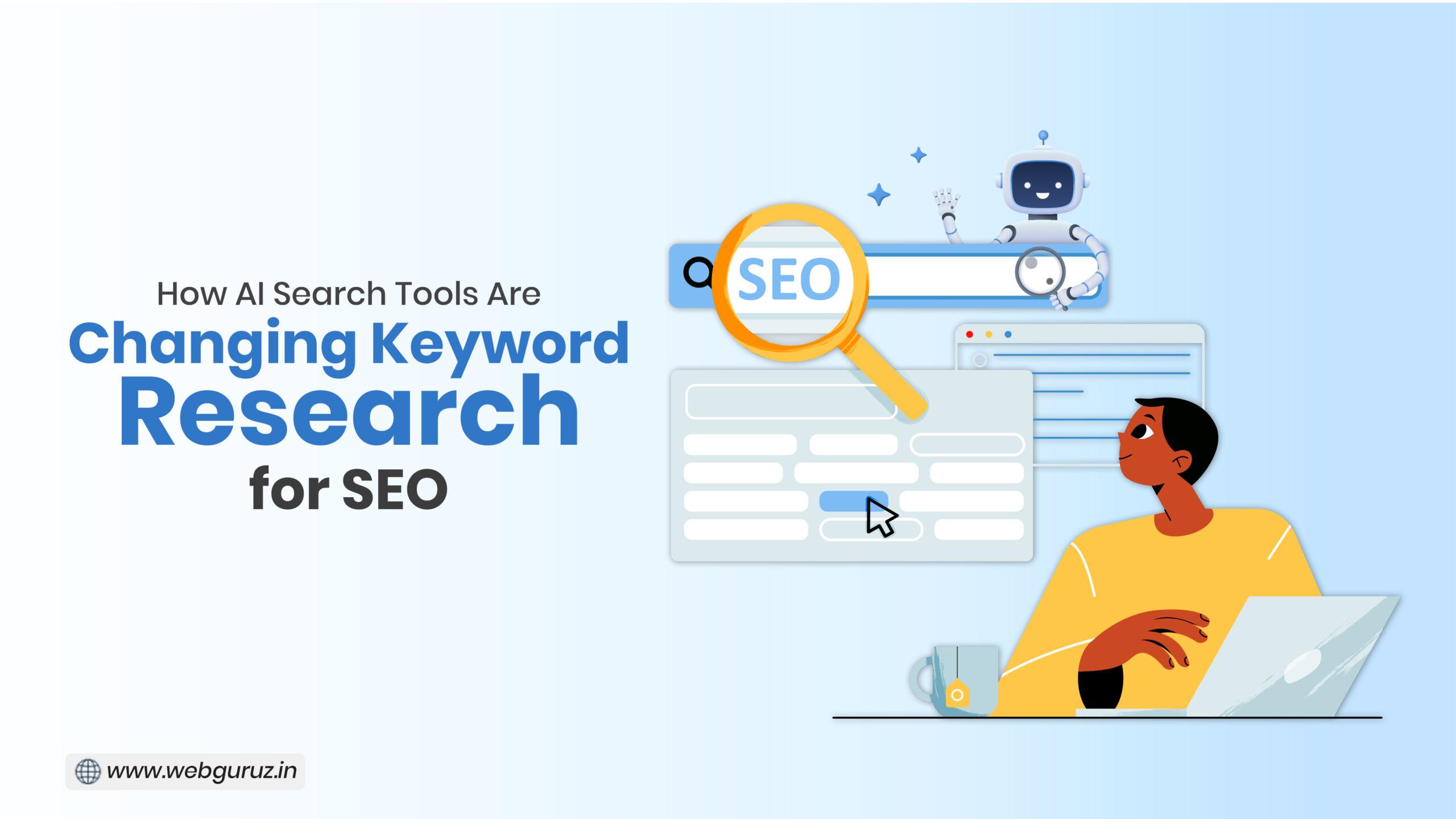
Keyword research used to be a fairly predictable discipline. You identified what your audience searched for, you checked the volume and competition data, and you built content around the terms that offered the best opportunity. Rank on page one, get the click, measure the traffic. Straightforward.
That model is not broken. But it is no longer complete.
For two decades, search engine optimization effectively meant Google optimization. That era ended in 2025. The search landscape has fractured into a multi-platform ecosystem where ChatGPT, Google Gemini, Perplexity, Claude, and Grok each serve distinct audiences and information-seeking behaviors, and where the question of how to do AI SEO effectively is no longer hypothetical. It is urgent.
This guide breaks down exactly what has changed, what the data actually shows, and what a genuinely updated keyword research and AI SEO strategy looks like in 2026.
Before strategy, the data. Because the scale of the shift in search behavior is not always obvious until you see it laid out.
| Signal | Statistic | Source |
|---|---|---|
| AI Overview presence | Appears in 25.11% of all Google searches | Conductor, Sep 2025 |
| CTR drops when AI overview is present (uncited) | 61% decline | Position. Digital, 2026 |
| CTR boost when cited in AI Overview | 35% higher than uncited competitors | Whitehat SEO, 2026 |
| ChatGPT weekly active users | 900 million | OpenAI, Feb 2026 |
| Zero-click AI search sessions | ~93% end without a website click | Superlines, 2026 |
| AI referral traffic share | 1.08% of all website traffic, growing ~1% MoM | Conductor, 2026 |
| AI visitor conversion rate vs organic | 4.4× higher on average | Semrush, 2026 |
| Content freshness impact on citations | Pages updated within 2 months earn 28% more citations | Superlines, 2026 |
| Cited URLs not in Google top 100 | ~80% of AI citations come from outside top 100 organic results | Ahrefs, Aug 2025 |
The last row deserves to sit in your head for a moment. Around 80 percent of URLs cited in AI-generated answers are not ranking in Google’s top 100 organic results. Traditional SEO performance is not a reliable predictor of AI SEO performance. They are overlapping but distinct disciplines.

Keyword research has not been replaced. But it has been expanded in three specific ways that most teams have not fully absorbed yet.
Traditional keyword research identifies how people phrase a search when they want to find something. AI SEO requires understanding how people phrase a query when they want an AI to synthesise an answer for them.
The difference is significant. A search keyword might be “best CRM for small business.” A prompt to ChatGPT or Perplexity sounds like “What CRM would you recommend for a 15-person B2B sales team that wants something simpler than Salesforce but more powerful than HubSpot Starter?”
The prompt is longer, more specific, more conversational, and more contextual. It also reveals a buying intent that the keyword alone does not surface. AI chatbots are becoming popular search channel alternatives, especially for ultra-long and super-specific queries. Modern AI SEO strategies need to map content to the full spectrum of how buyers phrase their questions, not just the abbreviated search bar shorthand.
Ranking on page one of Google used to be the primary objective. In an AI-generated answer environment, the primary objective is being selected as a cited source within the answer itself.
GEO focuses on earning inclusion in synthesized AI responses, not ranking pages for clicks, but being selected as a source in synthesized answers. This distinction reframes the entire purpose of content creation. A piece of content that ranks position seven but gets cited in ChatGPT answers for high-intent queries may drive more qualified traffic than a position-one ranking that appears beneath an AI Overview that answers the question completely.
AI SEO services for businesses increasingly cover both dimensions simultaneously (traditional ranking for search engines and citation optimization for AI platforms) because the two require different content architectures and different success metrics.
Citation rates, sentiment, and brand mention patterns vary up to 615x across AI platforms, meaning brands need multi-platform tracking to understand their visibility. The same brand, the same content, and the same time period: citation volumes differ by a factor of 615 depending on whether the platform is Grok, ChatGPT, Perplexity, or Gemini.
This is the most practically disruptive implication of the new search landscape. A keyword strategy optimized for a single platform is structurally incomplete. AI SEO in 2026 means having a view of your brand’s visibility and citation behavior across every major AI search surface, not just Google.

Understanding how each platform behaves differently is the foundation of any effective multi-platform AI SEO approach, because they do not all operate the same way, and a strategy built for one will underperform on the others.
There is no single AI SEO configuration that performs equally across all six. A strategy that optimizes for one platform’s citation behavior while ignoring the others is leaving significant visibility on the table.
Google AI SEO tools, specifically the signals emerging from AI overviews and AI mode, are producing some of the most actionable data on what content actually earns citations in 2026.
The single most important finding: 44.2 percent of all LLM citations come from the first 30 percent of text, the introduction. This rewrites the conventional wisdom about saving your best material for deeper in the article. If nearly half of all citations are drawn from the opening third of the content, the intro is not an on-ramp. It is the most important real estate on the page.
Beyond placement, structure matters more than almost any other variable. Pages with well-organized headings are 2.8 times more likely to earn citations in AI search results. Content that includes statistics, citations, and quotations achieves 30 to 40 percent higher AI visibility.
Freshness is a continuous requirement; pages updated within two months earn 28 percent more citations than older content, which makes quarterly content audits an insufficient cadence for any page you want to maintain in AI citation rotation.
The content type data is equally instructive. Listicles account for 21.9 percent of citations in AI Mode, ChatGPT, and Perplexity. Articles account for 16.7 percent. Product pages come in at 13.7 percent. And the intent split is clear: 45.48 percent of informational queries cite articles, while 40.86 percent of commercial queries cite listicles, meaning the format that earns citation is determined as much by query intent as by content quality.
The shift from top-of-funnel to bottom-of-funnel as the highest-performing content category in AI SEO is counterintuitive and important. Buyers using AI search are often further along in the decision process than traditional search data suggests; they are querying with specific, comparative, purchase-adjacent questions. Content that speaks to that stage earns citations. Content that explains basic concepts is increasingly answered by the AI itself, without citing

Two terms are now central to any serious AI SEO services conversation: Generative Engine Optimization (GEO) and Answer Engine Optimization (AEO). They describe overlapping approaches, and the terminology is still unsettled across the industry, but the underlying practice matters more than which acronym you use.
Generative engine optimization is the practice of structuring content and digital presence so that AI-powered platforms (ChatGPT, Gemini, Perplexity) cite, recommend, or mention your brand when users ask questions. It is not about ranking in a results page. It is about being selected as a source inside a synthesised answer.
AEO services for businesses focus specifically on structuring content to be extracted and surfaced as a direct answer, particularly for question-based queries where the AI needs a concise, citable response rather than a synthesized summary.
In practice, both come down to the same set of content decisions. Put your direct answer in the first paragraph, not after a lengthy preamble. Build FAQ sections with concise, standalone answers that AI systems can extract without needing surrounding context. Implement schema markup (FAQ, Article, HowTo), so both traditional crawlers and AI agents understand your content’s structure. Invest in E-E-A-T signals: author credentials, cited sources, verifiable data, and clear organizational authority, since AI platforms systematically prefer attributable, trustworthy sources over anonymous content. Maintain a content freshness schedule; stale content loses citation share month over month, regardless of how well it performed at publication. Build presence on the platforms LLMs pull from most heavily: Reddit, LinkedIn, and YouTube. And prioritize structured data on pricing pages and case studies, since bottom-funnel pages consistently earn the highest AI referral traffic.
Generative Engine Optimization and Search Everywhere Optimization SEO converge at the same strategic point: your content needs to be visible, authoritative, and structurally retrievable across every surface where your buyers are forming opinions, not just Google.
The ChatGPT SEO impact on keyword research is the most practically significant change for content teams because it reshapes not just how you find keywords but what kind of content you build around them.
Bottom-funnel content like case studies and pricing pages get the highest AI referral traffic, while top-of-funnel content saw massive drops in the past two years. This means the keyword opportunities with the highest AI SEO return are not the high-volume informational queries that traditional keyword research prioritizes. They are the specific, intent-rich, comparative, and decision-stage queries that historically had low search volume but high conversion value.
ChatGPT SEO services are built around this insight. Rather than starting with volume data and working backwards to content, the process starts with buyer decision stages and works forward to the queries that AI systems are being asked at each stage. The keyword list looks different. The content looks different. And the traffic that arrives converts at 4.4× the rate of traditional organic visitors.
The Perplexity AI SEO dynamic reinforces this further. Perplexity routes more traffic per citation than ChatGPT or Gemini because of its more open, link-forward UX. Brands that appear in Perplexity answers for commercial queries receive fewer but higher-quality visits, a profile that is worth pursuing specifically for B2B and professional services audiences where the quality of traffic matters more than volume.
Perhaps the least discussed but most practically important implication of the AI search shift is this: your current analytics setup is probably not measuring it accurately.
Agentic traffic from AI agents like GPTBot and PerplexityBot often appears as “Direct” traffic in traditional analytics tools, if it appears at all. If AI agents are crawling your documentation and influencing decisions without visibility into that interaction, optimization becomes guesswork.
AI integration services that connect your content infrastructure to AI visibility tracking are no longer a specialist investment; they are a baseline requirement for any business that wants to understand where its organic influence is actually coming from. Tools like Ahrefs Brand Radar, Otterly.AI, and Semrush’s GEO tools now cover citation tracking across ChatGPT, Perplexity, Gemini, Copilot, AI Overviews, and AI Mode simultaneously.
A brand can lose a third of its AI presence in just over a month; weekly monitoring is the minimum for maintaining AI search visibility. Quarterly audits, the traditional cadence for SEO reporting, are insufficient in an environment where 40 to 60 percent of cited sources change month-to-month across Google AI Mode and ChatGPT.

Everything covered in this How AI Search Tools Are Changing Keyword Research for SEO guide comes back to a single operational question: what does a keyword strategy actually look like when it is built for both traditional search and AI-generated answers simultaneously?
Here is the framework that AI SEO services engagements are increasingly built around.
Start with discovery, but map buyer decision stages to prompt patterns, not just search queries. What would a buyer in evaluation mode ask ChatGPT or Perplexity? That question is the unit of analysis, not the keyword volume report.
Run an AI visibility audit before building anything new. Query your target terms across ChatGPT, Perplexity, Gemini, and Google AI Mode simultaneously. Note which brands are cited, which URLs are referenced, and what content format those pages use. That audit tells you more about the competitive landscape than a keyword difficulty score.
Build bottom-funnel content first. Pricing pages, comparison guides, and case studies earn the highest AI referral traffic. Top-of-funnel awareness content, what-is and how-to guides, has seen the steepest traffic drops as AI systems increasingly answer those questions directly without citing anyone.
Structure every page for AI extraction. Direct answers in opening paragraphs, FAQ schema, HowTo schema, and clear heading hierarchies all increase citation likelihood. These are not SEO decorations; they are the structural signals that AI systems use to determine whether your content is worth citing.
Invest in authority signals: E-E-A-T credentials, data citations, third-party mentions, and community presence on Reddit, LinkedIn, and YouTube, the platforms LLMs pull from most heavily when building their answers.
Finally, measure weekly, not quarterly. A brand can lose a third of its AI search presence in five weeks. Citation share, brand mentions, and AI referral traffic need to be tracked at a cadence that matches how quickly the AI search landscape moves.
AI SEO services for businesses that cover this full cycle (from prompt-based discovery through to weekly AI visibility monitoring) are what produce the compounding visibility advantage that the new search environment rewards.
AI SEO in 2026 is not a replacement for traditional search engine optimization. Google still processes 14 billion queries daily. Organic search still drives more website traffic than any other channel. The fundamentals, E-E-A-T, structured content, technical health, and authority signals are as important as they have ever been.
What has changed is the ceiling. Doing only traditional SEO in 2026 means optimizing for one channel while an increasingly influential set of channels routes buyers to your competitors. The businesses building real search visibility this year are the ones treating AI SEO as the expansion of their existing strategy rather than an alternative to it, earning citations across AI platforms while maintaining their Google rankings, measuring both, and building content that performs in both environments simultaneously.
The keyword research methodology is not dead. It has grown up.
It’s still relevant, but it’s no longer the full picture. Traditional keyword research tells you what people type into search engines. AI search requires you to understand how people ask questions in full sentences. So instead of replacing keyword research, you’re expanding it into prompt research.
Ranking gets you visibility on a results page. Being cited gets you embedded inside the answer itself. And that’s a big deal because users often don’t click anymore. If you’re not cited, you’re invisible in that interaction, even if you technically rank.
None of them in isolation. That’s the trap. Each platform (ChatGPT, Perplexity, Gemini, etc.) behaves differently and cites different sources. A strategy that works on one can completely miss on another. The goal is multi-platform visibility, not platform loyalty.
Bottom-funnel content is winning right now, things like comparison pages, pricing, and case studies. AI users tend to be further along in their decision-making, so content that helps them choose (not just learn) gets cited more often.
That’s the tricky part; you often don’t, at least not clearly. A lot of AI-driven traffic shows up as “direct” or gets lost in attribution. To really understand it, you need tools that track AI citations and visibility, not just traditional analytics.
Vedanshi
2026-10-23
7 min read
Your business uses HubSpot to manage customer relationships, but disconnected systems create data issues.
Read More
Vedanshi
2026-10-22
7 min read
Ask ChatGPT, Gemini, or Perplexity to recommend a supplier or a software tool, and you get a short list of names, not ten blue links.
Read More
Vedanshi
2026-10-21
7 min read
Building a website takes more than picking colors, dropping in images, and writing copy.
Read More