 sales@webguruz.in
 +1 (213) 715-5368
Vedanshi
2026-10-23
7 min read
Custom HubSpot Integrations: Benefits, Examples, and Best Practices
Your business uses HubSpot to manage customer relationships, but disconnected systems create data issues.
Read More
Published On:2026-08-04
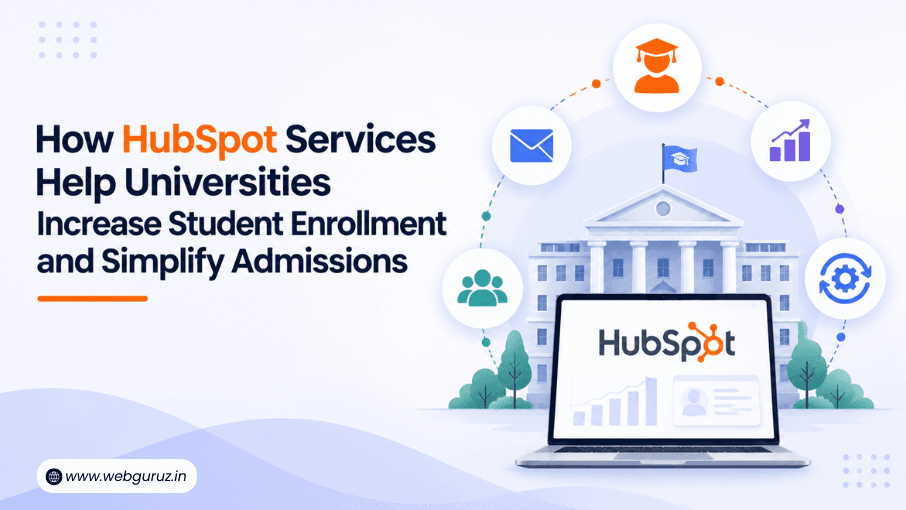
Universities have never had more ways to reach prospective students.
From social media and virtual campus tours to webinars and AI-powered search, students can discover a university almost anywhere. The challenge isn’t getting noticed anymore; it’s keeping students engaged once they show interest.
A prospective student might visit your website, download a course guide, attend an online event, and even begin an application. But if communication feels slow, generic, or disconnected, there’s a good chance they’ll continue exploring other options.
This is exactly why more institutions are investing in HubSpot Services. It’s no longer enough to collect inquiries in a CRM. Universities need a connected system that helps every team deliver a smooth and personalized experience from the first enquiry to final enrollment.
The institutions succeeding today aren’t necessarily the ones spending the most on marketing.
They’re the ones making it easier for students to choose them.

Across many higher education CRM projects, one pattern appears again and again.
Universities rarely struggle because students aren’t interested.
They struggle because interest fades before an application is completed.
Today’s students don’t make decisions after a single website visit. Before they apply, they compare universities, read reviews, watch campus videos, explore AI-generated search results, and revisit websites several times. By the time they submit an inquiry, they already expect quick, relevant, and personalized communication.
Unfortunately, many universities still rely on disconnected systems that make delivering that experience difficult.
A student downloads a course brochure.
Then nothing happens for several days.
Someone else receives three generic emails that don’t answer the questions they actually have.
Another student attends a webinar, but the admissions team has no visibility into that interaction when they later call to discuss enrollment.
Small gaps like these may not seem significant on their own.
Together, they create enough friction for prospective students to continue exploring other universities.
Students now expect the same digital experience they receive from banks, retailers, and streaming platforms. They want quick responses, relevant information, and conversations that continue from where they left off.
When universities can’t deliver that experience consistently, even interested applicants can lose momentum before reaching the enrollment stage.
The way universities recruit students has changed dramatically over the past few years.
Students no longer follow a straight path from discovering a university to submitting an application. They move between websites, search engines, AI tools, videos, reviews, and social media before making a decision.
That means admissions teams need to build relationships throughout the entire journey.
| Student Journey Stage | Traditional Admissions | Modern Student Recruitment |
|---|---|---|
| How students discover universities | Google search, brochures, education fairs | Google Search, AI Overviews, ChatGPT, YouTube, social media, student communities |
| First interaction | Website enquiry form | Personalized landing pages, virtual events, downloadable course guides, AI-assisted search |
| Communication | One-size-fits-all email campaigns | Personalized communication based on course interest and engagement |
| Follow-up process | Manual emails and phone calls | Automated workflows supported by admissions teams |
| Student information | Stored across multiple systems | One complete student profile shared across departments |
| Decision-making factors | Course details and campus visits | Reviews, employability, student experience, online reputation, AI recommendations |
| Success measurement | Number of enquiries | Applications, enrollments, and student engagement throughout the journey |
Students expect universities to deliver the same digital experience they receive from banks, retailers, and streaming platforms. They want quick responses, personalized communication, and conversations that continue from where they left off.
Today’s technology has changed how they make decisions. Before applying, they compare universities through AI-powered search, read reviews, watch campus videos, and research programs across multiple devices. By the time they submit an inquiry, they already expect a smooth and connected experience.
According to Salesforce’s Connected Student Report, 88% of students say the experience an institution provides is just as important as the quality of its academic programs. That means communication, responsiveness, and personalization now play a major role in enrollment decisions.
Many universities have strong recruitment teams, but they’re often working with disconnected systems. Marketing manages inquiries in one platform, admissions tracks applications in another, and event registrations or email interactions live somewhere else.
When information is scattered, follow-ups become slower, conversations lose context, and prospective students can easily lose interest.
This is where a HubSpot education CRM makes a real difference. By bringing every interaction into one shared platform, universities can give marketing, recruitment, and admissions teams a complete view of each prospective student, making communication more timely, relevant, and personal.
Your Website Is Often the First Campus Students Visit. For many prospective students, the university website creates their first impression.
Before booking a campus tour or speaking with an admissions advisor, students browse courses, compare tuition fees, read success stories, and decide whether the institution feels right for them.
If that experience is slow, confusing, or inconsistent, many won’t return.
Higher education institutions don’t need another platform that stores student information.
This is why many universities are adopting HubSpot for higher education.
Instead of separating marketing, admissions, recruitment, and communications, HubSpot connects them through one shared system. Everyone can see where a prospective student is in their journey, what information they’ve already received, and which actions they’ve taken.
Imagine a student who downloads a postgraduate brochure, registers for an open day, and later asks a question through your website.
When those interactions are connected, the admissions team doesn’t have to start the conversation from scratch. They already understand the student’s interests and can provide more meaningful guidance.
That creates a much better experience for both students and university staff.

Many institutions are already using HubSpot to improve more than just admissions.
Some of the most common use cases include:
Many universities also invest in HubSpot marketing automation services to build these workflows more efficiently and ensure communication remains consistent throughout the enrollment process.
The result isn’t just a more organized admissions team.
It’s a smoother and more engaging experience for every prospective student.

Choosing the right CRM is only the first step.
The real challenge is making sure it fits the way your university already works.
Every institution has different admissions processes, recruitment goals, approval workflows, and reporting requirements. A CRM that isn’t configured correctly can quickly become another system that teams avoid using.
This is why many universities choose to work with experienced HubSpot Consultants.
Rather than forcing institutions to change their existing processes, consultants help design a solution around the way admissions, marketing, and recruitment teams already operate. That makes adoption much easier and helps universities start seeing results sooner.
More importantly, it ensures every department works from the same student information instead of maintaining separate records.
A CRM doesn’t improve enrollment on its own.
Success depends on how it’s implemented and how well different teams use it.
Across higher education projects, one pattern appears repeatedly. Universities achieve better results when marketing and admissions stop working in silos and begin sharing the same goals, data, and reporting.
This is where experienced HubSpot Experts add real value.
Instead of focusing only on software setup, they help institutions improve the entire recruitment journey—from attracting prospective students to nurturing inquiries and measuring enrollment performance.
Larger institutions may also require HubSpot Technical Consulting to support complex reporting, custom automation, data migration, and integrations with existing student information systems.
The objective isn’t simply to implement HubSpot.
It’s to build an enrollment system that grows with the university.

Behind every smooth student experience is a great deal of planning.
Forms need to connect with the CRM.
Email campaigns need to trigger automatically.
Reporting must show which marketing activities generate real enrollments.
Experienced teams delivering HubSpot Development Services help universities connect these moving parts into one system that supports every stage of recruitment.
Projects like these are often led by a certified HubSpot developer, ensuring custom functionality, workflows, and automation continue working as the institution grows.
The result is a platform that saves time for staff while giving students a more consistent experience.
One of the biggest challenges universities face is fragmented information.
Marketing may know which campaign generated an inquiry, while admissions knows whether that student enrolled.
Without connected reporting, it’s difficult to understand what is actually driving enrollment growth.
This is why HubSpot Integrations and Data have become an important part of modern higher education technology.
Connecting CRM data with student information systems, event platforms, and reporting tools gives universities a complete view of the recruitment journey. Instead of making decisions based on assumptions, teams can see which activities genuinely influence applications and enrollments.
Large integration projects are often supported by experienced HubSpot CRM Developers, particularly when institutions need custom functionality or complex system integrations.
For universities planning long-term growth, working with Certified HubSpot CRM Developers also helps ensure those integrations remain secure, scalable, and easier to maintain over time.
Higher education is changing.
Students expect faster answers, personalized communication, and a seamless experience from the moment they discover a university.
They research programs through Google, AI-powered search tools, social media, and online reviews long before speaking to an admissions advisor.
That means universities are no longer competing only on academic reputation.
They’re competing on the quality of the experience they deliver throughout the enrollment journey.
This is exactly where HubSpot makes a difference.
Instead of managing marketing, recruitment, and admissions separately, universities can bring every interaction into one connected platform. Teams gain better visibility, students receive more relevant communication, and institutions are better equipped to turn enquiries into enrollments.
Technology alone won’t attract more students.
But the right technology—supported by the right strategy—can help universities build stronger relationships, improve operational efficiency, and create an enrollment experience that today’s students expect.
Universities are using HubSpot to bring marketing, admissions, and recruitment together in one platform. This helps teams respond faster, personalize communication, and track every prospective student’s journey from enquiry to enrollment.
Yes. HubSpot supports student recruitment, marketing automation, CRM management, reporting, and admissions workflows, making it a flexible solution for colleges and universities of all sizes.
Automation helps universities send relevant emails, reminders, and updates based on a student’s interests and stage in the admissions process. This improves engagement without increasing manual work.
Yes. HubSpot can integrate with student information systems, event platforms, learning management systems, and other applications, helping universities maintain one complete view of every prospective student.
Many institutions choose experienced implementation partners because they can configure the platform around existing admissions processes, simplify data migration, and build workflows that support long-term enrollment goals.
Vedanshi
2026-10-23
7 min read
Your business uses HubSpot to manage customer relationships, but disconnected systems create data issues.
Read More
Vedanshi
2026-10-22
7 min read
Ask ChatGPT, Gemini, or Perplexity to recommend a supplier or a software tool, and you get a short list of names, not ten blue links.
Read More
Vedanshi
2026-10-21
7 min read
Building a website takes more than picking colors, dropping in images, and writing copy.
Read More