 sales@webguruz.in
 +1 (213) 715-5368
Vedanshi
2026-10-23
7 min read
Custom HubSpot Integrations: Benefits, Examples, and Best Practices
Your business uses HubSpot to manage customer relationships, but disconnected systems create data issues.
Read More
Published On:2026-06-10
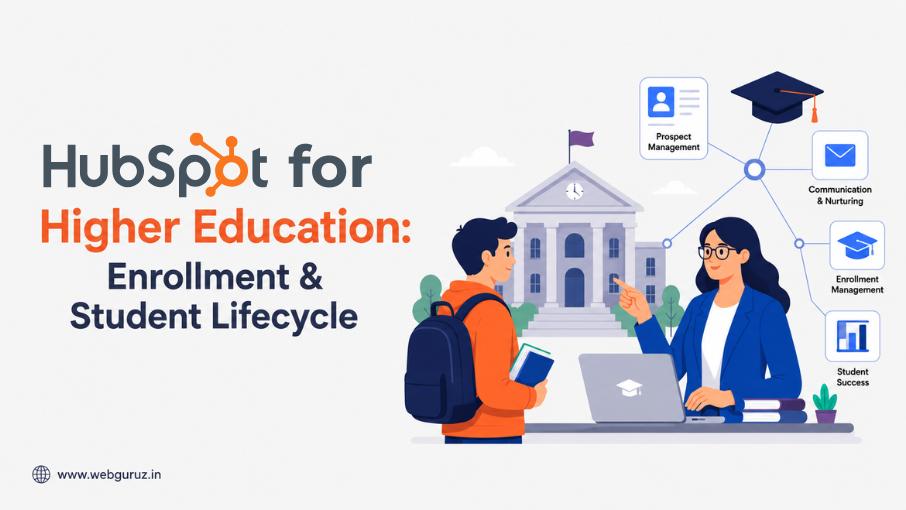
Higher education is facing one of its most challenging recruitment environments in decades. Graduate enrollment declined 5.9% in Fall 2025 due to nearly 10,000 fewer international students, while competition for domestic students has intensified as institutions fight for a shrinking traditional-age pool, according to the National Student Clearinghouse Research Center, 2026. At the same time, 98% of Gen Z prospective students now engage with at least one major digital platform daily, which means institutions that are not meeting them through personalized, digital-first communication are losing ground to those that are.
The response most institutions reach for is more tools, more email platforms, more CRMs, and more marketing software. The problem is rarely a shortage of tools. It is a shortage of connection between them. Admissions teams work in one system, student success teams in another, and alumni relations in a third. The student ends up being treated as three different people across their journey with the institution. By bringing marketing, communication, and engagement efforts into a single ecosystem, HubSpot Marketing Hub helps eliminate these disconnects and creates a more unified student experience.
HubSpot for Higher Education solves that problem by bringing every stage of the Student Lifecycle Management journey into a single, connected platform, from the first time a prospective student visits your website to the day they become an engaged alumnus. This guide explains exactly how.
Most CRM platforms are built for sales pipelines. HubSpot has evolved into something more useful for universities: a relationship management platform that tracks long-term, multi-stage journeys, which is exactly what the student lifecycle is.
A prospective student’s journey typically involves dozens of touchpoints over six to eighteen months before they apply. An enrolled student has ongoing needs across academic support, campus life, financial aid, and career services. An alumnus has a lifelong relationship with the institution that, when managed well, produces donations, referrals, and advocacy. No sales CRM is designed for a journey this long or this complex, but HubSpot is.
The University of Wyoming demonstrated this directly: 60% of one incoming class engaged with a HubSpot landing page at some point in their enrollment journey, according to HubSpot’s own higher education case studies. This is the result of a well-architected Enrollment Management strategy that put the right content in front of prospective students at the right moment, tracked engagement, and responded accordingly.
Global Schools Foundation took a similar approach at an even larger scale, standardizing their CRM processes across 35 campuses and 10 countries using HubSpot, demonstrating that the platform scales from a single institution to a global network without losing the personalization that makes it effective.

The student journey does not follow a straight line; it moves through distinct phases, each with its own communication needs, team owners, and success metrics. HubSpot’s connected platform means that instead of managing each phase in a separate tool, institutions can run the entire lifecycle from a single environment where every interaction informs the next. Here is how each stage works in practice.
The first stage of the Student Lifecycle Management journey is attracting prospective students and converting their initial curiosity into genuine engagement with your institution.
Marketing Hub is where this begins. It gives admissions and marketing teams the tools to run multi-channel campaigns (email, social media, paid ads, and organic search) from a single interface, with every interaction tracked back to the individual contact record. A prospective student who clicks a Facebook ad about your engineering program, visits the program page, and downloads a course brochure has a contact record that tells that entire story before any human has spoken to them.
This matters because a modern student recruitment CRM strategy cannot rely on blanket outreach. A prospective postgraduate student researching an MBA program needs different content at different times than an undergraduate applicant exploring a creative arts degree. HubSpot Marketing Hub allows admissions teams to segment their prospect database by program interest, geographic location, inquiry stage, and engagement level, and deliver communication that reflects each segment’s specific situation rather than a generic institutional message.
The Breeze AI layer embedded in the Marketing Hub extends this further. AI-powered email content generation, send-time optimization, and behavioral lead scoring mean that the most engaged prospects (those most likely to apply) are surfaced automatically to admissions counselors rather than buried in a spreadsheet that someone has to manually review each week.
Once a prospective student moves from aware to interested, the Admissions CRM function kicks in, and this is where many institutions experience their greatest drop-off. The gap between inquiry and application is where prospects go cold, forget to complete their materials, or choose a competitor that followed up more consistently.
When a student submits an inquiry form, a workflow can immediately send a personalized acknowledgment email, create a task for the relevant admissions counselor, set a follow-up reminder for three days later, and enroll the prospect in a nurture sequence that delivers relevant content such as campus life, scholarship information, and faculty profiles. With HubSpot CRM Workflows, these actions can be automated based on where a student is in the decision process, helping institutions maintain timely and relevant communication at scale.
As a prospect’s behavior changes, they open emails, revisit program pages, and attend a virtual open day, their status in the system should evolve as well. With HubSpot CRM Automation, these updates can happen automatically, ensuring communication sequences adapt in real time to reflect each student’s level of interest and engagement. A prospect who visited the financial aid page three times in a week is telling you something. A properly configured university CRM responds to that signal rather than waiting for the next scheduled email to go out.
The admissions pipeline in HubSpot can be configured to mirror your institution’s specific application stages (Inquiry, Prospect, Applied, Under Review, Admitted, Committed, Enrolled) with each stage triggering the appropriate communication and task assignments. Certified HubSpot CRM developers who have worked with educational institutions understand the nuances of this configuration: the different pipelines needed for undergraduate versus postgraduate applicants, the suppression logic required to prevent enrolled students from receiving prospecting emails, and the reporting structure that allows enrollment directors to see pipeline health at a glance.
Enrollment is not the finish line. It is the beginning of a relationship that the institution needs to actively maintain, because a student who feels unsupported is a student at risk of dropping out. And the statistics here are stark: the 30-year first-year dropout rate in U.S. higher education remains significant, according to Nutshell’s 2025 Higher Education CRM research, with early disengagement being one of the most consistent predictors of non-completion.
Student support teams can manage queries, complaints, and ongoing communications through a ticketing system that keeps every interaction on record and ensures nothing falls through the cracks. When a student contacts the financial aid office, the academic support team, and the student life office in the same month, all three interactions are visible in a single contact record, which means any team member who interacts with that student has full context, rather than asking them to explain their situation from scratch each time. This level of visibility and coordination is made possible through HubSpot Service Hub, helping institutions deliver a more connected and responsive student support experience.
The HubSpot Automation Services capability at this stage includes automated check-in sequences at key points in the academic calendar: the start of the semester, mid-term, and before key registration deadlines. These touchpoints are not just pastoral; they are predictive. Students who disengage from institutional communication are often disengaging from their studies at the same time. Automated re-engagement workflows that respond to reduced email interaction or website inactivity give student success teams an early warning system rather than a reactive crisis management tool.
Consistent, high-quality communication across the entire student journey requires more content than most institutional teams can produce manually. Prospective students need program-specific information. Enrolled students need campus updates, academic reminders, and career development resources. Alumni need institutional news, reunion invitations, and fundraising appeals. Each audience has different needs, different expectations, and different optimal communication channels.
HubSpot Content Hub brings the content creation, management, and distribution elements together in one place. Blog posts, landing pages, email campaigns, and social content can all be created, scheduled, and analyzed from a single interface, which means the marketing team is not toggling between four platforms to manage what should be a unified communication strategy.
The AI content tools within HubSpot Content Hub allow teams to generate first drafts of program-specific landing pages, personalize email body copy based on a contact’s program interest, and create content variations that are tested against each other to find what actually resonates. For institutions managing content across multiple faculties, campuses, or program types, this capacity to produce relevant content at scale (without proportionally scaling the team) is one of the most practically impactful capabilities HubSpot brings to the higher education context.
For educational institutions, the website is often the primary discovery surface and one of the most valuable sources of student intent data. Through HubSpot website development, visitor behavior can be connected directly to CRM records, which means a prospective student’s web journey, including the pages they visited, the resources they downloaded, and the time they spent exploring postgraduate programs, becomes visible before any form has been submitted. That behavioral data strengthens the Admissions CRM function and makes outreach significantly more targeted and relevant.
The final stage of the student lifecycle is the one most institutions manage least effectively and the one with the greatest long-term institutional value. Alumni are sources of donations, referrals, employer partnerships, mentoring relationships, and the kind of social proof that influences prospective students more than any institutional marketing campaign.
Alumni engagement works on the same principle as admissions nurture sequences: the right communication at the right time, triggered by behavior and milestones rather than a mass broadcast schedule. With HubSpot Automation Solutions, institutions can create personalized journeys that respond to alumni activity and engagement levels automatically. A graduate who updates their LinkedIn profile with a new role gets a congratulations email. An alumnus who opens three consecutive newsletters gets added to a high-engagement segment. An alumnus who has not engaged in two years gets a reactivation sequence before they are quietly removed from active campaign audiences.
The HubSpot Services capability for alumni relations also includes event management (reunion invitations, speaker series, professional development events) with registration, reminder automation, and post-event follow-up all handled within the platform. Donation appeals can be personalized based on giving history, program affiliation, and engagement level, making fundraising campaigns more efficient and more effective simultaneously.

Knowing that HubSpot can support the full student lifecycle and having it actually configured to do so are two different things. The following areas define what a well-implemented Higher Education CRM environment covers in practice:
HubSpot Technical Consulting and HubSpot Automation Services that address all of these areas (rather than simply setting up basic email workflows) are what produce an institutional CRM that performs across the entire student lifecycle, rather than one that works well for admissions and then fades into irrelevance once students are enrolled.
One of HubSpot’s genuine advantages for higher education is that the tools needed for every stage of the student journey are available within a single platform rather than requiring separate vendors for each function. HubSpot Hubs covering marketing, sales (in the context of admissions), service, and content work from a shared contact database, which means a student’s full interaction history is visible to every team that touches them, regardless of which Hub they are working in.
This unified data model is the infrastructure that makes Student Lifecycle Management genuinely possible rather than theoretically appealing. When the admissions team can see that a current student previously attended two virtual open days, downloaded a scholarship guide, and had three conversations with a student ambassador before applying (and the student success team can see the same record), the institution is treating that person as a continuous relationship rather than a series of disconnected transactions.
Everything covered in this HubSpot for Higher Education: A Complete Guide to Enrollment, Engagement & Student Lifecycle Management guide points to one conclusion: the institutions that will manage enrollment pressure most effectively in 2026 and beyond are the ones that treat the student journey as a single, continuous relationship, not a series of handoffs between disconnected teams and disconnected systems.
HubSpot, configured well for a higher education context, provides exactly that: a connected platform where admissions, student services, marketing, and alumni relations all work from the same picture of each person they serve. The technology is capable. The outcomes are well-documented. The variable is the quality of the implementation, and that starts with understanding the student lifecycle well enough to build a CRM that genuinely reflects how your institution actually operates.
Absolutely. While HubSpot started as a business CRM, it’s now widely used by educational institutions to manage student recruitment, admissions, engagement, and alumni communications from one connected platform.
Yes. HubSpot helps institutions attract prospective students through targeted marketing campaigns, personalized email nurturing, and automated follow-ups that keep applicants engaged throughout the decision-making process.
HubSpot keeps all student interactions in one place, making it easier for different departments to work together. Whether a student contacts admissions, financial aid, or student services, teams have the context they need to provide better support.
In most cases, yes. HubSpot can be integrated with Student Information Systems (SIS), Learning Management Systems (LMS), and other platforms, helping institutions keep student data connected and up to date.
Definitely. Universities can use HubSpot to automate alumni communications, promote events, segment audiences, manage fundraising campaigns, and maintain stronger relationships long after graduation.

Vedanshi
2026-10-23
7 min read
Your business uses HubSpot to manage customer relationships, but disconnected systems create data issues.
Read More
Vedanshi
2026-10-22
7 min read
Ask ChatGPT, Gemini, or Perplexity to recommend a supplier or a software tool, and you get a short list of names, not ten blue links.
Read More
Vedanshi
2026-10-21
7 min read
Building a website takes more than picking colors, dropping in images, and writing copy.
Read More