Vedanshi
2026-09-21
7 min read
Revenue Operations Software Explained: How the RevOps Industry Works in 2027
Businesses don’t necessarily have a shortage of revenue software. They have a shortage of connected revenue systems.
Read More
If your marketing strategy is still built around getting more clicks, more impressions, and higher rankings, it may already be falling behind.
Customers don’t search the way they did a few years ago. Today, they ask ChatGPT for recommendations, read Google’s AI Overviews instead of clicking multiple websites, compare products through AI-powered search, and expect every interaction to feel personalized. By 2027, these behaviors won’t be early trends; they’ll be how most people discover, evaluate, and choose businesses.
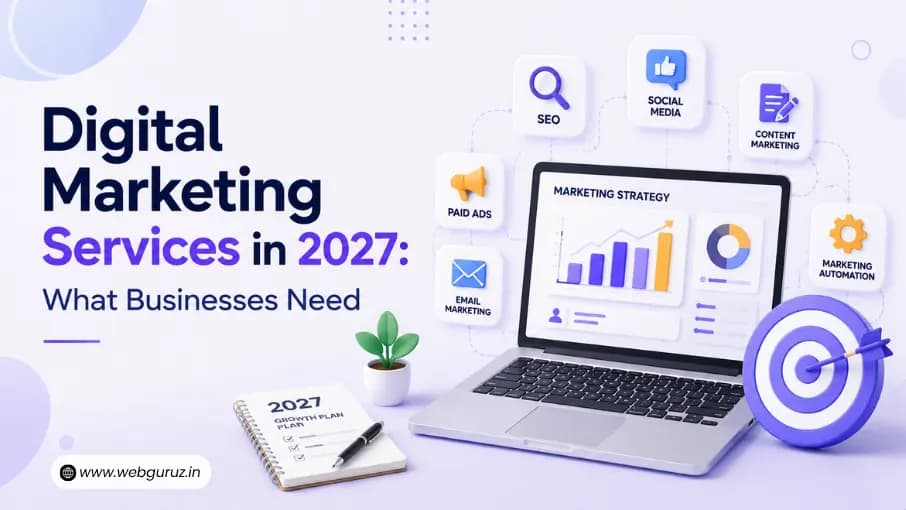
This shift is forcing companies to rethink what effective Digital Marketing Services actually look like. Success will no longer depend on mastering a single channel or platform. Instead, businesses will need connected strategies that combine AI, search, content, advertising, automation, and customer experience into one cohesive growth engine.
The question isn’t whether digital marketing will change.
The question is whether your business will be ready when today’s changes become tomorrow’s standard.
One of the biggest misconceptions about the future of marketing is that it’s still years away.
It isn’t.
The changes shaping 2027 are already influencing how customers search, buy, and interact with businesses today.
Think about your own habits. When you need a quick answer, do you always open Google, or do you sometimes ask ChatGPT? When you’re researching software or comparing services, do you visit ten different websites, or do you trust AI-generated summaries to narrow your options first?
Your customers are doing the same thing.
According to Google, AI-powered search experiences are encouraging users to ask longer, more conversational questions, while businesses are seeing customer journeys become less linear and more dynamic. Instead of moving from search engine to website to purchase, people now switch between AI assistants, social platforms, reviews, videos, and brand websites before making a decision.
This means businesses are no longer competing only for rankings or clicks. They’re competing to become the brand that customers (and increasingly AI) trust enough to recommend.
By 2027, the businesses that stand out won’t necessarily be the ones spending the most on marketing. They’ll be the ones that started adapting while everyone else was still waiting for the future to arrive.
One of the biggest frustrations businesses face today is this:
“We’re investing in SEO, publishing content consistently, and our website traffic is growing. So why aren’t we seeing more qualified leads?”
The answer isn’t that SEO has stopped working. It’s that the way customers discover businesses is changing.
A few years ago, most buying journeys began with a Google search. Today, someone researching a product or service might ask ChatGPT for recommendations, read Google’s AI Overview, watch a short video on LinkedIn or YouTube, and only then visit a company’s website. In many cases, they make a shortlist before ever clicking a search result.
This means businesses investing in SEO Services India will need to think beyond rankings. Search visibility in 2027 will depend on creating trustworthy, experience-driven content that AI platforms can understand, reference, and confidently recommend.
Ranking on the first page of Google will still be valuable, but it won’t be the only measure of success.
AI-powered search platforms don’t simply list websites; they evaluate information from multiple sources before generating an answer. That means businesses will need to demonstrate expertise, keep information accurate, build topical authority, and create content that genuinely helps users solve problems.
This is why more businesses are investing in AI SEO Services. The goal is no longer just to increase organic traffic but to build digital authority across both traditional search engines and AI-powered platforms. The brands that earn trust will be the ones customers see most often, regardless of where the search begins.
Another challenge many businesses already face is rising advertising costs.
Competition is increasing, customer attention spans are shrinking, and simply raising your budget no longer guarantees better results. Many marketing teams are asking the same question:
“Why are we spending more but getting less in return?”
The answer lies in relevance, not reach.
By 2027, AI will make advertising far more predictive. Instead of relying on broad audience targeting, campaigns will continuously analyze user behavior, buying intent, and engagement patterns to deliver more relevant experiences at the right moment. Businesses using PPC Management Services will increasingly focus on strategy, audience insights, and conversion optimization while AI handles much of the day-to-day campaign management.
The businesses that succeed won’t necessarily have the largest advertising budgets. They’ll be the ones that use data more effectively.
AI is already helping marketers test creative variations, identify high-performing audiences, optimize bids in real time, and uncover opportunities that would take humans hours to find. Over the next few years, these capabilities will become standard rather than optional.
As a result, Google Ads Optimization will become less about manual adjustments and more about combining AI-driven automation with human strategy. Businesses that embrace this balance will spend less time managing campaigns and more time improving customer acquisition and long-term growth.
| Traditional Marketing Focus |
What Successful Businesses Will Focus on by 2027 |
Business Impact |
|---|---|---|
| Driving more website traffic | Becoming visible across AI-powered search platforms | Higher-quality discovery and qualified leads |
| Publishing more content | Creating content that demonstrates expertise and trust | Greater authority and AI recommendations |
| Running separate marketing campaigns | Building connected customer journeys | Better customer experience and retention |
| Increasing ad spend | Improving campaign intelligence with AI | Higher ROI and more efficient acquisition |
| Measuring clicks and impressions | Measuring revenue, customer lifetime value, and AI visibility | Smarter business decisions |
For years, the advice was simple: publish more blogs, post more often on social media, and stay visible across every channel.
That approach is becoming less effective.
Today, AI can generate thousands of articles, emails, and social media posts within minutes. As a result, customers are overwhelmed with content, making it harder for businesses to earn attention and even harder to earn trust.
The businesses that stand out in 2027 won’t be those creating the most content. They’ll be the ones creating the most useful content.
This is why Content Marketing Services are shifting away from volume and focusing on quality, originality, and expertise. Instead of chasing keywords alone, successful businesses will answer real customer questions, share practical insights, and create content that demonstrates genuine experience. That’s the type of content both people and AI-powered search platforms are more likely to trust.
Search is becoming more conversational.
Instead of searching for “best CRM software,” customers now ask questions like, “Which CRM is best for a growing manufacturing company?” or “How can I improve my lead generation strategy?“
AI platforms look for content that provides clear, accurate, and trustworthy answers rather than pages that simply repeat keywords.
This is where AEO Services are becoming essential. By organizing information around user intent, using clear page structures, and answering questions directly, businesses improve their chances of being referenced across AI-powered search experiences. The goal isn’t just to rank well, it’s to become part of the answer.
Modern customers don’t compare your business only with your competitors.
They compare every experience with the best digital experiences they’ve ever had.
If Netflix recommends relevant content, Spotify remembers listening habits, and Amazon suggests products based on previous purchases, customers naturally expect the same level of personalization from every brand they interact with.
Businesses offering Email Marketing Services will increasingly rely on AI to deliver personalized communication based on customer behavior, interests, and stage in the buying journey. Instead of sending the same message to every subscriber, they’ll create experiences that feel timely, relevant, and genuinely helpful.
Personalization will no longer be a competitive advantage; it will become an expectation.
Customers no longer interact with brands through a single channel.
They discover businesses on LinkedIn, ask questions on social platforms, watch short-form videos, read reviews, and continue conversations across multiple touchpoints before making a decision.
Managing these interactions consistently will become even more important as AI increasingly uses publicly available conversations and brand signals to understand credibility and relevance.
Professional Social Media Management Services will evolve beyond scheduling posts. They will focus on building communities, encouraging meaningful engagement, strengthening brand authority, and creating conversations that reinforce trust across both people and AI-driven platforms.
One of the biggest mistakes businesses make is treating marketing as a collection of separate activities.
SEO operates independently from paid advertising.
Social media follows its own strategy.
Email campaigns run on different systems.
Customer data is scattered across multiple platforms.
By 2027, this fragmented approach will become increasingly difficult to sustain.
Successful businesses will invest in digital marketing solutions that connect every channel into one unified strategy. AI will help analyze customer behavior, automate routine tasks, identify growth opportunities, and provide insights faster than ever before, but technology alone won’t create results.
The real competitive advantage will come from combining AI with clear strategy, trusted content, connected data, and human expertise. Businesses that bring these elements together will be better equipped to adapt as customer expectations continue to evolve.
The future of marketing isn’t arriving in 2027; it is already taking shape today.
Customers are changing how they search, how they evaluate businesses, and how they make purchasing decisions. AI is accelerating these changes, but it isn’t replacing the fundamentals. Trust, expertise, relevance, and meaningful customer experiences will continue to define successful marketing strategies.
Businesses that begin preparing now won’t simply keep up with change; they’ll be in a stronger position to lead it. By embracing modern digital marketing services that combine AI, automation, content, search, advertising, and customer experience, organizations can build a marketing strategy that’s ready not just for 2027, but for whatever comes next.
As these expectations continue to evolve, businesses will also need to look beyond choosing individual SEO packages or standalone marketing tactics. Long-term success will depend on building a connected strategy where every channel works together to deliver value, earn trust, and create meaningful customer experiences across an increasingly AI-driven digital landscape.
Digital marketing will become more AI-driven, with businesses focusing on customer experience, personalization, AI-powered search visibility, and connected marketing strategies rather than individual channels alone.
No. AI will enhance digital marketing by automating repetitive tasks and improving decision-making, but strategy, creativity, and human expertise will remain essential.
AI-powered search platforms provide direct answers instead of just listing websites. Businesses need content that is accurate, well-structured, and trustworthy to improve their chances of being referenced.
Businesses should focus on AI-ready SEO, content quality, personalization, marketing automation, paid media optimization, and building connected customer journeys across all channels.
Start by reviewing your current strategy, investing in AI responsibly, creating helpful content, connecting your marketing tools, and focusing on long-term customer trust rather than short-term marketing tactics.

Vedanshi
2026-09-21
7 min read
Businesses don’t necessarily have a shortage of revenue software. They have a shortage of connected revenue systems.
Read More
Vedanshi
2026-09-21
7 min read
Software companies have never had more opportunities to grow, or more competition for attention.
Read More
Vedanshi
2026-09-18
7 min read
Most failed HubSpot rollouts don’t fail because of the software. They fail because nobody mapped the process, cleaned the data, or planned how teams would actually use it before flipping the switch.
Read More