 sales@webguruz.in
 +1 (213) 715-5368
Vedanshi
2026-10-23
7 min read
Custom HubSpot Integrations: Benefits, Examples, and Best Practices
Your business uses HubSpot to manage customer relationships, but disconnected systems create data issues.
Read More
Published On:2026-06-18
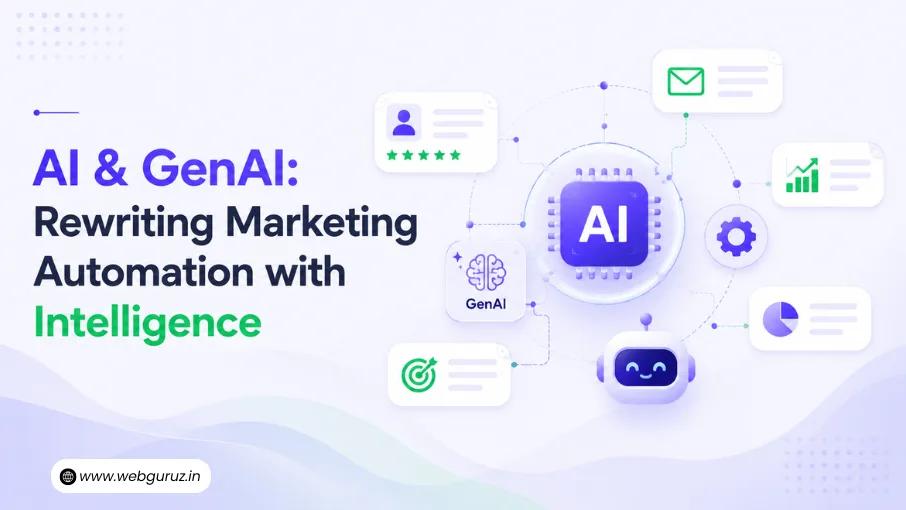
For years, businesses have relied on Marketing Automation to simplify repetitive tasks like sending emails, assigning leads, scheduling campaigns, and nurturing prospects. Those rule-based workflows helped teams save time and improve consistency, but they also came with limitations. Every action depended on predefined logic, meaning marketers had to anticipate customer behavior before it happened.
Today, that approach is changing rapidly. Artificial intelligence (AI) and generative AI (GenAI) are transforming automation from a system that follows instructions into one that can analyze patterns, make recommendations, generate content, and adapt to customer behavior in real time. Instead of simply executing workflows, intelligent platforms are helping organizations make better marketing decisions faster and at scale.
This shift is more than a technology upgrade. It represents a fundamental evolution in how brands engage audiences, personalize experiences, and drive growth. Organizations investing in modern Marketing Automation Solutions are discovering that combining automation with AI creates opportunities that traditional workflows simply cannot match.

Not long ago, automation meant creating if-then rules.
If a prospect downloaded an ebook, send an email. If they opened three campaigns, assign them to sales. If they abandoned a cart, trigger a reminder after 24 hours.
While these workflows remain valuable, they depend entirely on human-designed logic. They cannot easily recognize unexpected customer behavior or adjust messaging based on changing preferences.
AI-powered systems add a new layer of intelligence. They analyze historical interactions, identify patterns across thousands of users, and continuously improve recommendations. Rather than simply following rules, they help marketers predict what customers are likely to do next.
Research from McKinsey estimates that generative AI could increase marketing productivity by 5% to 15% of total marketing spending, highlighting its potential to improve efficiency while supporting better customer engagement. This demonstrates why businesses are moving beyond conventional automation toward more adaptive, data-driven strategies.
| Traditional Automation | AI-Powered Automation |
|---|---|
| Follows predefined rules | Learns from customer behavior and data |
| Requires manual workflow updates | Continuously adapts and improves recommendations |
| Uses static segmentation | Enables dynamic, AI-driven personalization |
| Scores leads based on fixed criteria | Uses predictive analytics to identify high-intent prospects |
| Creates repetitive customer journeys | Delivers context-aware experiences across channels |
| Needs manual content creation | Leverages Generative AI to accelerate content production |
Customer journeys have become increasingly complex.
A buyer may discover a brand through organic search, interact with social media posts, visit multiple web pages, download resources, watch product videos, attend webinars, and engage with sales representatives before making a purchase. Trying to manage that experience with fixed workflows often creates fragmented communication.
An intelligent automation platform can process these interactions together and determine the most appropriate next step without requiring marketers to manually build every possible path.
This is one reason organizations investing in advanced digital marketing solutions are seeing stronger customer experiences while reducing operational overhead.

One of the biggest shifts introduced by GenAI is its ability to generate content rapidly while maintaining relevance.
Instead of manually creating dozens of email variations for different audience segments, marketers can use Generative AI Tools to produce personalized subject lines, draft campaign copy, generate product descriptions, summarize customer conversations, or create multiple versions of landing page content.
That does not eliminate the need for human oversight. Rather, it allows teams to spend less time on repetitive drafting and more time refining messaging, ensuring quality, and developing strategy.
The result is faster campaign execution without sacrificing personalization.
Consumers increasingly expect brands to understand their interests and communicate accordingly.
Earlier automation systems often relied on simple segmentation such as geography or industry. AI expands this capability significantly by incorporating browsing behavior, purchase history, engagement trends, lifecycle stage, and predictive analytics into personalization decisions.
Instead of sending identical nurture sequences to every lead, organizations can deliver individualized experiences based on evolving customer intent.
Salesforce research has consistently shown that customers expect companies to understand their unique needs and preferences, making personalization a competitive advantage rather than a luxury.

Not every lead deserves the same level of attention.
Traditional scoring models typically assign points based on actions like email opens or form submissions. While helpful, they may overlook subtle behavioral signals that indicate purchase readiness.
AI-powered lead scoring evaluates broader datasets to identify prospects most likely to convert. It continuously adjusts recommendations based on outcomes, helping sales teams prioritize opportunities with greater confidence.
Businesses leveraging Marketing Automation Services alongside predictive analytics often experience more efficient resource allocation because teams spend less time chasing low-intent prospects.
Modern buyers rarely interact through a single platform.
They move between websites, email, paid advertising, messaging applications, webinars, and customer portals. Maintaining continuity across these touchpoints can be difficult using disconnected systems.
AI-enhanced automation helps orchestrate cross-channel experiences by determining the optimal message, timing, and delivery channel based on customer behavior.
Instead of following a rigid campaign schedule, communications become adaptive and responsive.
This capability is increasingly valuable as organizations strive to deliver seamless experiences throughout the customer lifecycle.
Behind every successful AI initiative lies reliable data.
Incomplete records, duplicate contacts, inconsistent lifecycle stages, and disconnected systems reduce the effectiveness of intelligent automation. AI performs best when it has access to clean, structured, and continuously updated information.
According to McKinsey’s global research, 65% of organizations report regularly using generative AI in at least one business function, illustrating how rapidly adoption has accelerated across industries. However, extracting meaningful value still depends heavily on the quality of underlying business data.
Before implementing sophisticated automation strategies, many organizations focus on improving CRM governance, data standardization, and system integration.
Despite impressive advances, AI does not replace experienced marketers.
Algorithms can generate ideas, optimize timing, and identify trends, but they cannot fully understand brand positioning, market context, emotional nuance, or long-term business strategy.
Successful organizations use AI as an accelerator rather than a substitute. Marketing professionals review outputs, validate messaging, ensure compliance, and align campaigns with broader objectives.
The strongest results come from combining intelligent technology with thoughtful human decision-making.

Complex buying committees, lengthy sales cycles, and multiple decision-makers make B2B marketing particularly suited to AI-enhanced automation.
Platforms enriched with predictive intelligence can identify buying signals, personalize account-based outreach, summarize engagement history, and recommend next-best actions for sales representatives.
This is where specialized offerings such as Pardot Consulting Services and Marketo Consulting Services become increasingly valuable. Experienced consultants help organizations configure advanced workflows, integrate customer data sources, and implement AI-driven capabilities aligned with business goals rather than generic templates.
As businesses mature, strategic consulting often becomes the bridge between owning powerful software and realizing measurable business outcomes.
While GenAI introduces exciting opportunities, responsible implementation remains critical.
Marketing teams should establish review processes for AI-generated content, monitor outputs for factual accuracy, protect customer data, and maintain transparency regarding automated interactions.
Organizations that balance innovation with governance are more likely to build long-term customer trust while minimizing operational risks.
Many experts believe the next generation of automation will become increasingly autonomous. Systems may proactively identify campaign opportunities, recommend budget allocation, forecast customer churn, and generate personalized experiences with minimal manual intervention.
At the same time, marketers will continue to shape strategy, creativity, and ethical oversight.
As discussed in “From Rules to Intelligence: How AI and GenAI Are Rewriting Marketing Automation,” the biggest competitive advantage will not come from adopting AI alone. It will come from integrating intelligence thoughtfully into business processes while keeping customer value at the center of every interaction.
Jumping straight into AI-driven automation without the right foundation can lead to disappointing results. Before investing in advanced tools or adopting Generative AI Marketing strategies, businesses should evaluate their existing processes, data quality, and technology stack.
A good starting point is auditing current workflows to identify repetitive tasks that consume time but add little strategic value. Activities like lead routing, email nurturing, customer segmentation, and campaign reporting are often ideal candidates for AI-enhanced automation. At the same time, organizations should ensure that customer data is accurate, standardized, and centralized, as AI systems perform best when they have reliable information to work with.
Selecting the right technology is equally important. The best Marketing Automation Solutions are those that integrate seamlessly with existing CRM platforms, analytics tools, and sales processes while offering flexibility to scale as business needs evolve. Rather than adopting AI for its own sake, companies should focus on solving specific operational challenges and measuring outcomes against clear objectives.
Finally, employee training should not be overlooked. Marketing and sales teams need to understand how to collaborate with AI, interpret its recommendations, and apply human judgment where creativity, context, and brand voice matter most. When technology and expertise work together, businesses are better positioned to unlock the full value of intelligent automation and deliver more meaningful customer experiences.

Not every organization needs to overhaul its existing systems overnight. However, the following indicators suggest it may be time to incorporate AI and Generative AI Tools into your automation strategy:
By recognizing these signals early, organizations can make informed investments in marketing automation services and AI-driven capabilities that support long-term growth rather than simply adding more technology to their stack.
Businesses no longer compete solely on product quality or marketing reach. They compete on how effectively they understand customers, personalize engagement, and respond to changing behavior at scale.
Modern Marketing Automation has evolved from executing predefined workflows to enabling intelligent decision-making powered by AI and GenAI. When supported by clean data, strategic implementation, and experienced oversight, these technologies help organizations improve efficiency, strengthen customer relationships, and unlock new opportunities for growth.
Companies exploring advanced Marketing Automation Services, scalable Marketing Automation Solutions, and AI-driven digital marketing solutions are positioning themselves for a future where automation is not just about doing more work—it is about making smarter decisions.
Traditional automation follows predefined rules and workflows that marketers manually create. AI-powered automation can analyze data, recognize patterns, predict customer behavior, and adjust actions dynamically, making campaigns more responsive and personalized.
Not entirely. Generative AI is excellent at accelerating tasks like drafting content, summarizing information, and generating ideas, but human expertise is still essential for strategy, brand voice, creativity, compliance, and quality assurance.
Organizations of all sizes can benefit, but companies managing large lead volumes, multiple marketing channels, or complex customer journeys often see the greatest improvements in efficiency and personalization.
Specialized consultants help businesses configure these platforms, optimize workflows, integrate CRM data, and implement AI-powered capabilities in ways that align with specific operational goals and marketing strategies.
Yes. AI systems rely on accurate, structured, and complete data to generate meaningful insights and recommendations. Investing time in data quality and governance significantly improves the effectiveness of intelligent automation initiatives.
Vedanshi
2026-10-23
7 min read
Your business uses HubSpot to manage customer relationships, but disconnected systems create data issues.
Read More
Vedanshi
2026-10-22
7 min read
Ask ChatGPT, Gemini, or Perplexity to recommend a supplier or a software tool, and you get a short list of names, not ten blue links.
Read More
Vedanshi
2026-10-21
7 min read
Building a website takes more than picking colors, dropping in images, and writing copy.
Read More