 sales@webguruz.in
 +1 (213) 715-5368
Vedanshi
2026-10-26
7 min read
7 Ways Modern Web Development Can Turn Your Online Store Into a Growth Engine
Your online store may have great products, competitive prices, and a strong brand, yet sales may still fall short of expectations.
Read More
Published On:2026-10-07
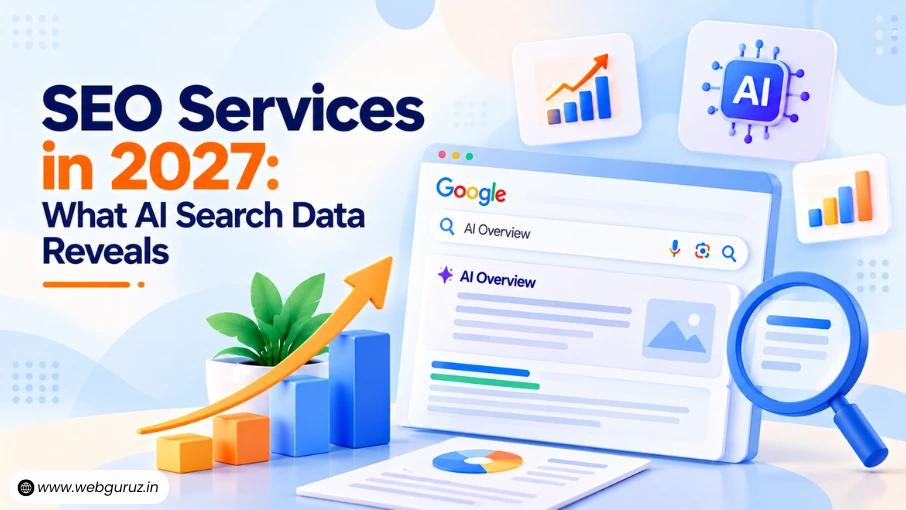
For years, ranking on Google’s first page was one of the clearest goals in search marketing. But search is no longer limited to a list of blue links. AI Overviews and AI Mode can now answer questions directly, summarize information, compare options, and point users toward selected websites.
That change matters for businesses that depend on organic traffic. A page can still rank well and receive fewer clicks if an AI-generated answer satisfies the searcher’s need before they visit a website.
This does not mean search visibility is disappearing. It means businesses need to think beyond rankings alone. SEO Services in 2027 need to account for technical health, useful content, brand authority, search intent, and how information is presented across both traditional and AI-powered search.
So, what does this shift mean for businesses investing in organic search?
Semrush analyzed 126 million real U.S. AI search prompts across 22 industries from January through April 2026, looking at how brands were mentioned, cited, and represented across major AI search platforms.
One key takeaway is that being mentioned isn’t the same as being cited. A brand may appear in an AI-generated answer without its website being used as a supporting source.
For businesses, this means SEO visibility is no longer just about rankings. Your website also needs to provide useful, trustworthy information that AI systems can understand and reference.
Google’s AI search features still rely on core SEO fundamentals, so pages need to be crawlable, indexable, useful, and relevant.
The basics of SEO haven’t changed. The way people discover information has.

AI Overviews can answer part of a user’s question directly on the search results page. This can change what happens after a user sees a website ranking in search.
Pew Research Center analyzed browsing activity from 900 U.S. adults during March 2025. It found that users clicked a traditional search result in 8% of visits when an AI-generated summary appeared, compared with 15% when no AI summary appeared.
The difference does not mean every website will lose the same amount of traffic. CTR can vary based on the query, search intent, industry, ranking position, and the type of AI result shown.
The Techmagnate study that inspired this article also found a similar pattern in its BFSI keyword dataset. It reported that AI Overview presence increased from 6.86% in October 2024 to 29.07% in May 2025, while average top-10 CTR declined from 5.7% to 3.66% during the same period.
These figures should not be treated as a universal CTR benchmark. They come from different studies, time periods, and datasets. But they point to an important change: ranking well may no longer be enough to guarantee the same level of organic clicks.
This is why businesses need to look beyond rankings and consider whether their pages provide enough value, context, and relevance to make users want to click.
AI Overviews can answer part of a user’s question directly on the search results page, changing what happens next.
Ahrefs’ 2026 analysis of 300,000 keywords found that the presence of an AI Overview was associated with a 58% lower average CTR for the top-ranking page across its analyzed informational keywords.
This shouldn’t be treated as a universal CTR forecast. Search behavior varies by query, industry, intent, and the type of result shown. But it highlights why businesses should no longer treat ranking position as the only measure of search performance.
The better question is:
What happens after my page becomes visible?
When search results change, the strategy behind them needs to change too. SEO strategy & consulting services can help businesses look at search as a complete customer journey rather than a list of keywords.
For example, a business may rank for a high-volume informational query but get very few leads from it. Another page with lower traffic may attract fewer visitors but bring in people who are much closer to making a purchase.
This means SEO planning should connect search intent with business goals.
A practical strategy should consider:
Google’s current guidance reinforces this approach. Google says there are no special technical requirements or separate “AI optimization” markup needed to appear in AI Overviews or AI Mode. Existing SEO fundamentals remain the foundation.
That makes strategic thinking more important, not less.
It is easy to focus on AI-generated answers and overlook the technical foundation underneath them. But technical seo services remain important because search engines need to access, understand, and index your website before its information can be considered for search features.
Google’s guidance specifically recommends making sure pages can be crawled, important content is available in text, internal links help users and search engines find pages, and structured data matches the visible content.
For businesses, this means technical issues can still create problems such as:
| Technical issue | Possible impact |
|---|---|
| Pages blocked from crawling | Search engines may not access important content |
| Poor internal linking | Important pages may be harder to discover |
| Duplicate URLs | Search engines may struggle to identify the preferred URL |
| Slow or poor page experience | Users may leave before engaging |
| Important content hidden behind scripts | Key information may be harder to process |
| Incorrect structured data | Search engines may receive unclear signals |
There is no shortcut around this foundation. AI search does not remove the need for a technically sound website.
As AI makes content production easier, publishing more pages is not automatically a better strategy.
Google’s guidance says websites should focus on unique, valuable, reliable, people-first content rather than producing large amounts of low-value material. Using generative AI to create many pages without adding meaningful value can also create spam-policy risks.
This makes Content Marketing Services less about publishing as much as possible and more about creating useful resources that answer real customer questions.
A strong piece of content should do something more than repeat information already available on dozens of websites. It might include original research, first-hand experience, expert analysis, examples, comparisons, data, or a clear explanation of a difficult topic.
For businesses, this also means content should connect to the buying journey.
An informational guide can introduce a problem. A comparison page can help a buyer evaluate options. A service page can explain how a solution works. A case study can show what happened in a real situation.
Together, these pages create a stronger search presence than a collection of disconnected articles.
AI is becoming part of the search experience, but businesses also need to think about how they use it internally. AI integration solutions can help connect AI tools with existing marketing, CRM, analytics, and content workflows.
For example, AI can assist with:
The important point is that AI should support the process rather than replace expertise.
Google’s guidance also makes this distinction clear. Generative AI can be useful for research and structuring content, but automatically producing large amounts of content without adding value can violate Google’s spam policies.
For SEO teams, the practical approach is to use AI where it improves research, analysis, and efficiency while keeping human judgment behind strategy, accuracy, and final content quality.

The fundamentals of organic SEO services have not disappeared. What has changed is the environment in which those fundamentals operate.
Businesses still need pages that search engines can crawl and index. They still need useful content, strong internal linking, relevant authority, and a website that provides a good experience.
But organic search success increasingly needs to be measured across several stages:
Visibility → Clicks → Engagement → Leads → Revenue
A ranking can create visibility, but visibility alone does not pay the bills.
This is especially important when AI answers satisfy simple informational searches without requiring a click. Businesses may need to focus more heavily on topics where their expertise, products, services, data, or experience give users a reason to visit the website.
The goal is not simply to appear everywhere. It is to be visible when the right audience is looking for something your business can genuinely provide.
The growing number of AI search platforms has also created a new category of AI SEO Tools. These tools can help marketers monitor brand mentions, analyze AI visibility, study search results, identify content opportunities, and compare how brands appear across different AI platforms.
However, tools should support decision-making rather than become the strategy themselves.
A dashboard may tell you that your brand is mentioned less often than a competitor. It does not automatically explain why. A content analysis tool may identify a missing topic, but it cannot always determine whether that topic is valuable to your customers.
That is why AI tools work best alongside traditional SEO analysis, customer research, analytics, and expert review.

As search becomes more complex, businesses should avoid relying on a single SEO metric.
A broader measurement framework can include:
Google says traffic from AI features is included in the overall Search Console web performance data. This means businesses can continue using Search Console alongside analytics and conversion data to understand what is happening after search visibility changes.
The right metrics will depend on the business model. An ecommerce company may focus heavily on revenue and product-page performance, while a B2B company may care more about qualified leads and pipeline.
SEO cannot be treated as a completely separate activity from the rest of marketing. Search visibility, content, brand reputation, paid campaigns, social activity, and customer data can all influence how people discover and evaluate a business.
This is where digital marketing solutions need to become more connected.
A useful approach is to make search data part of broader marketing decisions. Search queries can reveal customer concerns. Content performance can show which topics matter. Conversion data can reveal which pages attract valuable visitors. Brand data can show whether people already know and trust the business.
When these signals are considered together, marketing teams can make better decisions about where to invest their time and resources.
The rise of AI search does not mean businesses need to throw away their existing SEO plans. It means they need to review what those plans are designed to achieve.
Start with the basics:
Google’s own guidance is clear that SEO remains relevant to AI search. The opportunity is not to find a shortcut around SEO, but to apply its fundamentals to a search environment that now includes AI-generated answers and more complex user journeys.
The 126 million AI search prompts analyzed by Semrush offer a useful view of how quickly search behavior and AI-powered discovery are changing. At the same time, Google’s guidance makes one point clear: the fundamentals of SEO still matter.
The future of SEO Services is therefore not about choosing between traditional search and AI search. It is about building websites and content that can be discovered, understood, trusted, and acted upon across both.
For businesses, that means focusing on technical health, useful content, search intent, strong customer journeys, and measurable business outcomes.
AI may change how people find information, but businesses still need to give those people a reason to trust them, visit their website, and take the next step.
Yes. SEO will still be important, but businesses will need to focus on more than rankings. Technical SEO, useful content, search intent, and conversions will all matter.
They can. If an AI Overview answers a user’s question directly, they may have less reason to click a website. The impact will vary by query, industry, and search intent.
Start with the basics: keep your website technically healthy, create useful content, build genuine expertise, and track conversions instead of focusing only on rankings.
Not really. Google says there are no special technical requirements or separate AI markup needed. Strong SEO fundamentals still provide the foundation.
Look beyond rankings and traffic. Track qualified visitors, conversions, revenue, branded searches, and how your business appears in AI-generated search results.

Vedanshi
2026-10-26
7 min read
Your online store may have great products, competitive prices, and a strong brand, yet sales may still fall short of expectations.
Read More
Vedanshi
2026-10-23
7 min read
Your business uses HubSpot to manage customer relationships, but disconnected systems create data issues.
Read More
Vedanshi
2026-10-22
7 min read
Ask ChatGPT, Gemini, or Perplexity to recommend a supplier or a software tool, and you get a short list of names, not ten blue links.
Read More