 sales@webguruz.in
 +1 (213) 715-5368
Vedanshi
2026-10-23
7 min read
Custom HubSpot Integrations: Benefits, Examples, and Best Practices
Your business uses HubSpot to manage customer relationships, but disconnected systems create data issues.
Read More
Published On:2026-08-07
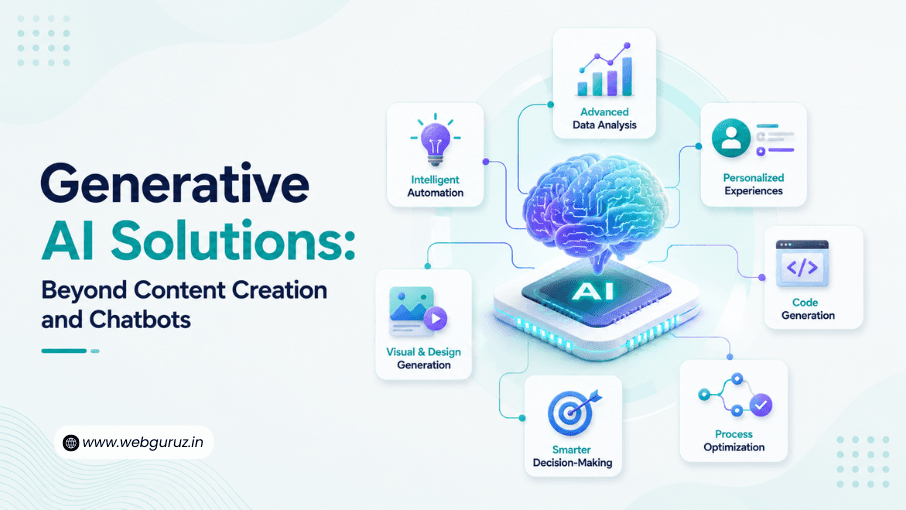
Artificial intelligence has become one of the biggest business conversations of the past few years. Yet for many organizations, its use is still limited to writing emails, generating blog posts, or answering customer questions through chatbots. While these are valuable applications, they only scratch the surface of what AI can achieve.
Today’s Generative AI Solutions are helping businesses streamline operations, improve customer experiences, automate repetitive tasks, and make faster, data-driven decisions. Whether it’s creating personalized marketing campaigns, assisting sales teams, or improving internal workflows, generative AI is quickly becoming a strategic business tool rather than just a productivity shortcut.
In this guide, we’ll explore how generative AI is transforming modern businesses, where it delivers the most value, and how organizations can adopt it responsibly to stay competitive in an increasingly AI-driven world.
When most people hear the term “generative AI,” they immediately think about writing articles, creating social media posts, or using chatbots like ChatGPT. While these use cases have introduced AI to millions of people, they represent only a small portion of its capabilities.
Businesses today face challenges that go far beyond creating content. Teams spend hours searching for information, responding to repetitive customer queries, analyzing reports, and completing manual administrative tasks. These activities consume valuable time that could be spent on innovation, customer relationships, or business growth.
Generative AI is changing that.
Instead of replacing employees, AI is helping them work more efficiently by handling repetitive tasks, organizing information, and supporting faster decision-making. According to McKinsey & Company, generative AI has the potential to add trillions of dollars in value to the global economy by improving productivity across industries, with marketing, sales, software engineering, and customer operations among the areas expected to see the greatest impact.
The biggest opportunity isn’t simply using AI to create more content; it’s using it to help people do better work.
| Common Myth | Reality |
|---|---|
| AI is only for writing content. |
It also helps automate workflows, analyze information, generate ideas, and improve decision-making. |
| AI replaces employees. |
AI supports employees by reducing repetitive work and improving productivity. |
| AI is only useful for large companies. |
Businesses of all sizes can adopt AI to improve daily operations. |
| AI only benefits marketing teams. |
Sales, customer service, HR, finance, and operations can all benefit from AI. |
| AI is a future trend. |
Businesses across industries are already using AI to improve efficiency and customer experiences. |
Organizations that recognize this broader potential are moving beyond experimentation and building long-term AI strategies.
At its core, generative AI uses advanced machine learning models trained on large amounts of data to create new content, summarize information, answer questions, and generate ideas based on user prompts.
Unlike traditional software, which follows fixed rules, generative AI can understand context, recognize patterns, and produce human-like responses across different formats, including text, images, code, audio, and more.
This flexibility allows businesses to apply AI in many different ways, such as:
As organizations continue investing in Generative AI Tools, they are discovering that AI becomes even more valuable when integrated into everyday business processes rather than used as a standalone application.
The real value of AI comes from solving practical business problems. Instead of asking, “How can we use AI?” successful organizations ask, “Which repetitive or time-consuming tasks can AI improve?”
Today, businesses are applying AI across multiple departments.
| Business Function | How Generative AI Helps |
|---|---|
| Marketing | Creates campaign ideas, ad copy, blogs, and email drafts. |
| Sales | Personalizes outreach and summarizes customer interactions. |
| Customer Support |
Drafts responses and assists support agents with faster resolutions. |
| HR |
Creates job descriptions, onboarding documents, and training materials. |
| Operations |
Summarizes meetings, generates documentation, and organizes knowledge. |
| Leadership |
Helps analyze reports, identify trends, and support decision-making. |
According to Microsoft’s Work Trend Index, employees spend a significant portion of their workday on repetitive digital tasks, highlighting the growing need for AI-powered productivity tools that reduce manual work and allow teams to focus on higher-value activities.
Rather than replacing expertise, AI acts as an assistant that helps employees complete routine work more efficiently.

Marketing has become one of the fastest-growing applications for AI because it combines creativity, personalization, and data analysis.
Instead of spending hours brainstorming ideas or manually creating multiple versions of campaigns, marketing teams can use AI to accelerate content creation while maintaining brand consistency.
This is why businesses are increasingly investing in Generative AI Marketing strategies that support every stage of the customer journey.
Some common applications include:
When combined with human creativity and editorial oversight, AI helps marketers produce better content faster without sacrificing quality.
One of the biggest misconceptions about AI is that it can completely replace human decision-making.
In reality, AI works best when paired with human expertise.
While AI can generate ideas, summarize information, and automate repetitive work, people are still responsible for:
The businesses seeing the greatest success with AI are those using it to enhance human capabilities rather than replace them.
As AI continues to evolve, organizations that combine technology with human experience will be better positioned to innovate, adapt, and deliver exceptional customer experiences.
Many businesses start using AI with a single tool, but the biggest benefits come when AI becomes part of a larger strategy. Instead of treating it as a standalone solution, organizations should look for ways to connect AI with their existing marketing, sales, and operational processes.
This is where Generative AI Marketing Services can make a real difference. Rather than simply creating content, these services help businesses use AI to improve campaign planning, customer engagement, audience segmentation, and performance analysis.
For example, a marketing team can use AI to draft campaign ideas, personalize email content for different customer groups, analyze campaign performance, and identify new content opportunities. Instead of replacing marketers, AI allows them to spend more time on strategy and creativity while reducing repetitive work.
The most successful businesses don’t ask, “How can AI do our work?” They ask, “How can AI help our people do their work better?”
Using multiple AI tools independently can create more problems than solutions. Teams may end up with disconnected data, inconsistent workflows, and duplicate efforts.
That’s why many organizations are investing in AI Integration Solutions that connect AI with CRM platforms, marketing automation software, customer support systems, and business intelligence tools.
Some common examples include:
When AI becomes part of existing workflows instead of another separate platform, businesses see greater efficiency and better collaboration across teams.

Marketing teams are under constant pressure to create more content, respond faster to changing trends, and deliver personalized customer experiences.
Modern AI Marketing Solutions help businesses meet these expectations by combining automation with data-driven insights.
Instead of manually creating every campaign from scratch, AI can support marketers by:
However, successful marketing still depends on human creativity. AI can generate ideas quickly, but experienced marketers provide the strategy, brand voice, and emotional understanding that technology cannot replace.
Automation has been part of digital marketing for years, but generative AI is making it much smarter.
Traditional automation follows predefined rules. Generative AI can understand context, generate responses, and adapt content based on different customer needs.
This is why GenAI Marketing Automation is becoming an important part of modern marketing strategies.
Businesses are using it to:
By reducing repetitive work, teams can focus on strategy, creativity, and building stronger customer relationships.
As AI becomes part of everyday business operations, platforms like Meta AI are expanding the ways organizations interact with customers.
From assisting conversations across Meta’s ecosystem to supporting content creation and customer engagement, Meta continues to introduce new AI-powered capabilities for businesses.
Businesses are also exploring Meta AI Tools to improve productivity, generate creative ideas, and support marketing activities across social platforms.
While every AI platform has its strengths, businesses shouldn’t rely on a single tool. A balanced strategy that combines multiple AI technologies helps organizations stay flexible as the AI landscape continues to evolve.

The rapid growth of AI has created countless opportunities, but it has also made decision-making more challenging. With so many tools available, it’s easy to adopt technology without a clear business objective.
Instead of asking, “Which AI tool should we use?”, businesses should ask:
Answering these questions first helps organizations choose the right technology instead of following trends.
Successful AI adoption isn’t about using the newest tools. It’s about solving real business problems in practical, measurable ways.
Generative AI is evolving rapidly, but one thing is already clear: it will become a standard part of how businesses operate.
From marketing and customer service to sales, operations, and decision-making, AI is helping organizations work faster, improve customer experiences, and unlock new opportunities for growth.
Businesses that begin experimenting today, invest in responsible AI practices, and continue refining their approach will be better prepared for the future than those waiting for AI to become “perfect.”
The goal isn’t to replace people with technology. It’s to create workplaces where people and AI work together to achieve better results.
The conversation around AI has moved far beyond content creation and chatbots. Today’s Generative AI Solutions are helping businesses streamline operations, improve customer engagement, support smarter decision-making, and unlock new opportunities for growth.
By combining the right technology with experienced strategy, AI Solutions can deliver real business value across every department. Whether it’s adopting AI Marketing Solutions, implementing AI Integration Solutions, or exploring the latest AI-powered tools, businesses that embrace innovation today will be better equipped to compete in tomorrow’s digital landscape.
Generative AI Solutions use artificial intelligence to create content, generate ideas,
automate repetitive tasks, analyze information, and support business decision-making.
They help organizations improve productivity while enhancing customer and employee experiences.
Traditional automation follows fixed rules and predefined workflows. Generative AI Tools
can understand context, create new content, summarize information, and adapt responses,
making them far more flexible for modern business needs.
Absolutely. Businesses of all sizes can use generative AI to save time, improve marketing,
automate routine work, and provide better customer experiences without requiring large
technology teams.
AI Integration Solutions connect AI with your existing business systems, such as CRM,
marketing automation, and customer support platforms. This creates smoother workflows,
improves data sharing, and increases overall efficiency.
Start by identifying repetitive tasks or business challenges that consume the most time.
Choose AI tools that address those specific needs, train your team on responsible AI usage,
and regularly review performance to ensure the technology continues to deliver value.
Vedanshi
2026-10-23
7 min read
Your business uses HubSpot to manage customer relationships, but disconnected systems create data issues.
Read More
Vedanshi
2026-10-22
7 min read
Ask ChatGPT, Gemini, or Perplexity to recommend a supplier or a software tool, and you get a short list of names, not ten blue links.
Read More
Vedanshi
2026-10-21
7 min read
Building a website takes more than picking colors, dropping in images, and writing copy.
Read More