 sales@webguruz.in
 +1 (213) 715-5368
Vedanshi
2026-10-23
7 min read
Custom HubSpot Integrations: Benefits, Examples, and Best Practices
Your business uses HubSpot to manage customer relationships, but disconnected systems create data issues.
Read More
Published On:2026-08-07
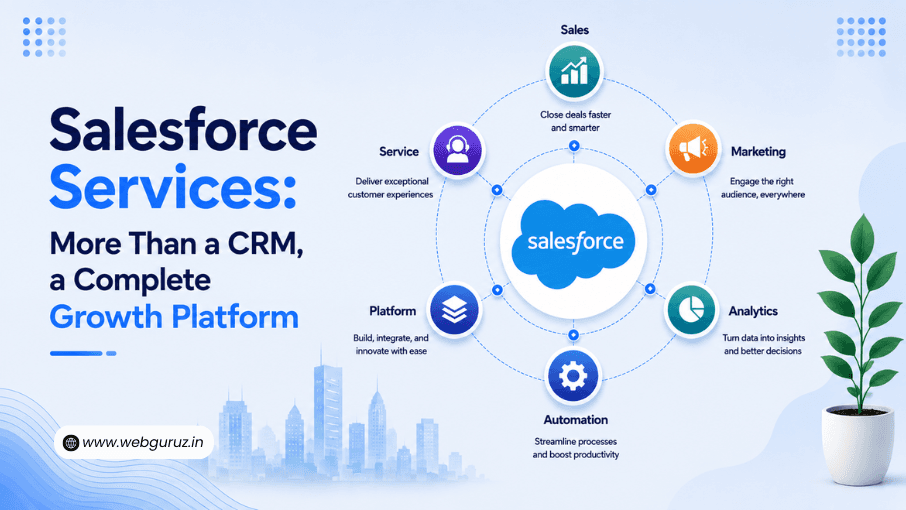
When people hear the word Salesforce, they often think of it as a CRM for managing customer information. While that’s true, it’s only a small part of what the platform offers. Today, Salesforce has evolved into a connected business ecosystem that helps organizations manage sales, marketing, customer service, commerce, automation, analytics, and AI from one place.
Choosing the right Salesforce Services isn’t about adopting every available product. It’s about selecting the solutions that match your business goals and integrating them in a way that improves productivity, customer experiences, and long-term growth. Whether you’re a growing startup or an established enterprise, understanding how Salesforce works as a complete platform can help you make smarter technology decisions.
In this guide, we’ll explore the Salesforce ecosystem, explain what each major solution does, and help you determine which services are most valuable for your business.
Customer expectations have changed dramatically over the last decade. Today’s customers expect personalized communication, quick support, seamless online experiences, and consistent interactions across every channel.
Meeting those expectations becomes difficult when sales, marketing, customer service, and operations all use different systems that don’t communicate with one another.
According to Salesforce’s State of the Connected Customer research, customers increasingly expect companies to understand their unique needs and provide connected experiences across every interaction. Businesses that rely on disconnected tools often struggle to deliver this level of service.
That’s why many organizations are moving beyond standalone CRM software toward connected business platforms that bring teams, customer data, and business processes together.
Instead of managing separate systems for marketing, customer support, sales, and reporting, businesses can operate from one connected environment where information flows across departments.
The result is better collaboration, improved visibility, and faster decision-making.
One of Salesforce’s biggest strengths is that it isn’t a single product. Instead, it offers a collection of cloud-based applications designed to solve different business challenges while sharing the same customer data.
Rather than asking, “Which Salesforce product is best?”, businesses should ask:
“Which business challenge are we trying to solve?”
The answer will often determine which Salesforce solution delivers the greatest value.
| Business Goal | Salesforce Solution | How It Helps |
|---|---|---|
| Generate and manage leads | Sales Cloud | Tracks opportunities and improves sales productivity. |
| Deliver better customer support | Service Cloud | Helps support teams resolve customer issues faster. |
| Run personalized marketing campaigns | Marketing Cloud | Automates customer journeys and communications. |
| Sell products online | Commerce Cloud | Creates connected ecommerce experiences. |
| Build customer or partner portals | Experience Cloud | Enables secure collaboration and self-service. |
| Generate accurate quotes | CPQ | Speeds up quoting and pricing processes. |
| Gain AI-driven insights | Einstein | Supports smarter business decisions with AI. |
| Connect different business systems | Integration Services | Keeps customer data synchronized across platforms. |
The real value comes from using these products together instead of treating them as separate tools. For example, businesses using Salesforce Experience Cloud Services can create secure customer and partner portals that work seamlessly alongside Sales Cloud, Service Cloud, and Marketing Cloud, delivering a more connected experience across every customer touchpoint.
Businesses that understand the Salesforce ecosystem are better equipped to build scalable technology strategies instead of investing in disconnected software.

Every business has different goals, processes, and customer journeys. While Salesforce is highly flexible, that flexibility also means careful planning is essential before implementation begins.
This is where Salesforce Consulting Services provide value.
Rather than simply setting up software, consultants help businesses understand how Salesforce should support their operations. They evaluate existing processes, identify opportunities for automation, recommend the right Salesforce products, and create an implementation roadmap aligned with business objectives.
For example:
Each business requires a different combination of Salesforce capabilities.
Experienced consultants also help organizations avoid common implementation mistakes, including:
Starting with the right strategy often saves businesses significant time and cost later in the implementation journey.
Even the best technology can struggle if employees don’t know how to use it effectively.
Many organizations focus heavily on configuring Salesforce but give far less attention to preparing the people who will use it every day. As a result, teams continue relying on spreadsheets, manual processes, or outdated systems despite having a powerful CRM in place.
A structured Salesforce Onboarding process helps employees understand not only how to use the platform but also why new processes have been introduced.
Effective onboarding usually includes:
According to Gartner, technology implementations are far more likely to succeed when organizations focus on people, processes, and change management alongside the technology itself.
Successful onboarding creates confidence across teams, improves user adoption, and helps businesses achieve value from Salesforce much faster.
One of the biggest misconceptions about Salesforce is that every business needs every product. In reality, most organizations begin with one or two core solutions and expand as their requirements evolve.
The right choice depends on your business model, customer journey, and long-term objectives.
For organizations focused on improving lead management and sales performance, Salesforce Sales Cloud provides tools for managing opportunities, forecasting revenue, automating follow-ups, and improving visibility across the sales pipeline.
Businesses looking to build stronger customer relationships after the sale often benefit from Salesforce Service Cloud Solutions, which centralize customer support, automate case management, and help service teams deliver faster, more personalized assistance.
Marketing teams aiming to create personalized customer journeys frequently invest in Salesforce Marketing Cloud Services. These solutions help businesses automate campaigns, segment audiences, personalize communications, and measure marketing performance across multiple channels.
Each cloud serves a different purpose, but together they create a connected customer experience that supports growth across the entire business.
As businesses grow, customer interactions extend beyond sales and support. Many organizations also need online stores, self-service portals, and secure spaces where customers, partners, or employees can collaborate.
For businesses selling products online, Salesforce Commerce Cloud provides a connected ecommerce platform that helps deliver personalized shopping experiences across web and mobile channels. It brings together customer data, product information, and order management so businesses can create smoother buying journeys.
Organizations looking to strengthen customer engagement outside traditional support channels often turn to Salesforce Experience Cloud Services. These solutions allow businesses to build customer portals, partner communities, knowledge bases, and employee hubs that make information easier to access while reducing pressure on support teams.
Instead of treating every customer interaction as a separate experience, these solutions help businesses build connected digital journeys from the first visit to long-term customer loyalty.
Artificial intelligence is becoming an important part of modern CRM, but successful adoption isn’t about adding AI for the sake of innovation. It’s about helping employees make better decisions with less effort.
This is where Salesforce AI Enablement helps businesses unlock more value from the data they already collect.
By combining AI with customer information, sales activities, and service history, organizations can automate repetitive tasks, identify trends, and surface recommendations that help teams work more efficiently.
Businesses can also take advantage of Salesforce Einstein Services, which introduce AI-powered capabilities across the Salesforce platform. Depending on business needs, Einstein can assist with lead scoring, sales forecasting, customer insights, case prioritization, and predictive analytics.
Rather than replacing human expertise, AI helps employees focus on higher-value work while making everyday business processes faster and more informed.
Creating accurate quotes can become increasingly difficult as products, pricing models, and customer requirements grow more complex.
Salesforce CPQ Solutions help businesses streamline the entire quoting process by automating product configuration, pricing, approvals, and proposal generation.
Instead of manually preparing quotes, sales teams can create accurate proposals much faster while reducing pricing errors and maintaining consistency across the organization.
This not only shortens sales cycles but also improves the customer experience by delivering faster responses and more reliable pricing.
Even the most powerful CRM cannot deliver its full value if important business information is scattered across multiple platforms.
Many organizations rely on accounting software, ERP systems, ecommerce platforms, marketing tools, customer support applications, and internal databases. When these systems operate independently, employees often spend valuable time manually transferring information between them.
This is where Salesforce Integration Services become essential.
By connecting Salesforce with other business applications, organizations can create a single, consistent view of customer information while reducing duplicate data entry and improving collaboration across departments.
Businesses may also use Salesforce Integration Tools to connect platforms such as ERP software, ecommerce systems, marketing automation platforms, finance applications, and communication tools. These integrations help automate workflows, improve reporting accuracy, and ensure every team works with the same up-to-date information.
Instead of switching between multiple systems, employees can access the information they need from one connected ecosystem, making day-to-day operations more efficient and customer experiences more consistent.
Salesforce is a flexible platform, but flexibility doesn’t guarantee success. Many implementation challenges occur not because of the technology itself, but because of poor planning and user adoption.
Some of the most common mistakes include:
According to Salesforce research, businesses achieve the greatest value when technology, processes, and people work together rather than being managed independently.
Taking a phased approach allows organizations to learn, gather feedback, and improve continuously instead of trying to transform every department at the same time.

Every business has different goals, challenges, and customer journeys. That’s why there is no single Salesforce implementation that works for everyone.
An experienced implementation partner takes the time to understand your business before recommending technology. They help identify the right products, create practical implementation roadmaps, simplify complex processes, and support long-term adoption across your organization. Whether you’re investing in Salesforce Marketing Cloud Services, Sales Cloud, Service Cloud, or other Salesforce solutions, the right partner ensures every implementation aligns with your business objectives.
The right partner also continues to optimize your Salesforce environment as your business grows, ensuring your CRM evolves alongside changing customer expectations and business priorities.
Rather than simply deploying software, they help you build a connected platform that supports sales, marketing, service, and operations for years to come.
Choosing the right Salesforce services isn’t about adopting every product available. It’s about selecting the solutions that align with your business goals and creating a connected platform that helps every team work more effectively.
Whether your priority is improving sales with Salesforce Sales Cloud, delivering exceptional customer support, strengthening marketing campaigns, enabling AI-powered insights, or connecting business systems through Salesforce Integration Services, Salesforce offers the flexibility to grow alongside your business.
When supported by the right strategy, implementation, and ongoing optimization, Salesforce becomes far more than a CRM. It becomes a complete growth platform that helps businesses build stronger customer relationships, improve operational efficiency, and make smarter decisions in an increasingly connected world.
Salesforce Services include consulting, implementation, onboarding, cloud solutions, AI
capabilities, integrations, and ongoing support that help businesses use Salesforce more
effectively to manage customer relationships and streamline operations.
The right cloud depends on your goals. Sales Cloud is ideal for managing leads and
opportunities, Service Cloud supports customer service teams, Marketing Cloud helps
automate campaigns, Commerce Cloud powers ecommerce, and Experience Cloud creates
customer and partner portals.
Salesforce Consulting Services help businesses choose the right products, design efficient
workflows, avoid implementation mistakes, and ensure the platform supports long-term
business objectives.
Salesforce AI Enablement helps businesses use artificial intelligence within Salesforce to
automate tasks, generate insights, improve forecasting, and support better decision-making
using customer data.
Salesforce Integration Services connect Salesforce with other business applications such as
ERP systems, ecommerce platforms, accounting software, and marketing tools. This creates a
unified view of customer data, reduces manual work, and improves collaboration across teams.
Vedanshi
2026-10-23
7 min read
Your business uses HubSpot to manage customer relationships, but disconnected systems create data issues.
Read More
Vedanshi
2026-10-22
7 min read
Ask ChatGPT, Gemini, or Perplexity to recommend a supplier or a software tool, and you get a short list of names, not ten blue links.
Read More
Vedanshi
2026-10-21
7 min read
Building a website takes more than picking colors, dropping in images, and writing copy.
Read More