SEO Writing Technical Writing

RevOps Consulting Services: Build One Revenue Engine Instead of Three Separate Teams

Author
By Vedanshi

Published On:2026-08-12

0
View:69
singleblog

Many growing businesses invest in better marketing, hire experienced salespeople, and improve customer support, yet revenue growth still slows down. The problem often isn’t a lack of effort. It’s that each team works toward its own goals, uses different systems, and relies on disconnected data.

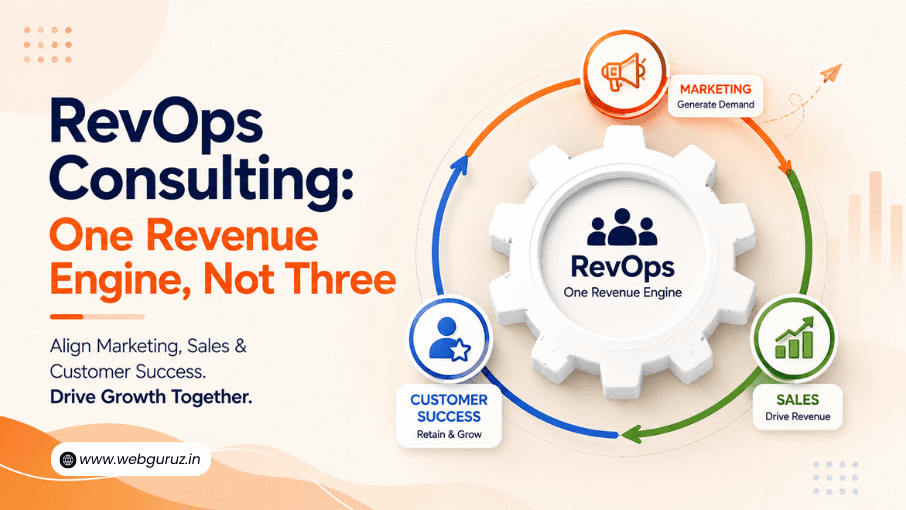
This is where RevOps Consulting Services make a difference. Revenue Operations (RevOps) aligns marketing, sales, and customer success around one shared strategy, one set of processes, and one source of truth. Instead of operating as separate departments, every team works together to create a smoother customer journey and drive sustainable business growth.

In this guide, we’ll explore why disconnected teams limit growth, what a connected revenue engine looks like, and how businesses can use RevOps to improve efficiency, collaboration, and customer experiences.

Why Revenue Problems Are Usually System Problems

When revenue slows down, businesses often assume they need more leads, better salespeople, or larger marketing budgets.

But many times, the real issue lies elsewhere.

Marketing generates leads that sales doesn’t follow up on. Sales closes deals without sharing important customer information. Customer success teams work hard to retain customers but don’t have visibility into what was promised during the sales process.

Each department performs well individually, yet the overall customer experience suffers because the systems, data, and processes aren’t connected. For businesses relying on multiple CRMs or disconnected tools, a well-planned HubSpot CRM Migration can bring customer data into one centralized platform, giving every team access to the same accurate information.

RevOps addresses these challenges by creating one connected process that supports the entire customer lifecycle rather than optimizing each department separately.

The Cost of Working as Three Separate Teams

Disconnected teams don’t just create internal challenges; they directly affect customer experience and business performance.

Consider what happens when each department operates independently:

Team Primary Focus Challenge Without RevOps Business Impact
Marketing Generate leads Limited visibility into sales outcomes Lower lead quality and missed opportunities
Sales Close deals Incomplete customer history Slower sales cycles and inconsistent follow-ups
Customer Success Retain customers Limited insight into previous interactions Reduced customer satisfaction and retention
Leadership Measure growth Different reports from different teams Poor forecasting and slower decision-making

When every team works from separate systems, customers often repeat the same information multiple times, internal handoffs become slower, and leadership struggles to make decisions based on reliable data.

This is why many businesses invest in HubSpot marketing automation as part of their RevOps strategy. By automating lead handoffs, follow-up tasks, and customer communications within a shared CRM, teams stay aligned and every department works with the same up-to-date information.

Businesses that connect these teams create a more consistent customer experience while improving efficiency across the organization.

What a Connected Revenue Engine Looks Like

RevOps isn’t about creating another department. It’s about helping every revenue-generating team work from the same playbook.

In a connected revenue engine:

  • Marketing understands which campaigns generate qualified customers.
  • Sales sees every customer interaction before making contact.
  • Customer success knows exactly what was promised during the sales process.
  • Leadership measures performance using one shared dashboard.

Instead of passing information manually between departments, customer data moves automatically throughout the business.

This creates faster responses, better collaboration, and more informed decision-making at every stage of the customer journey.

According to McKinsey, organizations that successfully connect data, technology, and customer-facing teams are better positioned to deliver personalized customer experiences and improve business performance.

Building RevOps Starts With the Right Foundation

Building RevOps

Technology plays an important role in RevOps, but software alone doesn’t solve disconnected processes.

Before implementing new tools, businesses should first understand how information moves between marketing, sales, and customer success.

Ask questions like:

  • Where do leads come from?
  • When should sales engage with a prospect?
  • How are customers handed over after a deal closes?
  • Which tasks can be automated?
  • What metrics should every team track?

Once these processes are clearly defined, technology becomes much easier to implement.

This is where HubSpot Implementation helps businesses create a connected CRM that supports every stage of the customer journey instead of managing separate systems for different departments.

Rather than adapting your business to fit the software, implementation should reflect the way your teams already work while creating opportunities to improve efficiency over time.

Why HubSpot Has Become a Popular RevOps Platform

A successful RevOps strategy depends on having one place where every team can access the same customer information.

HubSpot supports this by bringing marketing, sales, customer service, operations, and reporting into one connected platform.

Businesses often choose HubSpot Development Services when they need to customize their CRM, build tailored workflows, create custom objects, or connect HubSpot with existing business systems. These customizations help ensure the platform supports unique business processes rather than forcing teams to change the way they work.

Because every interaction is stored in one CRM, marketing can see campaign performance, sales can track deal progress, and customer success teams can access complete customer histories without switching between multiple tools.

The result is better collaboration, more reliable reporting, and a smoother experience for both employees and customers.

Why CRM Migration Is Often the First Step

Many businesses already have customer data, but it’s spread across spreadsheets, legacy CRMs, email platforms, and disconnected applications.

Before building a connected revenue engine, that information needs to be brought together.

A well-planned HubSpot Migration helps businesses move their customer data, workflows, and historical information into one centralized platform while minimizing disruption.

For organizations moving from another CRM, HubSpot CRM Migration is also an opportunity to remove duplicate records, standardize customer information, and simplify outdated processes before they become part of the new system.

Clean, organized data gives every department access to accurate information, making collaboration easier from day one.

Connect Teams With Intelligent Automation


Connect Teams With Intelligent

Technology alone doesn’t create alignment. The real value comes from connecting processes so information flows automatically between teams.

This is where HubSpot Automation Services become essential. Instead of manually assigning leads, updating records, or sending follow-up emails, businesses can automate these repetitive tasks while ensuring every department has access to the same customer information.

For example, when a prospect downloads a resource, requests a demo, or becomes a customer, automation can instantly notify the right team, update the CRM, and trigger the next step in the customer journey. This reduces manual work, eliminates delays, and helps every team stay aligned.

Automation isn’t about replacing people, it’s about giving them more time to focus on meaningful customer interactions.

Sales Works Better When It Has Complete Customer Context

Sales teams perform best when they understand the customer’s journey before the first conversation begins.

Without connected systems, sales representatives often spend valuable time searching for information or asking questions customers have already answered.

HubSpot Sales Consulting helps businesses design sales processes that use shared customer data to prioritize opportunities, improve follow-ups, and shorten sales cycles. Instead of relying on guesswork, sales teams can see marketing interactions, previous conversations, and customer activity in one place.

This allows representatives to have more relevant conversations and build stronger relationships from the very first interaction.

Adoption Determines Whether RevOps Succeeds

Implementing new technology is only part of the journey. Long-term success depends on whether people actually use it.

Many businesses invest in new CRM platforms but struggle because employees continue using spreadsheets, emails, or disconnected tools they’ve relied on for years.

A structured HubSpot Onboarding process helps teams understand not only how to use the platform but also why the new processes matter. When employees see how connected systems reduce manual work and improve collaboration, adoption becomes much easier.

According to Gartner, digital transformation initiatives are far more likely to succeed when organizations focus on people, processes, and change management alongside technology.

RevOps succeeds when technology becomes part of everyday work, not when it’s treated as another system employees are expected to learn on their own.

Why Businesses Work With Experienced RevOps Partners


Why Businesses Work

Building a connected revenue engine involves much more than implementing software. It requires aligning processes, integrating systems, improving data quality, and ensuring every department works toward shared business goals.

That’s why many organizations choose to work with a trusted RevOps Agency Partner rather than managing the transformation internally.

An experienced partner helps businesses:

  • Align marketing, sales, and customer success.
  • Build scalable CRM processes.
  • Connect business systems.
  • Improve reporting and forecasting.
  • Identify opportunities for automation.
  • Support long-term adoption and optimization.

Many organizations also rely on HubSpot Consultants to customize their CRM, recommend best practices, and ensure the platform continues to support changing business needs as they grow.

Rather than delivering a one-time implementation, the right partner helps businesses build a revenue system that continues to improve over time.

RevOps Is an Ongoing Business Strategy

RevOps isn’t a project that ends after implementation.

As businesses grow, customer expectations change, new technologies emerge, and internal processes evolve. A successful revenue engine should adapt alongside these changes.

Organizations that invest in Expert RevOps Services regularly review their processes, refine automations, improve reporting, and strengthen collaboration between teams. Small improvements made consistently often deliver greater long-term value than large one-time transformations.

The goal isn’t simply to connect software. It’s to create a business where every team contributes to one shared objective: sustainable revenue growth.

Conclusion

Growing businesses don’t need separate strategies for marketing, sales, and customer success—they need one connected revenue engine.

Investing in RevOps Consulting Services helps businesses align their teams, centralize customer data, automate repetitive processes, and make better decisions using shared insights. Whether you’re planning a HubSpot Implementation, improving automation, or optimizing your CRM, RevOps provides the foundation for predictable, scalable growth.

Businesses that connect their people, processes, and technology today will be better prepared to deliver exceptional customer experiences, improve operational efficiency, and grow with confidence in the years ahead.

Frequently Asked Questions

1. What are RevOps Consulting Services?

RevOps Consulting Services help businesses align marketing, sales, and customer success through connected processes, shared data, and integrated technology. The goal is to improve collaboration, customer experiences, and long-term revenue growth.

2. Is RevOps only for large businesses?

No. Businesses of all sizes can benefit from RevOps. Even small and mid-sized organizations often struggle with disconnected systems and manual processes. Implementing RevOps early creates a stronger foundation for future growth.

3. How does HubSpot support a RevOps strategy?

HubSpot brings marketing, sales, customer service, operations, and reporting into one CRM. This gives every team access to the same customer information, improving collaboration and enabling better automation across the customer journey.

4. Why is CRM migration important for RevOps?

Migrating to a single CRM helps eliminate duplicate data, improve reporting, and ensure every team works from one reliable source of customer information. This makes collaboration easier and supports more accurate business decisions.

5. Why should businesses work with a RevOps Agency Partner?

A RevOps Agency Partner helps businesses design connected processes, implement the right technology, improve data quality, automate workflows, and support long-term adoption. This reduces costly mistakes and helps organizations build a scalable revenue engine.

Author
WRITTEN BY:
Vedanshi
73

Vedanshi Sharma is a passionate content writer and editor who believes every brand has a story worth telling, and she's here to tell it right. She works closely with marketing teams to craft content that goes beyond the surface, blending technical depth with a narrative pull that keeps readers hooked.

View all Articles by Vedanshi
  • Forte:SEO Writing, Technical Writing
  • Likes: 0
  • Wannabe: Archeologist
  • Social:
  • Biggest Blunder Committed: None as yet.
Turn Separate Teams Into One Revenue EngineTalk to Our RevOps Experts
img1
  • Vedanshi

  • 2026-09-09

  • 7 min read

A Complete Checklist for Hiring the Right HubSpot Developer in 2027

Hiring a HubSpot developer used to be a fairly straightforward process. You looked for someone who understood HubSpot, knew how to work with APIs and CRM data, had experience with custom development, and ideally held relevant certifications.

Read More
img2
  • Vedanshi

  • 2026-08-25

  • 7 min read

Why Website Traffic Is Falling: The New Digital Marketing Reality

Google still processes billions of searches every day, but the way people search is changing fast. AI-powered search experiences, featured answers, and conversational tools now give users instant information without always sending them to a website.

Read More
img3
  • Vedanshi

  • 2026-08-25

  • 7 min read

SEO Services in 2027: What’s Changing and What Businesses Need to Know

There was a time when improving your SEO meant a fairly straightforward process.You researched keywords, published optimized content, built backlinks, and worked towards ranking on Google’s first page. If you ranked well, traffic increased.

Read More