 sales@webguruz.in
 +1 (213) 715-5368
Vedanshi
2026-10-23
7 min read
Custom HubSpot Integrations: Benefits, Examples, and Best Practices
Your business uses HubSpot to manage customer relationships, but disconnected systems create data issues.
Read More
Published On:2026-07-02
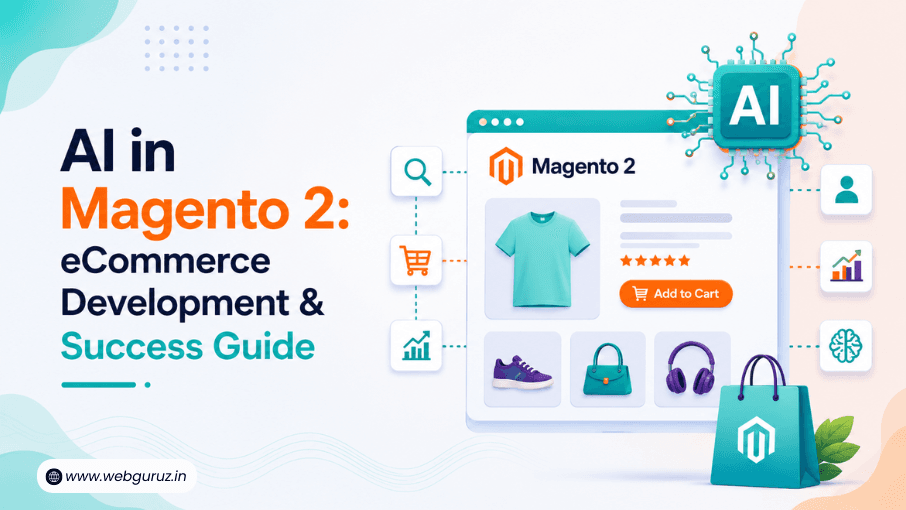
Most conversations about AI in eCommerce stop at the feature list. Personalized recommendations. Smart search. Chatbots. Dynamic pricing. The headline use cases are well-established, but the gap between knowing what AI can do and understanding how it actually integrates with a Magento 2 store’s architecture is where most merchants get stuck.
This is not a theoretical overview. It is a practical guide for Magento store owners and operators who want to understand which AI capabilities deliver real commercial impact, how they connect to Magento’s underlying systems, and what implementation actually involves. Whether you are evaluating your first AI integration or rethinking an existing setup, the clarity you need starts with understanding the use case before selecting the tool.
Professional Magento development services are increasingly defined by this capability, not just building and maintaining stores but architecting the AI integration layer that determines whether a Magento 2 investment compounds over time or plateaus.

Magento 2’s architecture is particularly well-suited to AI integration. Its REST and GraphQL APIs allow virtually any AI service to connect to the catalog, order management, and customer data layers without requiring platform replacement. Unlike more closed platforms, Magento lets you wire in best-of-breed AI tools (search providers, recommendation engines, fraud detection services, and pricing optimizers) while maintaining full control over your data and infrastructure.
Adobe Sensei, embedded in Adobe Commerce (Magento’s enterprise tier), provides native AI capabilities across product recommendations, live search, and customer segmentation. For merchants on the open-source tier or those with specific requirements that Sensei does not address, the Magento Marketplace and third-party API integrations provide access to specialized AI solutions that often bring domain-specific precision that a generalist platform AI cannot replicate. This is the integration landscape that any experienced Magento development company maps before recommending an AI toolset.
The result is an ecosystem where the decision is not “should we add AI?” but “which AI capabilities, deployed in what sequence, produce the clearest return for our specific store and customer base?” That sequencing question is where Magento website development expertise intersects with commercial strategy and where the difference between a technically capable implementation and a commercially effective one becomes most apparent.

Understanding that AI fits naturally into Magento 2 is only the starting point. The real value comes from identifying which use cases actually move the needle for your store and implementing them in the right order. Not every AI capability delivers equal impact at every stage of growth, and trying to do everything at once often leads to complexity without clear returns.
Not every AI capability delivers equal commercial value at the same stage of eCommerce growth. The comparison below shows where different AI integrations create the biggest operational and revenue impact inside Magento 2 environments.
| AI Capability | Primary Business Benefit | Magento Integration Complexity | Best For |
|---|---|---|---|
| Intelligent Search | Higher conversion rates and improved product discovery | Low to Medium | Stores with large catalogs |
| AI Fraud Detection | Reduced chargebacks and payment risk | Medium | High-transaction stores |
| Predictive Inventory Management | Better stock planning and lower overstock risk | Medium to High | Multi-SKU and enterprise stores |
| AI Chatbots | Faster customer support and reduced support workload | Medium | Stores with high support volume |
| AI Content Generation | Scalable SEO and faster catalog optimization | Low to Medium | Large product catalogs |
| Visual Search & AR | Better product discovery and buyer confidence | High | Fashion, furniture, and lifestyle brands |
| AI Email & Retargeting | Higher cart recovery and repeat purchases | Medium | Growth-focused eCommerce brands |
The use cases below focus on where AI consistently drives measurable commercial outcomes, along with how each integrates into Magento’s architecture and what to consider before implementation.
Standard Magento 2 search, built on Elasticsearch, is functional but limited. It matches keywords to product attributes without understanding query intent. A customer searching for “warm boots for wet weather” may receive results based on individual keyword matching rather than semantic understanding of what they are actually looking for.
AI-enhanced search replaces this keyword-matching model with natural language processing that interprets intent, corrects typos, handles synonyms, and learns from the queries that lead to purchases versus those that lead to exits. Tools like Algolia, Searchanise, and Adobe Live Search integrate with Magento’s catalog and indexing layer to deliver search results that reflect what customers mean, not just what they typed.
The revenue impact of search improvement is disproportionate to its prominence in most AI conversations. Visitors who use search convert at two to three times the rate of non-searchers, because search intent signals purchase readiness. According to industry eCommerce research, shoppers who use on-site search are significantly more likely to convert because they typically demonstrate higher purchase intent and deeper product engagement than general browsing visitors.
A search experience that fails those high-intent visitors is failing the highest-value segment of store traffic. Improving search relevance directly affects conversion rate, average session depth, and the likelihood of a visitor’s return.
For e-commerce development service partners working on Magento implementations, search is consistently one of the highest-ROI AI investments available, with high impact, a relatively contained implementation scope, and measurable before-and-after benchmarks.
Magento 2 stores processing significant transaction volume face a specific and expensive risk: card testing attacks, account takeover fraud, and chargeback exposure that accumulates faster than manual review queues can address. For merchants experiencing chargeback rates above 0.5 percent (the threshold where payment processors begin imposing penalties), AI fraud detection is risk management, not an optimization.
Tools like Signifyd, Kount, and Forter integrate at Magento’s order placement stage, analyzing hundreds of signals per transaction in milliseconds: device fingerprint, IP velocity, email account age, shipping address match rate, behavioral biometrics, and purchase pattern anomalies. The result is a fraud score that determines order approval or review routing, produced faster than any manual review process and with demonstrably lower false positive rates.
Signifyd’s model includes a financial guarantee against chargeback loss on approved orders, a feature that changes the risk calculus for high-volume merchants who currently absorb chargeback losses as an operational cost. The integration with Magento’s order management event system makes deployment relatively contained, and the ROI calculation is unusually direct: fraud losses prevented minus tool cost.
This use case is one of the strongest entry points for AI in Magento stores because the business impact is both measurable and immediate. It is also an area where e-commerce consulting services consistently find merchants underinvested relative to their actual exposure. For any Magento development services engagement that includes payment processing configuration, fraud detection integration should be part of the core scope rather than a later addition.
Inventory management errors are costly in two directions: stockouts lose sales and damage brand trust; overstocking ties up working capital and creates markdown exposure. Traditional inventory planning relies on historical sales data and manual judgment, which handles stable demand patterns reasonably well and seasonal spikes and disruptions poorly.
AI-powered inventory forecasting analyzes historical sales data, seasonality patterns, external signals (trend data, search volume, economic indicators), and promotional calendars to generate demand predictions that outperform rule-based models in accuracy and adaptability. McKinsey research has consistently found that personalization strategies powered by AI and behavioral data can significantly increase customer satisfaction, conversion rates, and long-term revenue growth for e-commerce businesses. The integration with Magento’s inventory management layer allows forecast outputs to inform automatic reorder triggers, supplier communication workflows, and stock allocation across multiple warehouse locations.
For e-commerce website maintenance contexts, where keeping an established store performing at its commercial potential is the ongoing brief, inventory AI is one of the highest-leverage investments available. It directly affects working capital efficiency, fulfillment reliability, and the customer experience quality that drives repeat purchase rates. Incorporating inventory forecasting into a Magento development services retainer is increasingly standard practice for agencies managing high-SKU stores where stockout and overstock costs are material.
AI chatbots in Magento 2 have evolved considerably beyond the simple FAQ responders of three years ago. Modern AI chat implementations handle order tracking, return initiation, product guidance, stock availability queries, and complex support conversations, with context maintained across the session and escalation pathways to human agents for cases that require judgment.
The operational impact is significant for high-volume stores: AI chat handles the majority of repetitive inquiries that would otherwise require human agent time, freeing support resources for complex issues while providing customers with instant responses at any hour. Customer satisfaction data consistently shows that response speed matters as much as response quality for inquiry resolution, and AI chat eliminates wait times that damage satisfaction even when the eventual response is helpful.
For eCommerce implementation solutions, the key integration consideration is connecting the chatbot to live Magento data (inventory levels, order status, and customer account information) so that responses reflect current reality rather than cached or static information. A chatbot that gives an accurate answer about a product’s availability at the time the customer asked is genuinely useful. One that gives an answer based on yesterday’s inventory data is not.
Managing product descriptions, meta titles, category copy, and blog content at scale is one of the most resource-intensive operational challenges for large Magento catalogs. A store with 10,000 SKUs where every product page needs a unique, keyword-optimized description cannot address this challenge manually at a cost that makes commercial sense.
AI content generation tools integrated with Magento’s product and catalog layer can draft product descriptions based on attribute data (specifications, materials, dimensions, category context) and optimize them for search intent. Adobe Firefly and generative AI integrations through Magento’s content APIs make this workflow implementable without rebuilding the CMS architecture.
The important caveat is quality control. AI-generated content requires human review and brand voice calibration, particularly for premium or specialist products where content quality is a differentiator rather than a baseline requirement. For commodity products and large catalogs where the alternative is no unique content at all, AI generation with editorial oversight produces a clear improvement in both content coverage and search performance.
CMS Web Development Services that include Magento engagements are increasingly expected to address content at scale as part of the platform’s value delivery, not as a separate content agency brief.
Visual search allows customers to upload an image (a screenshot, a photo from social media, a photo they took themselves) and find visually similar products within the Magento catalog. The integration works through computer vision APIs that analyze the uploaded image, extract visual attributes, and match them against the product catalog’s attribute layer.
For categories where visual similarity drives purchase decisions (fashion, furniture, home décor, accessories), visual search dramatically reduces the friction between inspiration and purchase. A customer who sees a product they like but cannot describe in keyword terms is traditionally lost. Visual search recovers that customer by making the catalog searchable through images rather than words. For agencies offering eCommerce website design services, visual search capability has become one of the most requested UX features for fashion and lifestyle store briefs in 2026 because it directly addresses the gap between how customers discover products on social media and how they can find those products in a store.
Augmented reality product visualization addresses a different but related challenge: purchase hesitation caused by uncertainty about how a product looks in context. AR implementations for Magento, such as “view in room” for furniture and large appliances and “try on” for eyewear and jewelry, reduce return rates by giving customers better purchase confidence before they commit. Adobe Commerce’s AR integration with Adobe Experience Manager makes this available without custom development overhead for merchants on the enterprise tier.
Cart abandonment rates across e-commerce average between 70 and 80 percent. Baymard Institute research shows that the average documented online shopping cart abandonment rate remains close to 70%, making AI-driven retargeting and personalized recovery workflows some of the highest-impact automation investments available to online retailers. The majority of those abandoned carts represent genuine purchase intent that was interrupted rather than extinguished, and AI-powered retargeting recovers a meaningful portion of that revenue when the timing, message, and channel are right.
AI email and retargeting tools integrated with Magento’s customer and order data generate send time optimization, content personalization, and suppression logic that significantly outperforms broadcast email campaigns. Rather than sending the same abandonment email to every cart abandoner at the same time, AI tools analyze individual engagement patterns to determine the optimal send window for each contact, the most relevant product to feature in the email body, and whether an incentive is likely to convert or simply train the customer to abandon intentionally for the discount.
This is where CMS website development and marketing infrastructure intersect in Magento implementations. The behavioral data generated by the store needs to flow cleanly into the marketing layer for AI-driven email to perform at its potential. Tools like Dotdigital, Klaviyo, and Salesforce Marketing Cloud all offer Magento integrations that handle this data pipeline, but the data quality and event tracking configuration on the Magento side determines the ceiling of what the marketing layer can do with it.
The use cases above represent different levels of implementation complexity, data maturity requirements, and commercial return timelines. For most Magento merchants evaluating where to begin, a practical sequence considers both the readiness of existing data infrastructure and the immediacy of business impact.
Fraud detection and intelligent search are consistently the strongest entry points. Both have contained implementation scope, measurable before-and-after impact, and do not require significant historical data to produce results. Product recommendations follow; they require behavioral data to train effectively, which accumulates relatively quickly on stores with meaningful traffic. Dynamic pricing and AI segmentation typically come next, as they benefit from the data richness that grows with store maturity. Content generation, visual search, and AR are most valuable once the foundational layers are producing reliable results.
The sequencing decision should also account for the existing web development company or internal team’s capacity to manage integration complexity alongside ongoing store operations. Businesses working with a full-service website development services partner are better positioned to implement multiple AI capabilities in sequence without disrupting live store performance because the integration work happens within a managed development environment rather than directly against a production store. Implementing four AI capabilities simultaneously is rarely the most efficient path to realizing their individual value because the organizational capacity to configure, monitor, and iterate on each use case is finite.

AI in Magento 2 is not a single decision or a one-time implementation. It is a layered capability that compounds in value as data accumulates, models improve, and integrations deepen. A Magento development company brings the dual perspective this requires: the technical capability to implement AI integrations correctly within Magento’s architecture and the commercial understanding to prioritize the use cases that produce the clearest impact for a specific store’s scale, category, and customer base. That combination (technical execution guided by commercial strategy) is what transforms AI from an impressive feature list into a compounding operational advantage.
Everything covered in this How to Use AI in Magento 2: A Magento Development Services Guide to eCommerce Success guide points to one conclusion: the question is not whether AI belongs in your Magento store. The question is where to start and how to build the foundation that makes every subsequent AI capability perform at its potential.
Everything covered in this How to Use AI in Magento 2: A Magento Development Services Guide to eCommerce Success guide points to one conclusion: the question is not whether AI belongs in your Magento store. The question is where to start and how to build the foundation that makes every subsequent AI capability perform at its potential.
No, you don’t. Adobe Commerce comes with built-in AI features like Adobe Sensei, but if you’re on Magento Open Source, you can still integrate powerful third-party AI tools. In many cases, those tools are more specialized and flexible anyway.
Start with intelligent search or fraud detection. Both are relatively easy to implement and have a clear, measurable impact. Search improves conversions quickly, and fraud detection protects revenue immediately.
It depends on the use case. Some integrations (like search or email automation) are quite manageable in cost and deliver fast ROI. Others, like predictive inventory or AR, require more investment. The key is prioritizing what gives you the biggest return first.
Not if it’s implemented correctly. Most AI tools run externally and connect via APIs, so they don’t overload your core Magento infrastructure. In fact, some (like AI search) can actually improve performance from a user experience perspective.
If your product data is structured, your tracking is in place, and your store has consistent traffic, you’re ready to start. If your data is messy or incomplete, it’s worth cleaning that up first, because AI is only as good as the data it works with.

Vedanshi
2026-10-23
7 min read
Your business uses HubSpot to manage customer relationships, but disconnected systems create data issues.
Read More
Vedanshi
2026-10-22
7 min read
Ask ChatGPT, Gemini, or Perplexity to recommend a supplier or a software tool, and you get a short list of names, not ten blue links.
Read More
Vedanshi
2026-10-21
7 min read
Building a website takes more than picking colors, dropping in images, and writing copy.
Read More